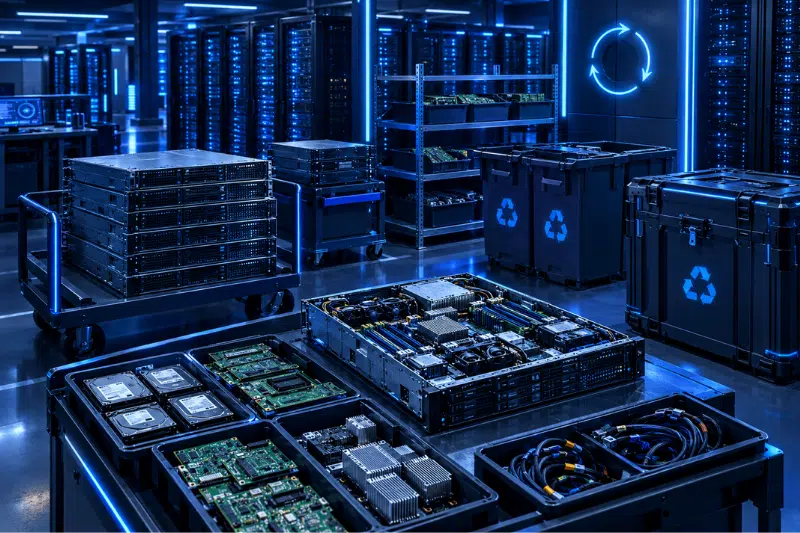
According to a 2026 study in Resources, Conservation and Recycling, AI servers could generate 131 to 225 kilotons of e-waste per year by 2030, the same as Norway and Denmark combined. E-waste generation and technological advances are making retired server disposition a growing environmental challenge.
But eco-friendly server disposal methods can reduce waste generation by 16% to 90%. This article covers responsible disposal of old servers, including the materials they contain, relevant rules, and what should happen once the equipment is taken out of service.
Key Takeaways
- Eco-friendly server disposal means checking every retired server for reuse or resale before sending it to recycling.
- Enterprises can hire certified recyclers that provide documented environmental results and secure data destruction in compliance with the jurisdiction’s rules.
Why eco-friendly server disposal matters
The environmental outcome of a retired server is decided downstream. Once it leaves the facility it can pass through several handlers before reaching a processing plant, and each handoff is a point where the equipment can be lost, mixed with other streams or exported without oversight.
Clear records are needed for the equipment before every transfer so the team can trace high-value components and sensitive data back to the original asset record.
The environmental cost of poor disposal
The world generated 62 million metric tons of electronic waste in 2022, and less than a quarter of it was collected and recycled formally, according to the UN’s Global E-waste Monitor.
Servers that end up in landfill waste streams leave hazardous materials in the environment. Lead, mercury and cadmium are among the hazardous substances found in electronic waste, and some equipment also contains brominated flame retardants. In some areas, unprocessed e-waste enters informal recycling facilities lacking environmental protections and worker safety measures. It is also hard to verify data security when equipment moves without documentation.
Materials found in a server
A large share of a server’s weight is steel, aluminum and copper. Circuit boards and connectors carry small amounts of higher-value metals such as gold, silver and palladium. Retired equipment is another source of raw material for processors, as they can recover these elements from it. So a server has material recovery value even after it stops working.
The urban mining opportunity
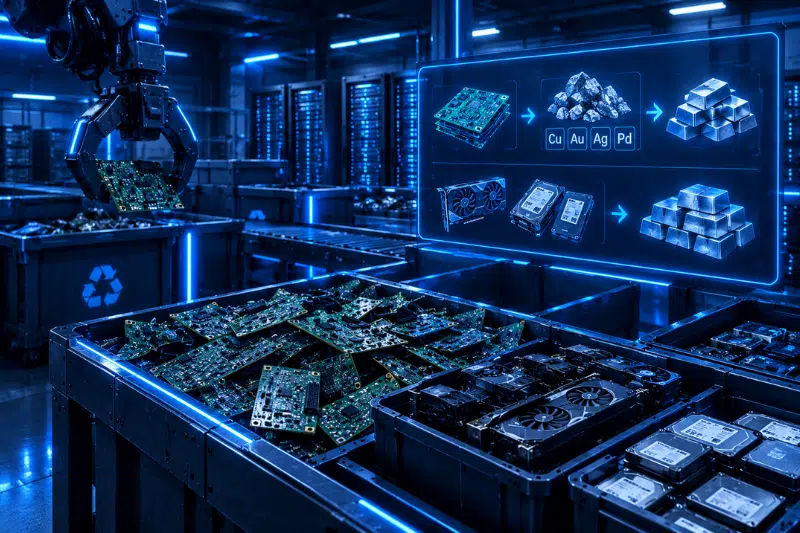
Urban mining uses discarded electronics as a source of recoverable raw materials. Its relevance has increased recently as data center equipment has more valuable processing hardware and dense electronic components.
Circuit board scrap is worth recovering as it has metals in high concentrations. AI infrastructure components like GPU servers also have expensive hardware, and their storage devices are very valuable after decommissioning.
What eco-friendly server disposal involves
Old servers don’t always need to be recycled, as some can be reused or sent for material recovery too. Before disposal, the equipment should be assessed for its condition and data to find out the best asset disposition route. The aim is to keep useful hardware in service and recover valuable parts from equipment that has reached the end of its useful life:
The disposal hierarchy
Working equipment is the first choice for continued use, as a server that passes functional testing can be redeployed in the same organization or resold.
Any server that needs repair before further use is sent for refurbishment. Repair costs depend on the hardware’s condition and the standard expected for the next use. The team tests the equipment and records its condition after repair. Anything that fails testing and grading, and is not worth repairing, goes to certified recyclers that recover metals and other usable material through controlled processing. Only the residual fraction that cannot be recovered goes to compliant waste disposal.
Assess the hardware before choosing the route
The first sign of an equipment’s value comes from assessing its condition. A server that passes functional testing has reuse value no matter how long it has been in production. A server that fails functional testing is assessed for repair or component recovery before it is sent to recycling, even if it is new.
A buyer could want an old server if it supports the required configuration, and reject a newer model with failing components. Sometimes hardware is destroyed even when it qualifies for resale because it contains highly sensitive data.
Project volume affects the assessment process: individual inspections can cover a small number of servers, but projects involving thousands of servers need consistent grading criteria and asset tracking.
Why the environmental math favors reuse
Manufacturing is responsible for most of equipment’s carbon footprint and causes roughly 70% to 80% of a laptop’s lifetime emissions. The estimate is for laptops, but the underlying issue is the same for servers also. When you replace a server, you are adding another manufacturing cycle that involves extracting and processing materials.
- Refurbishment: You can reduce the impact by refurbishing suitable equipment to extend its useful life and keep it in use.
- Recycling: UN-backed research estimates that recovering metals from e-waste causes 2-10 times less energy consumption than extracting from ores.
- Resale and reuse: Reusing electronic devices keeps them in use for longer and supports a sustainable future by delaying the need to manufacture new hardware.
How eco-friendly server disposal works in practice
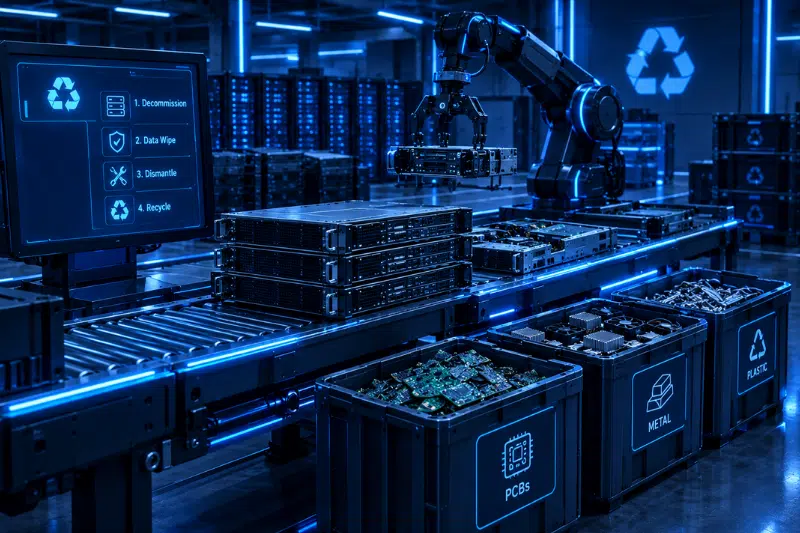
Old servers do not always need to go to a recycling facility. Some can be reused or could have valuable parts and materials. Before anything is dismantled, the data on the equipment also needs to be securely erased.
The aim is to get as much value as possible from the hardware and not treat every retired server as waste:
Recording inventory and testing equipment before sending it to recycle
Record each retired server’s serial numbers and component specifications first, and check its condition before recycling. Functional testing is done to identify equipment that has useful life left and could be reused. A server that fails as a complete unit could contain valuable components that can be recovered, so assessment of parts needs to be done before labeling the machine as scrap.
High-security data destruction and hardware refurbishing

The disposal team handles all data wiping before moving the equipment to its next destination in the new data center. They use approved software to wipe drives, then test and prepare working equipment for reuse. When the drives cannot be cleared, they physically destroy them for data security.
By keeping working hardware in use for longer, machine replacement demand reduces. Manufacturers then have to use fewer raw materials and less water and energy to produce new equipment. Continued use also keeps functional servers and components out of the waste stream.
Closed-loop dismantling and resource recovery
Recycling starts with dismantling equipment that has reached the end of its useful life and separating the materials for recovery. Servers have steel, copper, plastics, and small amounts of metals like gold and silver.
Recyclers recover as much useful material as possible while controlling hazardous substances during the process. They also handle heavy metals like lead and mercury to keep them out of ordinary waste and reduce the risk of contamination in soil and water.
Using certified recycling facilities
A recycler’s environmental claims should always be backed by evidence. R2v3 is the most widely used standard for electronics recyclers and requires independent third-party audits. Certification status can be checked in the public directory maintained by SERI, the body that administers the standard.
The recycler should be able to identify its current certification and explain how it controls downstream processing. The organization sending equipment for recycling needs documentation for what happened to the equipment after collection.
Track the environmental result
Security records tell you what happened to the data. Once the equipment leaves the site, the question changes to “Where the hardware went and what was done with it?”
The records show what was reused, resold, or refurbished and what was sent for recycling. After a few projects, the records make it very easy to see how much equipment was in use and what was sent for material recovery.
Regulations and the consequences of poor disposal

Companies should check regional disposal rules and be compliant with them. International shipments have to comply with both the rules in the country of origin and the destination country.
Rules could differ based on the asset disposition, as a server sent for reuse has different requirements than a server sent for recycling. So the company should identify the applicable rules and prepare the required records before shipment.
US regulations
The United States doesn’t have a common law that covers all electronic disposal. The Resource Conservation and Recovery Act has rules for some categories of hazardous waste, and individual states have their own requirements. Around 25 states have recycling laws, and many of them use an extended producer responsibility model.
EU regulations
The WEEE Directive has set a 65% collection target across the EU, but the European Commission’s 2025 evaluation found EU-wide collection close to 40%. A revision is expected later in 2026 under the EU’s Circular Economy Act.
The cost of poorly managing disposal
Businesses face cleanup liability for improper disposal of e-waste and also have to bear reputational costs that last much longer.
In 2024, Vishay Dale Electronics agreed to pay a $387,000 EPA civil penalty when inspections found hazardous waste violations in its Nebraska facilities. The violations were storage of waste beyond the 90-day limit with inadequate labeling and failing to separate incompatible wastes.
Data security applies at every stage
Responsible disposal includes proof that the data stored on the server has been destroyed or sanitized properly. It applies to equipment selected for reuse and hardware sent for recycling.
In 2019, ESET bought 18 used enterprise routers to test if the companies had properly erased them before resale. Only 5 of them had been wiped, and more than half had sensitive information, including corporate credentials and encryption keys. It shows how poorly erased network equipment can leak information that attackers can use to access corporate systems.
Mistakes to avoid while server disposal
- Treating labels as proof: A recycled label doesn’t tell what happened to the equipment, as it could have gone through many different routes or facilities. Check what certifications the provider has and their validity.
- Sending every server to recycling: Sending every server to a recycler is just throwing away equipment that could have been reused or resold. Test the hardware first and then decide what to do with it for proper disposal.
- Choosing on price alone: The cheapest option isn’t necessarily the cheapest in the end. You need to know what happens after the equipment is collected and who gets it next. A good provider should be able to answer those questions with relevant records.
- Losing the environmental record: Destroying the data is only one part of getting rid of old equipment. You also need to know what happened to the machines afterward. If they were reused, resold, or recycled, there should be some record of that journey.
Responsible server disposal comes down to sequence and proof
An eco-friendly server disposal starts with testing and grading to identify which equipment is suitable for reuse, refurbishment, resale, or recycling.
Reconext follows this process through testing, secure data erasure, refurbishment, resale, and certified recycling under its R2v3 program. Any equipment that cannot be reused or recovered is moved to material recycling.
The above process gives organizations proper records for retired equipment and identifies hardware that can continue to be used. See Reconext’s sustainable electronics lifecycle management approach to learn more about asset recovery.
Frequently Asked Questions
Does an eco-friendly way of server disposal cost more than standard disposal?
Not always. Resale value can offset processing costs, but recycling-only services could cost less upfront than certified secure destruction.
Can retired servers be donated?
Yes, if the equipment works and its data has been securely sanitized. The recipient must also have a practical use for it.
How can an organization verify a vendor’s recycling claims?
Check the vendor’s current certification and ask for records showing how equipment was handled and where it went.
What is the difference between recyclable equipment and responsibly recycled equipment?
Recyclable equipment has materials that can be recovered. Responsible recycling is when those materials are processed through an appropriate, documented recycling process.
What paperwork should you receive after server disposal?
A serialized certificate of data destruction, a chain-of-custody record, and a final report showing records of the servers that were reused, resold, and recycled. Keep these records for audits.