


When we introduced Aurora earlier this year, we focused on what she could do. Since then, the most valuable work has gone into depth, defining the service level targets for each program so Aurora measures every customer by the standards that program is actually held to.
Three things have changed since launch. Aurora knows each program in far more detail, she runs in far more places, and she delivers more each day.
Aurora by the numbers
- 18 customer programs supported, up from the original three pilot programs
- 13 sites across the Reconext network
- 150+ contractual SLAs reviewed, confirmed, and monitored daily
- Smart alerts on time-sensitive issues, replacing the once-daily digest
- Multiple updates per day, in place of a single next-morning report
More detail: our teams taught Aurora the business
Every program defines performance a little differently, and those definitions are what Aurora needed from our teams. Program Managers, General Managers, Account Managers, Business Analysts, Operations leaders, and IT worked on this together. They confirmed the service level targets that apply to each program, checked how each one is measured, cleaned up the operational data behind them, and corrected the calculations.
That work covered more than 150 contractual SLAs. Aurora now measures performance the same way our customers do, using each program’s own targets rather than a general standard. So when a customer asks how their program performed last week, the number they get is calculated the way that program’s targets say it should be.
The AI is the tool. The knowledge came from the people who run these programs every day, and that is what makes Aurora useful.
More places: 18 programs across 13 sites
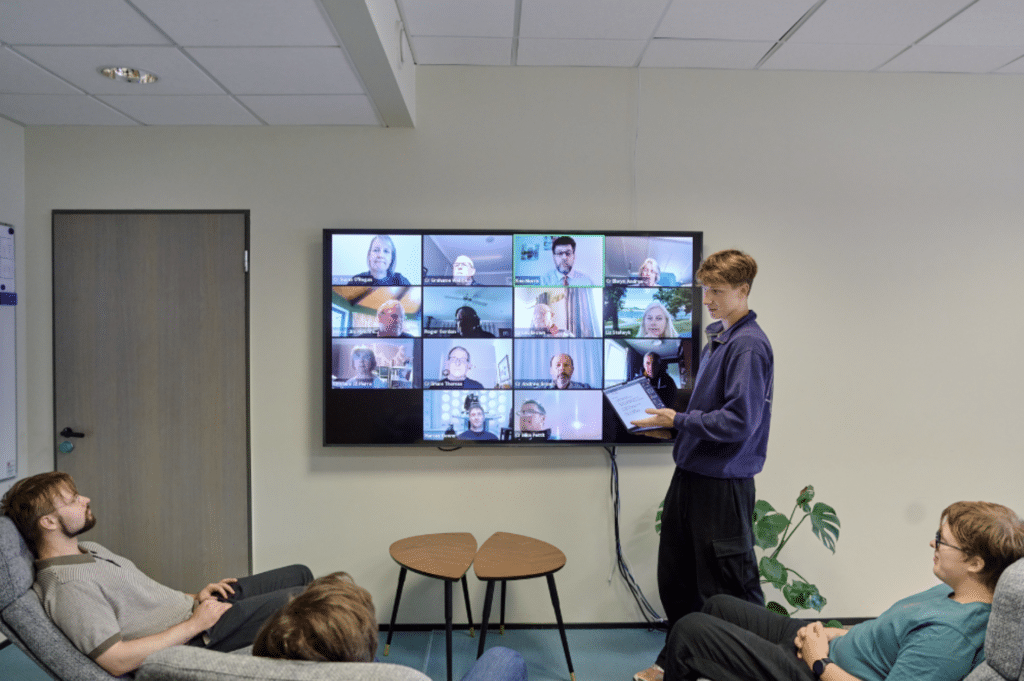
Aurora has moved well past the original three pilots and now supports 18 customer programs at 13 sites.
One recent program brought together data from our main ERP and from systems used at the site itself. That matters for customers whose work is spread across several facilities. Aurora pulls the picture together wherever the data happens to live, so a program does not have to be reshaped before it can be measured.

More each day: updates while there is still time to act
Updates throughout the day. Aurora reports several times a day instead of once. Teams can spot an SLA at risk while there is still time to fix it, rather than reading about it the next morning.
Weekly trend summaries. These help teams tell the difference between a bad day and a persisting pattern and show whether a fix worked.
The Program Manager Daily Recap. Every day, Aurora opens a ticket that lays out how the program is performing, what she recommends, and anything unusual worth a closer look. Program Managers use the same ticket to record what caused an issue, what they plan to do about it, what went well, and whether Aurora’s recommendation was any good.
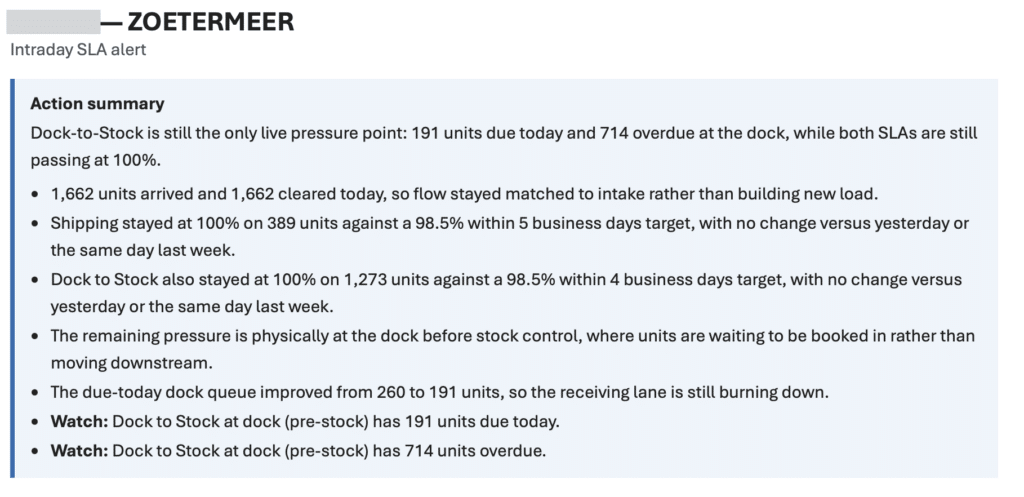
Below is an example of an intraday report Aurora generated at a live program:
What Aurora was able to do:
- Looked past the SLA number. SLA timing starts when a unit is booked in. 714 units were sitting at the dock unbooked, so they weren’t in the 100%. Aurora checked the dock queue directly instead of reading the SLA number.
- Pointed out that throughput matched intake, so the backlog didn’t move. 1,662 units came in and 1,662 went out. The units cleared were the day’s arrivals, so the 714 already waiting stayed where they were. Aurora reported the backlog alongside the throughput rather than the throughput on its own.
- Triaged the dock queue. Of the units at the dock, 191 were due today and could still be cleared on time, while 714 were already overdue and needed to be worked in order of how late they were. Aurora also compared against prior days and found the due-today count had come down from 260 to 191, so receiving was working the queue down.
- Ran the report mid-shift. These dock numbers are available if someone sits down and pulls them, but that takes about an hour and goes stale as soon as it’s finished. PMs don’t have time for it during a shift. Aurora put the report in front of the PM the same day without anyone going to look.
A scorecard is a fixed document and can only answer questions a manager has thought of asking in advance. Aurora finds problems that nobody has thought about.
This kind of recap is being piloted at our Grapevine and Memphis facilities.
What this means for your program
Aurora keeps improving because of the people behind her. Every SLA they confirm, every operational discussion, and every piece of Program Manager feedback makes her more accurate and more useful.
For customers, that means seeing risk earlier, getting performance measured against the terms of your own agreement, and running into fewer surprises at the end of the month.
Reach out to see what Aurora could look like in your program.


