



Meet Aurora, our new AI operations assistant!
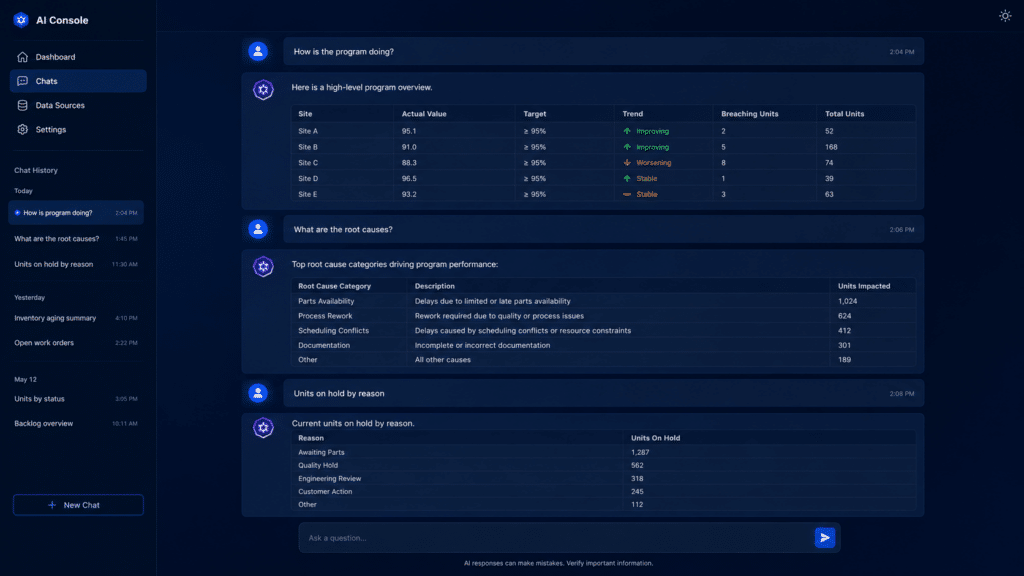
Aurora lets teams ask operational status questions in plain English and immediately see what’s holding up the line and what’s at risk. She handles the data interpretation and automates the workflow behind it, so you can move straight to corrective action.
Aurora is now live with select pilot repair programs, getting sharper as she’s tuned to each one’s SLA requirements, product mix, and site-level operating norms. Wherever she’s deployed, she brings the ability to act earlier and operate with greater clarity.
Aurora’s Place in the Reconext Agentic Family

Aurora is the latest addition to Reconext’s operational technology stack, serving as one of the agents in the intelligence layer that connects the systems capturing and managing warehouse activity.
Pegasus, Reconext’s warehouse management system, captures physical activity at the unit level: intake scans, dwell times, station events, and throughput data. Aurora interprets that data in real time, identifying what it means for SLA performance and flagging when something moves outside the expected range.
From there, Aurora triggers Quincy, Reconext’s ticketing system, to open a ticket and update Plus, Reconext’s operational record system. The right owner gets the issue without a manual handoff bridging the systems.
What This Means for Your Program
Earlier SLA Control
Aurora monitors contractual SLA signals across sites daily, comparing current warehouse activity against expected service levels. When aging units, throughput dips, backlogs, or process delays start moving in the wrong direction, Aurora flags them while there’s still time to act.
Faster Answers
When someone asks what happened, what’s stuck, or where the biggest risk is, Aurora returns a data-backed answer in plain English without waiting on manual report-building. A program manager can ask “What’s stuck at Memphis?” and get a direct view of the issue.
Root Cause Visibility
Aurora connects a performance risk or breach to the operational details behind it, breaking the issue down by site, station, commodity, SKU, hold reason, aged inventory, or pending customer decision. Teams come away with a clear investigation path: where the issue is, why it’s happening, and what needs to happen next.
Proactive Escalation
Aurora identifies whether a delay requires internal action or customer input, helping the team move it to the right owner faster rather than letting it sit.
Role-Based Visibility
Aurora pulls from the same warehouse data used for customer reporting and translates it into the view each role needs. Floor teams see what needs attention on the line, program managers see customer impact, and leadership sees where the biggest risks are.
Anomaly Detection
Aurora learns the normal operating patterns for each site and flags activity that falls outside the expected range, surfacing small problems before they affect the customer experience.
Daily Operating Rhythm
Aurora produces a daily ops report each morning covering the previous business day, giving teams a clear starting point for action. Live Q&A supports real-time investigation, with proactive alerts and weekly and monthly rollups planned for future release.
Aurora in Action
Reconext recently implemented Aurora for a global electronics manufacturer facing a recurring line performance challenge: cycle-time variance, station imbalance, and throughput drift were only surfacing in weekly reports, well after the corrective window had closed.
To catch issues while there was still time to act, Aurora was configured to run continuous station-level monitoring and anomaly detection against the live data stream rather than waiting on historical reports.
From there, Aurora tracks units from intake through the line and opens tickets automatically. When imbalance or drift is detected, she proposes a reallocation for line lead validation, keeping decisions on the floor and out of the manager review cycle.
As a result, issues are now caught in-shift. The daily manual spreadsheet reporting chain has been replaced with unified visibility across sites, and SLA performance is routed directly to the program managers and site leads who own it, eliminating morning report prep and custom reporting requests.
Turning Data into Lead Time
Aurora gives everyone from the floor to leadership a clear, consistent view of operations in plain English. By bringing performance signals into view earlier, she gives teams the lead time to respond effectively.
For Reconext customers, that means stronger program visibility, better-prepared conversations, and fewer surprises. Aurora helps our teams use data the way it should be used: not just to explain what happened, but to shape what happens next. Reach out to see what Aurora could look like in your program.


