A few years ago, IT asset disposition was mainly a concern for larger companies. Today, small and big companies alike have ITAD strategies that ensure retired IT assets are handled securely and responsibly.
If your business retires IT equipment regularly, you are under more pressure regarding data security, compliance, asset recovery, and e-waste than you would have been a few years ago.
As those pressures grow, the ITAD market is growing with them. In this article, we outline some of these IT asset disposition market trends and what they mean for you.
Key Takeaways
- The ITAD market is growing because companies are replacing devices more often and need safer ways to handle retired equipment without creating data, compliance, or e-waste risks.
- Growth is also being shaped by regional regulations, stronger recovery infrastructure, and rising demand for secure disposal, refurbishment, and value recovery across the full IT lifecycle.
The Current State of the ITAD Market
The global IT asset disposition market size is constantly growing. According to Grand View Research, it was valued at $25.31 billion in 2024 and projected to reach $54.54 billion by 2030. This growth reflects broader shifts in how organizations manage technology assets.
Device refresh cycles are accelerating across industries. Think about it: when a more capable and powerful laptop is launched, you are more like to upgrade frequently to stay competitive. The same goes for data center equipment or mobile devices.
Asset management is costly but delivers strong benefits, as internal chain-of-custody managers help maximize value from retired assets while minimizing financial liabilities from poor ITAD strategies.
Growth is especially pronounced in Asia Pacific, North America, and Europe, where regulatory frameworks have matured to support both compliance and value recovery. At the same time, developing regions are no longer treated as informal e-waste dumping sites. Countries such as India are implementing e-waste management regulations, reinforcing global sustainability efforts.
Together, these trends indicate that ITAD is becoming more integrated into device lifecycle manager, rather than remaining a standalone end-of-life process.
What Is Driving Growth in The ITAD Market?

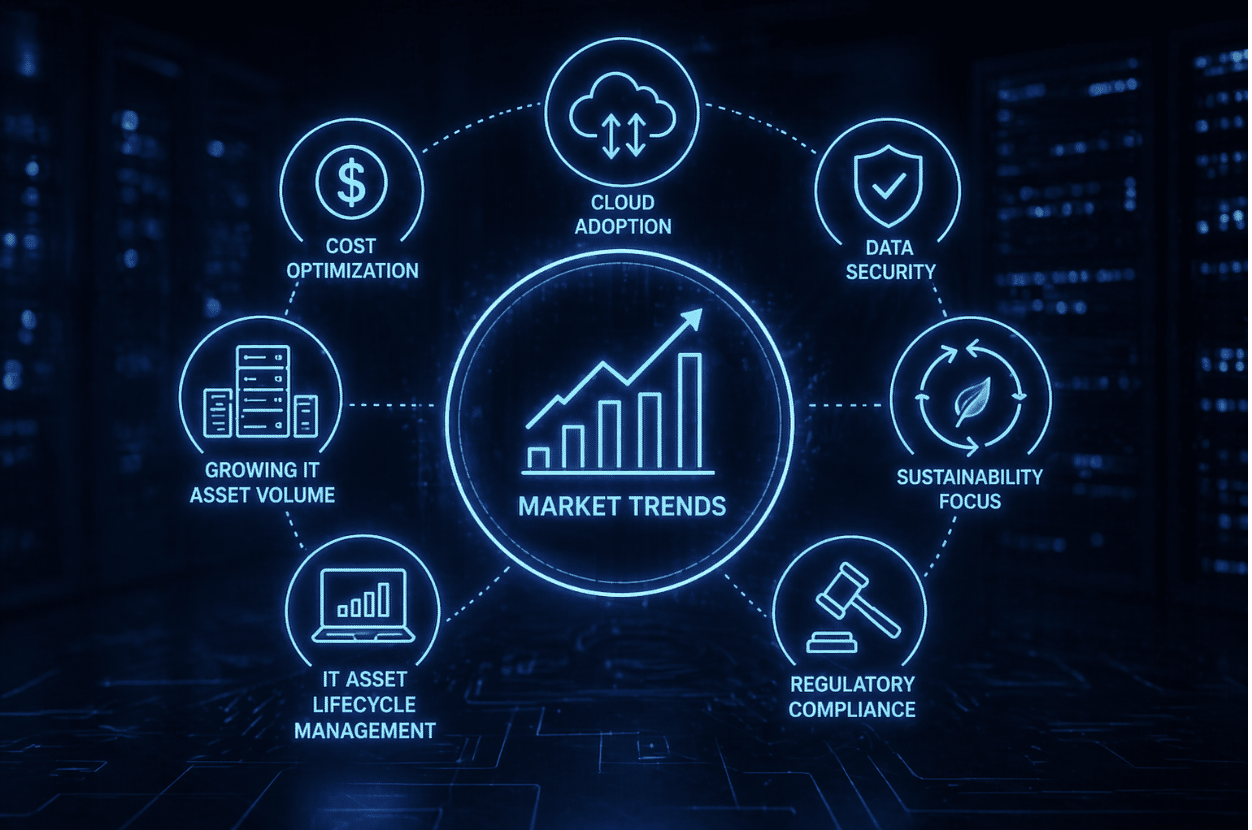
The ITAD market is being driven by factors like fast hardware refresh cycles, data compliance pressure, the circular economy, and technological advancements.
Faster Hardware Refresh Cycles
Device lifecycles keep getting shorter. It’s not that manufacturers are making faulty devices. If anything, technology is far more advanced than it was a decade ago.
The needs of your organization are what trigger these refresh cycles. For instance, the quad-core processor laptop can handle basic computing, but now that you have integrated AI into your workflows, you need a more powerful laptop.
During these hardware refreshes, you end up retiring a massive pile of devices that contribute to the growth of the ITAD market.
Data Security And Compliance Pressure
Data security has long been a concern, but data protection regulations have raised the standard. Organizations must now follow prescribed data sanitization practices, which informal asset disposition methods cannot reliably meet, making professional ITAD services a necessity.
This market growth also works in your favor. With the growth of the ITAD market size comes better infrastructure, more access, and favorable practices.
Circular Economy Goals
Minimizing electronic waste is central to the circular economy. The goal is to keep IT assets in use for as long as possible rather than discarding them. However, this does not apply to all devices, as regular refresh cycles are still necessary in many cases.
Professional ITAD providers will always recommend refurbishing used devices over destroying them when it is appropriate. This responsible ITAD practice aims to extend the lifespan of your devices, which is the goal of the circular economy. Other strategies, such as parts harvesting and responsible recycling, also contribute to circular economy objectives.
AI, Cloud, And Data Center Upgrades
Companies are switching to cloud computing and AI after experiencing their benefits. This move is triggering the retirement of old assets that do not support these technologies.
Data centers are also getting upgraded to handle the complex computing power needed by emerging tech. With these upgrades, secure ITAD processes are needed to ensure sensitive data is erased completely before devices are resold or recycled.
After switching to newer devices, the IT asset disposition industry responds by taking your retired device and resells, recycles, or harvests it for parts. When this process is done frequently, it triggers market growth.
Which IT Assets Do Companies Retire Most Often?

The IT assets that most companies retire most often are computers and laptops, storage equipment, mobile devices, and peripherals.
Computers And Laptops
In 2024, computers and laptops accounted for over 43.0% of revenue share in the IT asset disposition market. Since then, these devices have remained the most commonly disposed of assets. This influx of retired laptops and computers creates the need for secure disposal.
Critics view frequent refresh cycles as unnecessary, but they often serve a practical purpose. For example, if your company shifts to remote-first operations, laptops must be deployed while desktop systems are retired to maintain continuity. In such cases, credible IT asset disposition services are essential to ensure secure and efficient data destruction.
Servers And Storage Equipment
Servers and storage equipment usually have higher resale value than most IT assets. This is because they are built with powerful components designed to last a long time. As a result, they play a big role in market growth.
However, they are being retired more often today mainly because many companies are moving to cloud computing. When systems move to the cloud, there is less need for on-site hardware.
Mobile Devices
According to Grand View Research, the mobile devices market segment is estimated to grow at a CAGR of 15.3%, the fastest among all device categories.
Manufacturers release new models frequently, which quickly makes existing devices feel outdated. The rise of 5G connectivity has further contributed to this trend, leading many companies to replace devices more often.
Peripheral Equipment
Printers, monitors, and routers might not have a high resale value, but they still get decommissioned when they reach the end of their life because they contribute to e-waste if not processed properly.
The Fastest Growing Regions in the ITAD Market

IT asset market trends are shaped by global efforts, but some regions are growing faster than others due to stricter regulations and infrastructure. Asia Pacific, North America, and Europe make up the largest share of the market.
Asia Pacific
The Asia Pacific (APAC) region dominates the global electronic equipment market. As countries across the region implement stricter compliance regulations, it is also becoming one of the fastest-growing adopters of ITAD.
Some countries in the APAC region practice informal recycling. To take advantage of this, strategic ITAD providers are breaking into these markets, contributing to the growth of ITAD.
North America
North America’s ITAD market is more mature compared to the rapidly expanding APAC region, but it continues to grow steadily. The region holds the largest market share, driven in part by strict regulations such as HIPAA and CCPA that require secure data destruction.
Corporate ESG initiatives also support this demand. Many organizations prioritize ITAD solutions that reduce environmental impact while maximizing asset recovery, further reinforcing the market’s stability and continued growth.
Europe
Through the Green Deal initiative, the European Commission aims to make Europe the first climate-neutral continent by 2050. In response, many companies are adopting ITAD solutions to meet evolving regulatory requirements.
In countries such as the UK, government incentives further encourage organizations to align with net-zero targets, making ITAD adoption more accessible.
Across the region, market growth is largely driven by industries such as healthcare, finance, and automotive.
Challenges Facing the ITAD Market

The IT asset disposition sector is steadily growing, but that does not mean it is flawless. It has its highs and lows.
In developing regions like Africa, ITAD is practically a foreign concept. It is not that companies do not care about it. The issue is that the infrastructure for it is nonexistent.
For ITAD to work properly, collection networks, disposition strategies, and reliable reverse logistics have to be in place. Most developing regions lack these systems, making ITAD almost impossible.
The other challenge of ITAD in some regions is the lack of allocated budgets. IT asset disposition is a resource-intensive practice. While it consistently generates revenue, it can be costly for companies that cannot afford to allocate funds for it.
Some of these challenges also exist in more mature ITAD markets. However, established standards and consistent practices allow them to manage these issues effectively. Developing regions will need to strengthen their infrastructure to keep pace with the broader market.
Conclusion
As long as old devices are refreshed, the ITAD market will continue to grow. Each upgrade leaves you with more equipment that needs to be handled securely and responsibly. At the same time, your organization falls under more pressure to meet data protection rules and sustainability goals.
Demand is likely to keep rising as IT environments expand and replacement cycles stay short. That is why ITAD is becoming a more established part of how businesses manage technology throughout its lifecycle.
Reconext believes that IT assets deserve an extended life. Our ITAD principles focus on value recovery to keep valuable assets in circulation for longer. Partner with Reconext for end-to-end ITAD and reverse logistics solutions built to help you recover more from retired assets.
FAQs
What is IT asset disposition?
IT asset disposition is the process of getting rid of old IT equipment safely and responsibly. It usually covers data wiping, recycling, refurbishment, and resale, depending on the condition of the asset and what can still be recovered from it.
Why is the ITAD market growing?
The ITAD market is growing because companies are replacing old devices more often and need safer ways to dispose of them. Data security concerns, compliance pressure, and sustainability targets are also pushing more businesses toward formal ITAD services.
What IT assets generate the most ITAD demand?
Computers, laptops, servers, and storage devices generate the most ITAD demand. They make up a large share of retired IT equipment, and many of them hold sensitive data, which makes secure handling and disposal more important.
Which region is the ITAD market growing the fastest in?
Asia Pacific is the fastest-growing IT asset disposition market. The region has a high volume of electronic waste, fast digital growth, and rising demand for more structured ways to handle retired IT equipment.