When Reconext CEO Shahriyar Rahmati took the stage at ITAD Europe 2026 earlier this April, he came with a pointed observation: the hardware your organization is paying someone to take away may be one of the more undervalued assets on your balance sheet.
Data center vacancy in North America has hit historic lows. Power and permitting constraints are slowing new capacity. AI-driven demand is placing real pressure on component availability across the market.
Taken together, these forces have quietly shifted the economics of retired hardware in ways that most organizations have not yet caught up to, and the implications reach further than the ITAD industry alone.
Here is what that shift means, who it affects, and what it takes to act on it:
- Why circularity has moved from a sustainability topic to a core business strategy
- The supply conditions making retired hardware more valuable than it used to be
- Why most disposition processes are not built to capture that value
- What secondary markets reward, and how to meet that bar
This Affects More of Your Organization Than You Might Think
IT asset disposition has historically been an IT problem. A decommission cycle concludes, someone arranges the pickup, a certificate gets filed, and the matter is closed.
That is no longer the full picture.
Finance teams have skin in the game because recovered asset value flows to the bottom line, and mishandled disposition can create write-down liability and audit exposure.
Procurement and infrastructure leads care because retiring hardware affects component availability, which matters more when supply is tight.
Operations teams carry the logistical burden of doing this responsibly across multiple sites.
And sustainability teams are under growing pressure from investors and regulators to account for how end-of-life hardware is handled.
Finding a partner who can satisfy all of those stakeholders at once is harder than it sounds, and more important than it used to be.
Circularity Has Become a Business Strategy
For years, IT circularity was mostly an ESG story. Recover hardware, divert waste from landfill, report the tonnage. That work still matters, but the reason most large organizations are now investing in circularity has shifted.
Microsoft’s circular datacenter program was designed to reduce dependence on new manufacturing and strengthen supply chain resilience, not just to hit a sustainability target (1). Seagate has framed drive reuse and recertification in similar terms, as a supply stability play rather than a green preference (2).
These companies rank among the largest hardware consumers on the planet, and both have reorganized significant parts of their operations around keeping assets in circulation.
Why the Market Has Changed

New data center capacity is being delayed by power access and permitting backlogs (3, 4). Operators who cannot build fast enough are extending the life of existing infrastructure instead, which keeps demand for older components alive long after manufacturers have shifted production toward newer technologies. AI adoption has accelerated this, contributing to a supply crunch in memory markets that is rippling across the broader hardware ecosystem (5, 6).
The result is a secondary market where quality used hardware is in genuine demand from buyers who cannot easily find new alternatives.
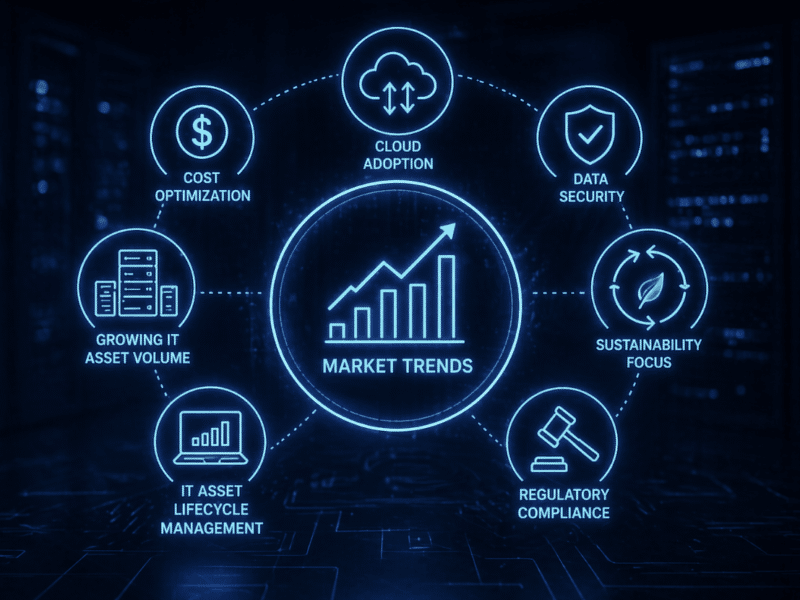
What makes this moment significant is the convergence: customer demand, supply chain pressure, component scarcity, economic incentives, and regulatory tailwinds are all pointing in the same direction, and the alignment across all of them at once is historically unusual.
Retired Hardware Still Has a Life to Live
Most decommissioned hardware has not actually reached the end of its useful life. A year-long study of more than 117,000 storage devices by the Circular Drive Initiative found that 87% were suitable for reuse after data sanitization (7). Microsoft achieved a 90.9% reuse and recycling rate for servers and components in 2024, exceeding its own target ahead of schedule (1).
Despite this, a significant share of viable hardware is routinely destroyed rather than recirculated. In a market where components are increasingly hard to source, that is both an environmental and an economic problem.
A more useful way to think about retired devices is that they are somewhere in the middle of their lifecycle, moving between owners and use cases rather than exiting the system. A server may have several owners. Components may be harvested and sold independently. Recycling isn’t where disposition should begin, but rather where a device’s lifecycle ends.
Why Most Companies Leave Value Behind

Most organizations would recover more from their retired hardware if they had the right process. The gap between what assets are worth and what gets recaptured usually comes down to capability.
There is also a benchmarking problem. Many OEMs and large enterprises compare secondary market returns against new-build margins, decide the economics do not work, and walk away.
The hardware has already been written off. The customer relationship already exists. Walking away means forfeiting recovery on assets that cost nothing additional to acquire, and losing contact with customers who are often still in the market for a second, third, or fourth device. The right comparison is against recovering nothing at all.
Even organizations that understand this often lack the tools to act on it. Capturing value from decommissioned assets requires precise diagnostics, component-level testing, and accurate grading. It requires knowing where demand is strongest in the secondary market at any given moment. Without that, the path of least resistance is destruction.
Reconext approaches this differently. The process starts by tracking demand signals from customers and partners to spot emerging opportunities before they become obvious to the market. Each asset is then tested and graded with enough precision to avoid doing more work than necessary, or less than the asset deserves. From there, it is matched to the right buyer in the right global market, with the goal of extracting the most value from the least processing. That discipline, supported by AI-assisted tools and proprietary testing technology, is what turns disposition from a cost into a recovery.
What Secondary Markets Actually Reward
Used hardware sells at a discount when buyers are uncertain about what they are getting. The less they can verify, the more they discount. The most successful refurbished hardware programs have built their models around removing that uncertainty.
Amazon’s renewed products marketplace requires professional inspection, testing, and documented condition standards (8). Lenovo’s certified refurbished server program includes inspection and warranty coverage to give buyers the confidence to pay full value (9). Both succeed because they give buyers a clear picture of what they are purchasing.
The same logic applies to any organization recovering value from retired assets. Better grading, clearer documentation, and credible testing results mean more confident buyers, faster sales, and better prices. How hardware is presented in the secondary market has a direct bearing on how much of its value is actually recovered.
The Bottom Line
The forces shaping this shift are not going away. Data center capacity is constrained. Component supply is tight. Demand for quality used hardware is growing. Regulatory and financial pressure to manage end-of-life assets responsibly is increasing.
Organizations that build the capability to recover value from retired hardware now will be better positioned than those that treat it as an afterthought. The value is already there. The question is whether your process, and your partners, are equipped to capture it.
Sources
- https://www.microsoft.com/en-us/microsoft-cloud/blog/2025/04/17/sustainable-by-design-innovating-for-zero-waste/
- https://www.seagate.com/resources/incentivizing-circular-economy-reuse-of-data-storage-drives/
- https://www.iea.org/news/data-centre-electricity-use-surged-in-2025-even-with-tightening-bottlenecks-driving-a-scramble-for-solutions
- https://www.cbre.com/insights/books/north-america-data-center-trends-h2-2025
- https://www.jll.com/en-us/insights/market-outlook/data-center-outlook
- https://www.reuters.com/world/china/ai-frenzy-is-driving-new-global-supply-chain-crisis-2025-12-03/
- https://circulardrives.org/bridging-the-circularity-gap-in-it-hardware/
- https://www.amazon.com/gp/help/customer/display.html?nodeId=GRAS7M4E8YJCLWH7
- https://www.lenovo.com/us/msd/en/certified-refurbished/servers-storage/