Every hardware refresh cycle creates a window of opportunity to recover measurable financial value from retiring IT hardware, but the outcome depends on decisions made before and during the IT asset disposition process.
Organizations that approach ITAD strategically can recover more value, reduce unnecessary costs, and strengthen compliance. Factors like processing speed, data sanitization, asset grading, and remarketing all influence the overall return.
In this article, we share ten practical strategies to help your organization maximize ROI from retired IT hardware.
Key Takeaway
- Maximizing IT asset recovery ROI depends on decisions across the entire asset disposition lifecycle.
- Accurate inventory tracking, rapid processing, software-based data sanitization, and strategic resale timing help preserve asset value and increase recovery returns.
What is IT Asset Recovery ROI?
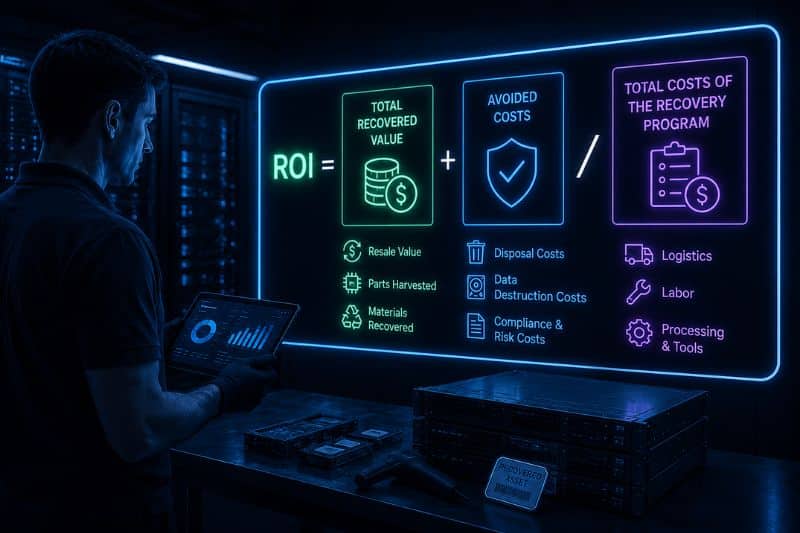
IT asset recovery ROI is the financial impact of reclaiming value from retired IT hardware compared to the costs of disposal and processing. If managed effectively, an IT asset-disposal program can offset some hardware-refresh costs.
It can be calculated using the formula:
ROI = Total Recovered Value + Avoided Costs / Total Costs of the Recovery Program
Where:
- Total Recovered Value: Cash generated from secondary market sales + internal redeployment savings.
- Avoided Costs: Saved recycling fees, avoided new hardware purchases, and mitigated compliance risks.
- Cost of Recovery: Fees paid to ITAD vendors, shipping/logistics, and internal labor for wiping and auditing.
To measure the efficacy of your recovery efforts, optimized ITAD programs can use the asset recovery rate as a key benchmark, calculated as:
(Number of Assets Recovered / Number of Eligible Assets) × 100
Optimized programs achieve recovery rates of up to 80%.
Beyond resale value, asset recovery ROI should also account for avoided costs, including reduced exposure to data breaches caused by improper disposal.
10 IT Asset Recovery ROI Tips
Poor asset lifecycle decisions can erode the value of retired IT hardware. These ten practices can help organizations avoid common mistakes and maximize asset recovery ROI.
1. Maintain a Complete and Accurate Inventory
A complete, accurate inventory gives organizations the visibility needed to recover more value from retired IT assets. It should track information like device age, lifecycle stage, warranty status, and physical condition.
Maintaining an up-to-date inventory helps organizations identify assets that are no longer needed and move them through the disposition process before significant depreciation occurs.
In many organizations, retired devices remain unused in storage for extended periods. As these assets sit idle, their resale value steadily declines, reducing overall recovery ROI. Experts recommend disposing of unused devices within 36-48 months: after the fourth year, devices start to lose a significant percentage of their value.
Inventories also support better decision-making during IT asset disposition. Asset data can be used to determine whether equipment should be redeployed, refurbished, resold, or recycled.
2. Prioritize Speed and Rapid Processing
The longer retired IT assets sit unused, the more value they lose. Prompt processing helps preserve their resale potential and maximize recovery ROI. Most ITAD experts recommend a 3-7 day turnaround from decommission to processing. Devices handled within this window retain more residual value because physical deterioration has not yet set in.
By contrast, inefficient pipelines can stretch to 60 days, absorbing value with each passing week.
Prompt processing reduces storage and handling costs, improving recovery ROI. Clear disposition triggers, such as employee offboarding or lease expiration, help assets enter the ITAD pipeline while they still retain value.
That said, speed should complement formal ITAD policies, not replace them. Rushing assets through without proper data sanitization or audit trails creates compliance exposure. The goal is a fast, structured process.
3. Use Software-Based Data Sanitization
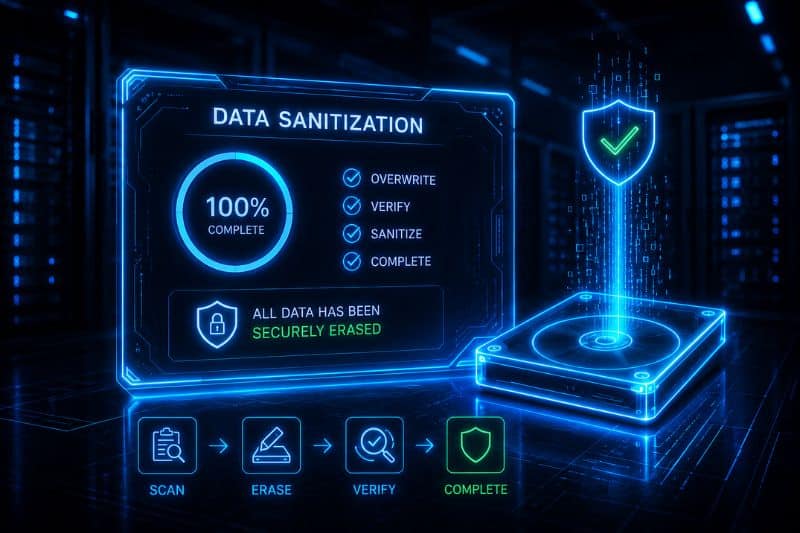
Software-based data sanitization techniques preserve a device’s physical integrity, helping organizations maximize resale value during the IT asset recovery process. In contrast, devices subjected to physical destruction can typically only be harvested for parts or recycled for raw materials, resulting in significantly lower recovery returns.
To maintain value, organizations should consider certified software-based sanitization techniques such as crypto erase that permanently remove data while leaving the hardware intact.
This approach allows equipment to be refurbished, redeployed, or resold on the secondary market.
4. Partner with Certified ITAD Providers
Certified ITAD providers improve asset recovery ROI through two primary mechanisms: remarketing expertise and buyer network depth. By refurbishing devices and positioning them in established secondary markets, they consistently negotiate better prices than internal disposal efforts.
They also reduce avoided costs, including recycling fees and compliance liabilities. Providers holding R2v3, e-Stewards, and NAID AAA certifications deliver the strongest performance across both financial recovery and regulatory compliance.
5. Time Sales Based on Market Demand
High-resale-value IT assets should be sold while demand is strong, ideally before newer models reduce secondary market value.
Market timing also matters. Demand for late-model business hardware may rise during school technology refreshes or cloud infrastructure expansion, creating opportunities for higher returns.
To avoid depressing resale prices, organizations should stagger large volumes of similar assets and work with ITAD providers to batch sales around market demand and major product launches.
6. Implement a Formal ITAD Policy
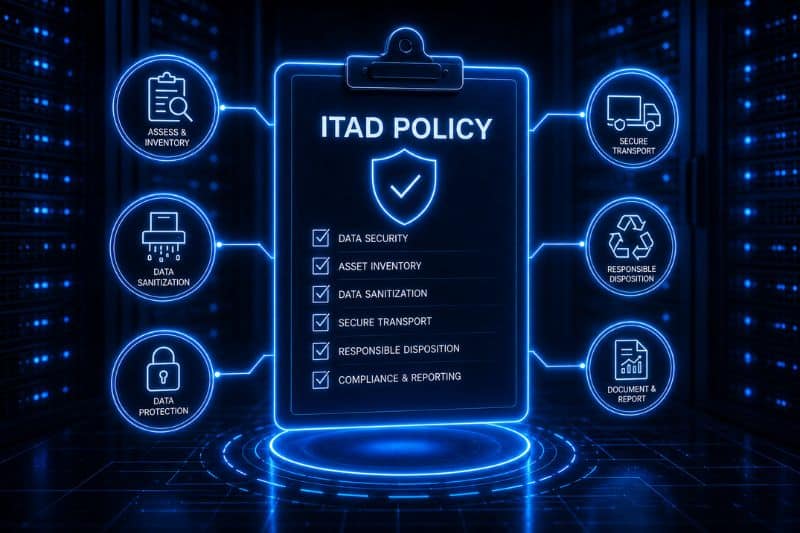
A formal ITAD policy creates a consistent framework for managing retired IT assets and maximizing recovery value.
The policy should establish clear criteria for deciding whether assets should be repaired, redeployed, resold, donated, or recycled. Security requirements should also be defined. These include removing VPN tokens, SaaS account credentials, asset tags, and other sensitive identifiers before assets leave the organization.
Assigning specific responsibilities to IT leaders, asset managers, and compliance teams is part of the policy. Clearly assigning responsibilities helps ensure that decisions are made consistently, that assets move through the process efficiently, and that recovery opportunities are not overlooked.
7. Explore Refurbishment and Reuse Opportunities
Refurbishment and reuse strategies improve IT asset recovery ROI by extending the life of retired equipment. Internal redeployment can reduce procurement costs by delaying new purchases and maximizing existing resources.
ITAD partners can support refurbishment programs by re-imagining devices for use in other departments, such as by adding RAM or replacing storage to meet new workload needs.
These practices also support circular economy goals by keeping equipment in use longer and reducing e-waste, strengthening corporate social responsibility (CSR) performance.
When devices are no longer needed internally but remain functional, donation to non-profit organizations is another option. In some cases, this may also provide charitable tax benefits while supporting community initiatives.
8. Recover and Salvage High-Value Components
Parts harvesting is a common IT asset value recovery strategy. Even when devices are non-functional, key components such as RAM, SSDs, GPUs, and power supplies often retain significant value in secondary markets. This strategy recoups value that would otherwise be lost in full-system disposal.
Cost reduction is another benefit, as harvested components can be used as replacement parts, reducing the need to purchase new hardware.
High-demand components such as enterprise SSDs and DDR4 or DDR5 memory modules often deliver the strongest returns due to continued demand in secondary markets.
9. Keep Equipment Intact and in Good Repair
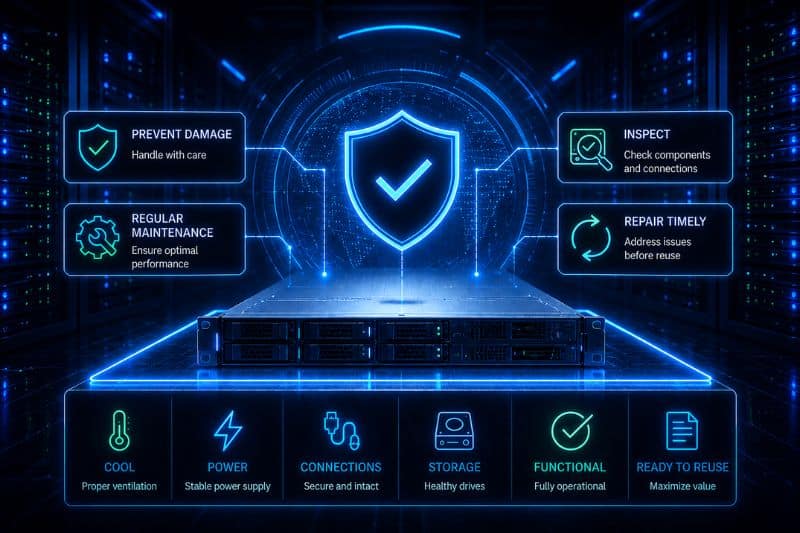
Device condition is one of the primary factors ITAD vendors use when assigning resale value. Equipment is typically graded from A to D based on cosmetic and functional state. Grade A units command the highest resale premiums because they require less refurbishment and attract stronger buyer demand.
A device’s grade at disposition is largely determined before it leaves active service. Storage, handling, and end-of-life maintenance can either protect or erode market pricing.
Strong lifecycle management during decommissioning helps preserve recovery value. One practical rule is the “100% intact” standard: keep all peripherals, chargers, and original components bundled with each unit.
Incomplete kits receive lower grades, attract fewer buyers, and reduce per-unit recovery returns.
10. Use Automation and Asset Management Software
Adopting automation and asset management software helps eliminate the tracking errors and processing delays that erode recovery ROI. AI-powered scanning achieves near 100% inventory accuracy, well above the error rates typical of manual tracking, ensuring no eligible assets are missed during disposition.
Real-time monitoring tracks each asset from purchase through final disposition, giving organizations the visibility needed to time resale and redeployment decisions more effectively. Automated offboarding tools simplify returns for remote employees by triggering return requests and generating shipping labels without manual intervention.
Visibility portals give teams 24/7 access to asset-level data, including current resale value, depreciation status, and sustainability metrics such as CO2 savings.
How Certified ITAD Providers Improve Asset Recovery ROI
The strategies above are more effective when managed by a certified ITAD partner. Most internal IT teams lack the secondary market access, refurbishment infrastructure, and compliance expertise certified providers offer.
On the remarketing side, certified providers use established buyer networks to secure better pricing and refurbish devices to higher condition grades, improving per-unit returns.
From a risk and compliance perspective, they reduce exposure through auditable data sanitization and documented chain-of-custody records. These avoided costs should factor into total asset recovery ROI.
Volume also matters. Organizations with large or recurring refresh programs benefit from the consistent processes and volume pricing of long-term ITAD partnerships, creating recovery gains that ad hoc disposal cannot match.
Conclusion
When managed effectively, IT asset recovery becomes a measurable contributor to an organization’s revenue.
Strong ITAD practices directly influence recovery ROI by preserving asset value throughout the lifecycle. Decisions made before disposal, such as handling, storage, and tracking, have a direct impact on final resale outcomes. This reinforces the need for structured processes rather than fixed retirement approaches.
Reconext has more than 14 years of professional experience helping organizations recover maximum value from retired IT equipment. Whether you are managing a one-time hardware refresh or building an ongoing disposition program, contact us to develop an ITAD strategy that maximizes returns and minimizes waste.
FAQs
How do I increase ROI from IT asset recovery?
You increase ROI from IT asset recovery by focusing on faster processing, data sanitization that preserves device value, and component-level reuse. A 3–7 day turnaround reduces depreciation losses. Software wiping maintains full resale capability, while harvesting parts improves total recovery value.
What mistakes reduce IT asset recovery ROI?
IT asset recovery ROI is reduced by storage delays, improper disposal methods, and inaccurate inventory tracking. Long storage increases depreciation, physical destruction eliminates resale potential, and manual errors result in lost or untracked assets that could otherwise generate value.
Which piece of equipment has the highest resale value?
The highest IT asset recovery ROI comes from late-model laptops, enterprise servers, storage arrays, and networking equipment. These categories maintain strong secondary market demand and consistent enterprise upgrade cycles.