


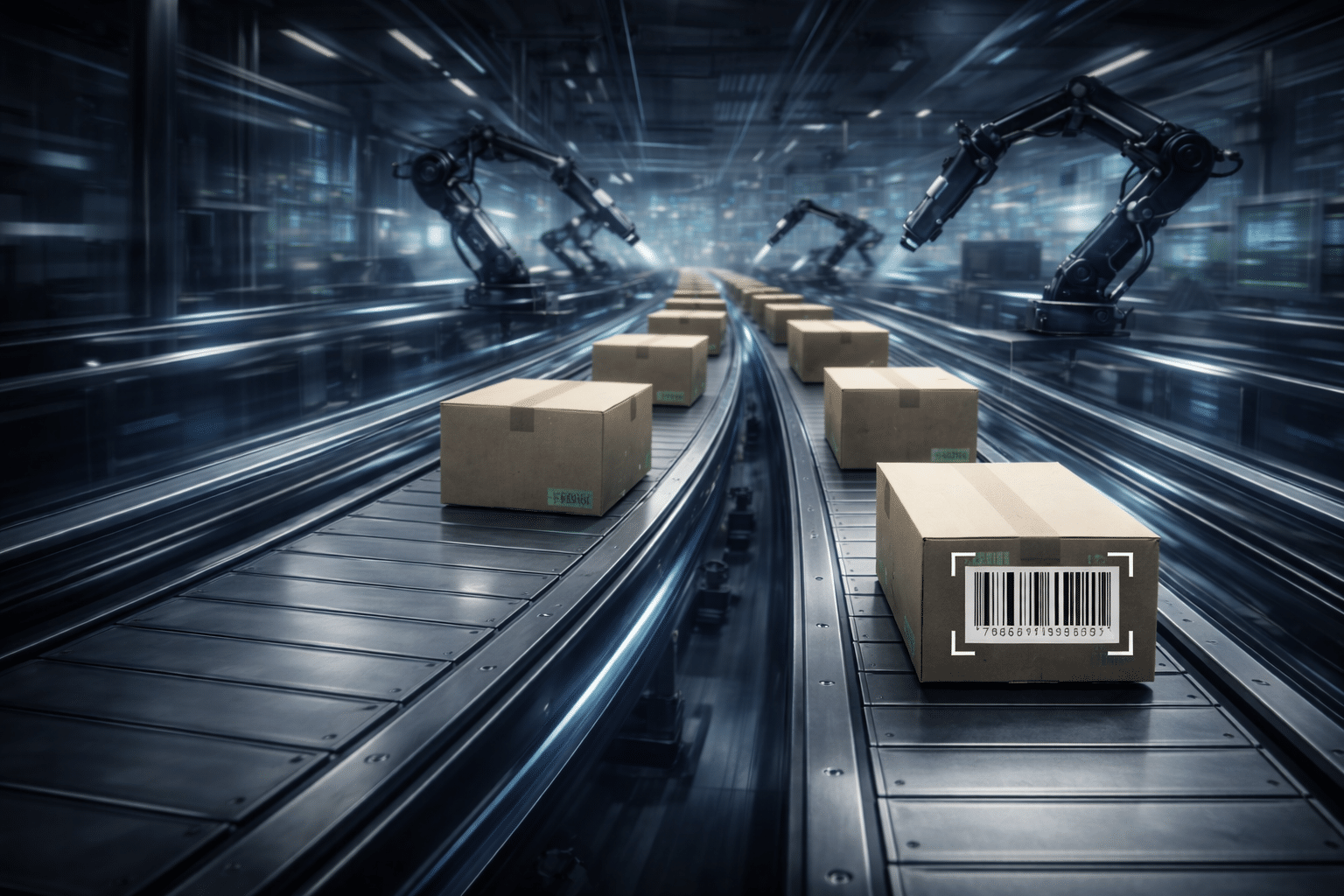
Every year, millions of IT assets move through device lifecycle programs worldwide, and almost every single one is received in the same slow, manual way. Operators juggle multiple screens and scan the same barcode three times, all while entering data by hand. It’s a process that has barely changed in decades, and the inefficiency has become a quiet, accepted cost.
Pegasus is Reconext’s response to that problem. It’s an AI-powered receiving solution that uses computer vision and automation to receive and log assets faster, more accurately. Pegasus converts manual receiving into a two-second process, cutting time spent by at least 40%, all while extracting rich data such as item condition and service tags.
What Is Pegasus?
Pegasus is a workstation built around three components: a camera mounted on a stand, a touchscreen display, and a computer. Reconext deliberately designed it to be simple: the goal is for Pegasus to become the default receiving setup across every program and every facility, and that requires a solution that is both affordable and straightforward to onboard.
The touchscreen display sits in front of the operator during the receiving process and livestreams what the camera sees as the operator presents items for intake.
Behind the camera feed, Pegasus runs our proprietary AI-assisted Optical Character Recognition (OCR) capability, object recognition, and dimensioning tools, allowing it to capture and interpret what it sees. It reads everything in its field of view and communicates the results directly to Reconext’s processing system, replacing the manual transactions an operator would otherwise have to complete themselves. For instance, scanning a serial number multiple times across different screens, or selecting a product model from a dropdown list.
Pegasus is also integrated into additional data sources to enrich its decision logic. When the receiving process requires a human decision, the software surfaces a simple prompt as opposed to the complex multi-screen interfaces that traditional receiving requires. In many cases, no input is needed at all.
What we end up with is a setup that looks simple but is doing considerable work underneath.

How Pegasus Works
- A shipment arrives at the dock. The operator brings it to the Pegasus workstation.
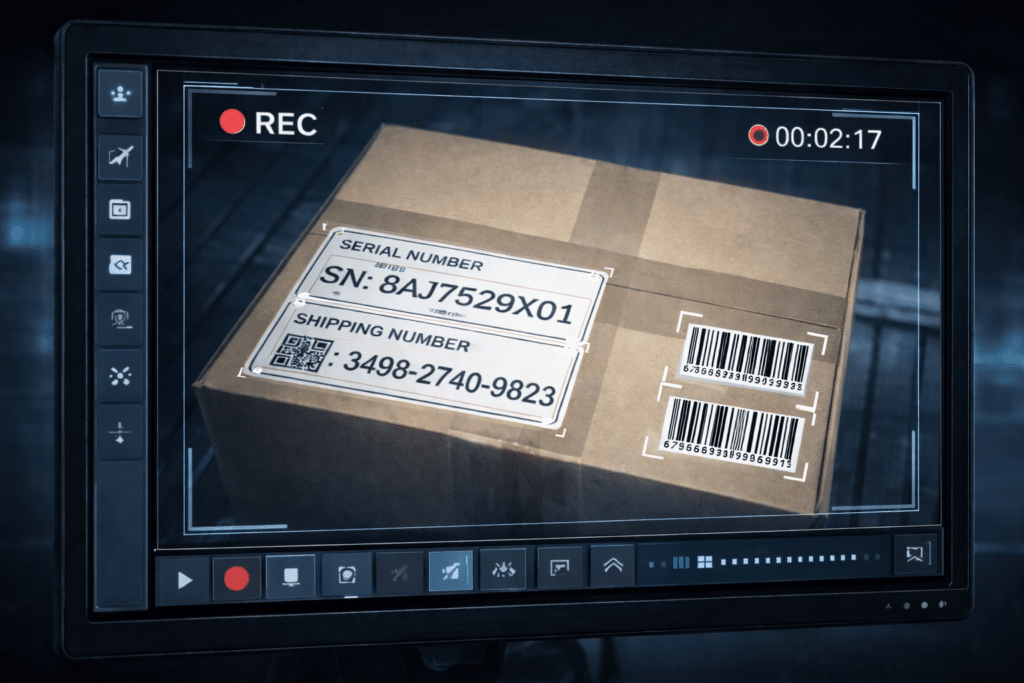
- The operator presents the shipping label on the box to the camera. Using our OCR tools, Pegasus reads the label and extracts the relevant data, such as the carrier tracking number.
- The operator removes the unit from the box and presents the product label to the camera. Pegasus captures the full label in a single pass, extracting barcodes, QR codes, and printed text.
- If the receiving workflow requires it, Pegasus identifies the product visually using AI-powered object recognition, matching it to the correct part number or model without requiring the operator to look it up manually.
- Pegasus passes all captured information to Reconext’s processing system in the background, automatically completing the steps that an operator would otherwise perform by hand. Where dispositioning decisions are required, Pegasus draws on external data sources such as databases and lookup tables, replacing the tribal knowledge operators currently rely on.
- If a human decision is required at any point, Pegasus surfaces a simple prompt on the touchscreen. Otherwise, the workflow advances on its own.
- Once all required data has been captured and submitted, the unit is received and ready for the next stage of processing.
What This Means for Your Device Lifecycle Program
The most immediate impact is speed. When Pegasus comes out of beta this month, we expect to see receiving efficiency improve by at least 40%. Across other programs we have already identified as strong candidates for Pegasus, we anticipate gains as high as 60-70%. At scale, that time adds up quickly into faster overall turnaround and shorter cycle times from intake to processing.
Accuracy improves alongside speed. Manual data entry is inherently prone to error, and a misread character or a barcode scanned into the wrong field can create downstream complications that are time-consuming to resolve. Because Pegasus captures all relevant data from a label in a single pass, the opportunity for those errors to occur is significantly reduced, resulting in cleaner records and more reliable reporting.
Pegasus is designed to be flexible and configurable, so it can be adapted to different programs and facility setups without requiring a custom build each time. That consistency across sites means your program is processed the same way whether an asset is being received in one facility or ten.
What’s Next for AI in Device Lifecycle Management
Pegasus is Reconext’s latest innovation, but it’s part of a much larger body of work. At our Memphis facility alone, an AI agent is already active in operations, handling tasks that would otherwise require manual intervention. Across our broader technology portfolio, solutions like Atheris, which uses machine learning to identify and process labels automatically, and Optiline, which applies the same technology to keep grading standards consistent, are already in use and represent just a portion of the capabilities we have developed and continue to build. Underlying all of it is a broader initiative to develop a fully automated device processing system driven by machine intelligence across many of its core functions.
The throughline across these tools is not a desire to adopt technology for its own sake. Device lifecycle management is a logistics-heavy business operating at a significant scale, and that means it generates enormous amounts of data. Machine learning is uniquely suited to that environment because it is built on data and continues to collect it, and in a business where identifying patterns across millions of assets can translate directly into efficiency and cost gains, that matters. Every tool Reconext builds with these capabilities is also an instrument for understanding the operation more deeply and improving it over time.
For customers, it’s what a serious, long-term investment in operational excellence looks like in practice.
Ready to modernize your device lifecycle program?
Reach out to Reconext to learn how Pegasus and our broader suite of technology solutions can make your program faster, more accurate, and more cost-efficient.


