Traditional data destruction methods left room for sensitive information to remain recoverable. As organizations faced growing concerns over compliance failures and security breaches, data degaussing emerged as a more definitive way to permanently erase magnetic storage media.
For organizations handling sensitive information, where and how this process takes place can be just as important as the destruction method itself.
This article explores how on-site data degaussing works, the types of devices it applies to, why organizations choose it over off-site destruction, and the security and compliance benefits it offers throughout the data disposal process.
Key Takeaway
On-site data degaussing permanently erases data on magnetic media while reducing chain-of-custody risks by keeping sensitive assets on-site.
Organizations use this approach to strengthen security oversight, support compliance requirements, and accelerate the destruction of sensitive IT assets.
What Is On-Site Data Degaussing?

On-site data degaussing refers to the process of destroying data at an organization’s premises rather than transporting assets to an external facility. This reduces the risk of sensitive information being exposed during transit.
Magnetic storage devices store information in tiny magnetic domains arranged in specific patterns. Degaussing disrupts these patterns using a powerful magnetic field, rendering stored data unreadable. To be effective, the magnetic force applied must exceed the strength of the device’s existing magnetic field.
What Types of Devices Can Be Degaussed?
Degaussing only works on magnetic-based devices, also known as magnetic media.
Common examples of such devices include the following:
- Hard Disk Drives (HDDs)
- Legacy magnetic media
- Magnetic backup tapes
- Drum-type memories
- Magnetic strip cards
Most organizations have shifted away from traditional magnetic storage devices in favor of modern alternatives, such as solid-state drives (SSDs).
Unlike magnetic media, SSDs store data using NAND flash memory, which retains information even without power. Because they do not rely on magnetic domains, degaussing cannot destroy data stored on SSDs. Instead, flash-based devices require alternative sanitization methods, such as crypto-erase or physical destruction through shredding.
Why Businesses Choose On-Site Data Degaussing

On-site degaussing provides much greater control over the data destruction process. Businesses choose this over off-site destruction because of reduced chain-of-custody risks, faster and safer destruction, and compliance requirements.
Reduced Chain-of-Custody Risks
On-site data sanitization reduces breach risk by keeping sensitive assets under the organization’s control. It limits exposure during transport, improves chain-of-custody visibility, and gives the organization closer oversight of the destruction process.
Faster and More Secure Data Destruction
On-site sanitization enables a business to sanitize devices with virtually no delays. Similarly, commercial degaussers can handle large batches of magnetic media because they have the resources and personnel to do so.
Organizations handling highly sensitive data may need to oversee and verify sanitization processes to meet internal security policies or compliance requirements. In such cases, on-site data destruction allows them to directly monitor the process.
Support for Compliance Requirements
Highly regulated industries use formal media sanitization techniques to protect sensitive information. To avoid compliance issues, businesses in these industries prefer on-premise degaussing services.
Additionally, these industries stick to the recommended data sanitization techniques as a framework for their internal policies. While these can still be achieved through off-site data sanitization, on-site data sanitization provides greater visibility into processes.
How the On-Site Data Degaussing Process Works
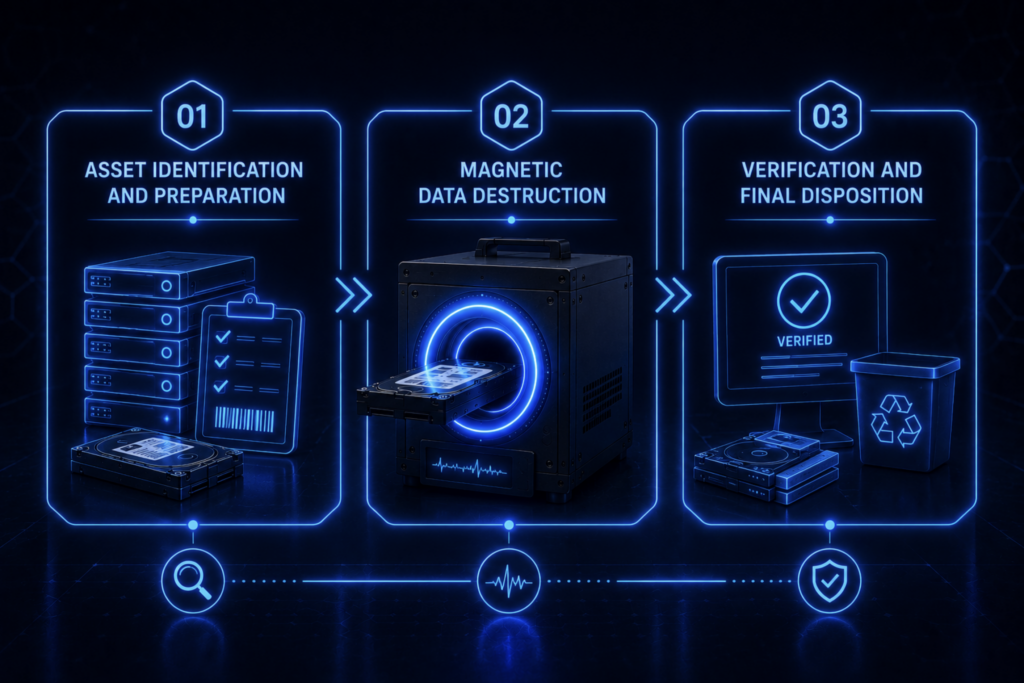
The degaussing technique remains the same regardless of the location. What changes is the workflow used. Data degaussing is a three-step process that starts with inventory, actual destruction, and final disposition.
Asset Identification and Preparation
Retiring assets must be identified and inventoried before the degaussing process begins. These devices are logged into a tracking system using their serial numbers.
Then comes processing, a stage that includes:
- Eligibility screening of devices
- Grouping devices according to similarities
- Tearing them down for easy access to the disk surface
- Validation and itemization
This first step involves preparing the degaussable devices for actual sanitization. Doing so ensures that no eligible devices are left unsanitized and that those that are sanitized are securely handled.
Magnetic Data Destruction
Magnetic data destruction is the second step in the degaussing process. The degaussing equipment applies a high-intensity pulse to the drive. This pulse generates a strong magnetic field that overpowers the device’s magnetic domain, causing a loss of alignment.
Besides data destruction, the drive’s servo tracks and firmware are also destroyed in the process. As these are the architecture of data storage, the drive suffers permanent damage and becomes unusable.
Verification and Final Disposition
Verification and final disposition come last in the data degaussing process. First, the vendors verify that all magnetic devices have been wiped clean. Following this, they prepare documentation that proves it.
The organization then has to decide what to do with the degassed drives. The NSA recommends physical destruction in addition to degaussing for added data security. However, in some cases, physical destruction can increase electronic waste.
If degaussed magnetic drives are no longer usable, they must be disposed of properly to avoid e-waste. For highly sensitive data, on-site shredding ensures drives are permanently destroyed. Parts harvesting is another disposition route used when the drive has valuable parts that can be recycled. Otherwise, vendors default to regular recycling methods.
When Do Businesses Use On-Site Data Degaussing?

Organizations typically choose on-site data degaussing when handling large volumes of sensitive assets or when security policies prevent devices from leaving the premises. Keeping the process on-site allows businesses to securely sanitize data while maintaining oversight throughout disposal activities.
Here are some situations that call for destruction on the premises:
- Data center decommissioning: Retiring infrastructure often involves destroying large quantities of storage devices containing sensitive operational or customer data.
- Office closures or relocations: Organizations may sanitize legacy devices before moving or shutting down facilities to prevent data exposure.
- Large-scale hardware refreshes: Replacing outdated systems generates significant volumes of retired drives that require secure disposal.
- Highly regulated or government environments: Industries with strict compliance requirements may require data destruction to occur on-site to maintain security protocols and chain-of-custody controls.
Conclusion
On-site data degaussing gives organizations more control over how magnetic media is destroyed, helping reduce exposure risks and supporting secure IT asset disposal. For businesses handling sensitive data, relocating operations, or retiring large volumes of devices, keeping destructionon-site can improve oversight and provide greater confidence in the sanitization process.
If your organization is planning a data center decommissioning, office move, or large-scale hardware refresh, Reconext can help with secure, compliant data destruction and IT asset disposition services. Contact Reconext to learn more about protecting sensitive data throughout the asset lifecycle.
FAQs
Does degaussing completely destroy data?
Yes. The process targets the servo tracks of the drive, which help computers read data. Destroying these servo tracks makes the data unreadable.
Can SSDs be degaussed?
No. Data degaussing works only on magnetic storage, whereas SSDs store data as electric charge patterns. Since there are no magnetic domains to realign, degaussing does not affect stored data.
Can data be recovered after degaussing?
No. The realignment that occurs after a magnetic pulse completely destroys the drive, rendering the data unreadable.
How long does it take to degauss a drive?
The actual degaussing can take anywhere between 5 and 30 seconds. However, the whole process takes longer because devices have to be torn down to expose the drive, and degaussers have to be set up correctly and powered on. Time will also depend on the total number of devices being degaussed.