Global data center decommissioning involves retiring, consolidating, or relocating data center infrastructure across regions. Since these projects span facilities, stakeholders, and regulatory environments, they require a structured approach to minimize risk and disruption.
A phased decommissioning process helps maintain operational continuity while ensuring sensitive data is securely destroyed and retired assets are properly handled. It also improves project visibility and control, reducing the risk of compliance issues, asset loss, and missed recovery opportunities.
This article examines the five key phases of a data center decommissioning project and the role each stage plays in achieving a secure and efficient outcome.
Key Takeaways
- Global data center decommissioning is most successful when executed in phases. A structured approach reduces operational risk, protects sensitive data, and improves compliance outcomes.
- Organizations should prioritize certified data sanitization, coordinated logistics, and strategic remarketing to recover value from retired equipment.
Why Businesses Decommission Global Data Centers

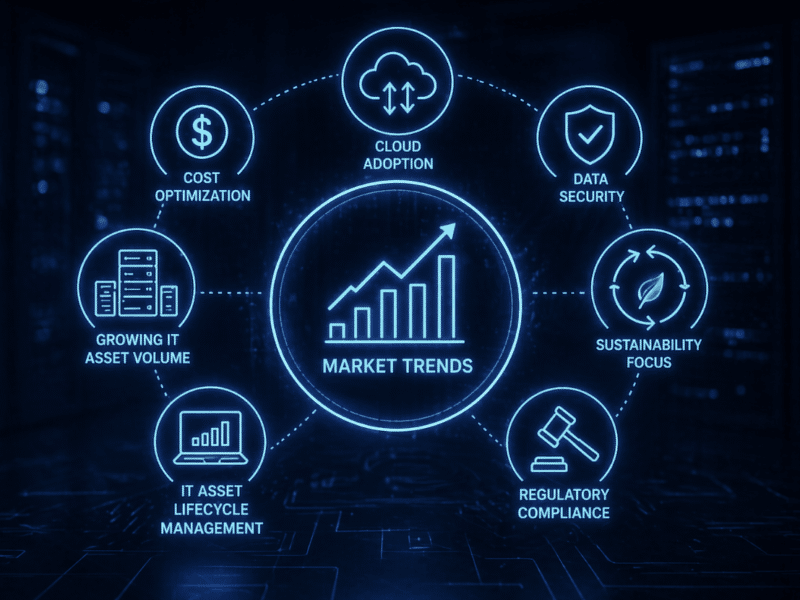
Data center decommissioning is typically driven by cost reduction, infrastructure modernization, facility consolidation, or migration to cloud and colocation environments.
Managing multiple data centers can become costly, especially when facilities depend on aging infrastructure. Older systems often require more support, use resources inefficiently, and introduce additional security risks. Decommissioning helps organizations replace obsolete environments with more modern and resilient infrastructure.
Organizations are increasingly shifting workloads to cloud-based environments to improve scalability, performance, and cost efficiency. As a result, some on-premises data centers become redundant as businesses replace physical infrastructure with virtual computing services from providers such as AWS.
With AI demanding heavy computing, most businesses are decommissioning data centers more often now. Previously, these projects were conducted in cycles of up to 7 years, but today they require up to 36 months.
Relocations, consolidations, and facility closures can also trigger data center decommissioning. Before a site is closed or moved, organizations need to inventory, secure, and remove IT assets to reduce data exposure, recover value from reusable equipment, and manage e-waste responsibly.
The 5 Phases of Global Data Center Decommissioning
Poor sequencing during a data center decommissioning project can disrupt workloads, weaken asset control, and expose sensitive data. A phased approach helps teams isolate systems, validate dependencies, and retire equipment with less operational risk.
Phase 1: Strategic Planning and Asset Discovery
The first phase focuses on visibility and accountability. It should start at least months before the actual decommissioning happens. A few key activities define success in phase one:
- The organization assembles a team of IT operations, infosec, legal, and other stakeholders required during data center decommissioning. This is where an organization must define a RACI matrix for easier task management.
- The team responsible for IT operations kickstarts the inventory audit. They capture asset tags, serial numbers, configurations, and software licenses. The inventory should also capture racks, cables, and cooling systems.
- Before closing phase one, a dependency map should be created. Applications and shared databases are captured to ensure services are not interrupted during shutdown.
Phase 2: Data Security and Certified Sanitization
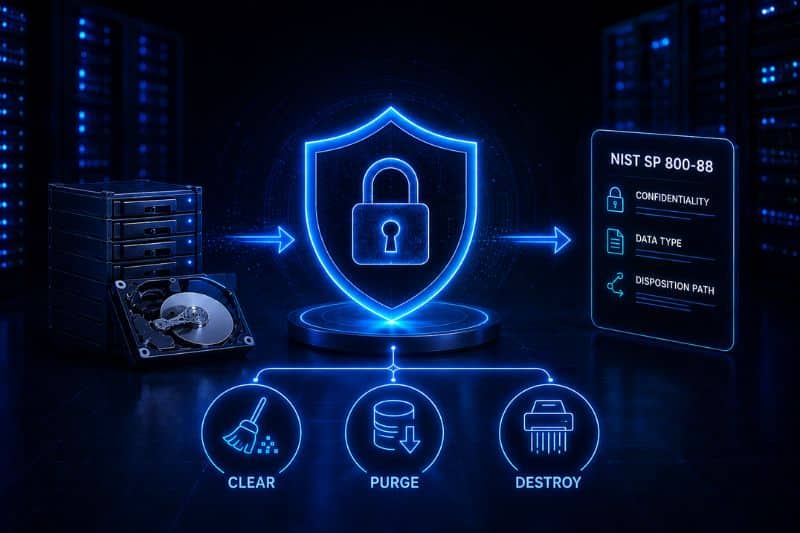
In phase two, data-bearing assets are treated in accordance with data protection guidelines. This is when most organizations bring in certified ITAD partners to handle the rest of the secure data destruction process.
Certified data sanitization follows guidelines such as NIST SP 800-88, which recommends handling data-bearing assets based on the confidentiality of the data they contain. The intended disposition path should also be considered when choosing a sanitization method.
Under these guidelines, the ITAD vendor will choose to either clear, purge, or destroy data-bearing assets.
Phase 3: Physical De-installation and Logistics Management
After successful data sanitization, assets in the data center are then de-installed and transported to designated destinations.
First, the data center is powered down. The power supply and the cooling system are cut off. This is done in a documented sequence to avoid data loss and to ensure applications are not disrupted.
Next, inactive systems like facility infrastructure are de-installed. Hazardous materials are also disposed of appropriately at this stage to avoid e-waste.
Remarketing assets are transported to an assortment center, where they are processed for secondary markets.
Phase 4: Value Recovery and Remarketing

Value recovery leads take over once items are de-installed, and before they are transported off-site. Their first objective is to quantify the possible resale value of the data center equipment. Concurrently, they time their market entry to coincide with the asset’s demand.
At this stage, remarketing teams choose the appropriate recovery channel for retired assets. They typically have three options:
- Direct end-user sales: Yields the highest return but is the slowest path, often taking 60 to 180 days.
- ITAD reseller buyouts: The fastest method, but comes at a discount, typically returning 35% – 60% of fair market value.
- Online auctions: Serve as a middle ground for high-volume, mixed-quality lots, usually closing within 21 to 60 days.
For assets too old to sell whole or that fail functional testing, vendors recover value through component harvesting. Components such as RAM, CPUs, NICs, and power supplies are removed, tested, graded, and resold.
Phase 5: Compliance Reporting and ESG Integration
At the final stage, organizations compile reports that document the full decommissioning process. These reports typically include certificates of destruction, proof of resale, and records showing how each asset was handled.
The reporting process also reconciles the closing inventory against the inventory captured at the start of the project. This helps confirm that all assets were accounted for and that no equipment was lost or processed outside the approved workflow.
Organizations also prepare sustainability and revenue reports. Sustainability reporting shows whether retired assets were handled in line with environmental requirements, while revenue reporting tracks which assets were resold and how much value was recovered. These records are retained for audits, compliance reviews, and future reference.
Best Practices when Decommissioning a Global Data Center

A clean decommissioning project depends on decisions made early. The right controls help prevent avoidable exposure later.
- Choose certified ITAD partners: Prioritize providers with certifications such as R2v3, e-Stewards, NAID AAA, and ISO 14001/45001 to support secure, compliant, and environmentally responsible asset disposition.
- Standardize through global coverage: Work with a provider that operates consistently across the Americas, EMEA, and APAC to simplify reporting, chain-of-custody management, and process control.
- Plan for environmental impact early: Conduct a pre-project environmental assessment to reduce unnecessary transportation, streamline logistics, and lower the project’s carbon footprint.
- Align sanitization with security risk: Use on-site data destruction in high-security environments so sensitive data is removed before assets leave the facility.
- Train project participants: Give employees clear responsibilities so each phase is executed consistently and without avoidable gaps.
- Maintain a tested rollback plan: Prepare for cases where a system scheduled for retirement is found to support a critical business function.
Conclusion
Global data center decommissioning involves more than shutting down infrastructure. With clear planning and disciplined execution, organizations can reduce risk, protect sensitive data, maintain compliance, and recover value from retired assets.
Just as important is the partner selected to support the project. Large-scale decommissioning efforts require consistent processes, secure handling practices, and global execution capabilities.
Reconext helps organizations manage these requirements by providing standardized data center decommissioning services across multiple regions. Contact Reconext to learn how your organization can decommission multiple data centers and recover value in the process.
FAQs
How long does a global decommissioning project take?
A global decommissioning project typically takes 12 to 18 months from kickoff to final reporting. The exact timeline depends on factors such as the number of sites involved, asset volumes, regulatory requirements, and logistics complexity. Multi-region projects generally require more time to coordinate and execute successfully.
Why isn’t degaussing recommended for modern data centers?
Degaussing is not recommended for modern data centers because it only works on magnetic hard disk drives. Most modern environments rely on SSDs and NVMe drives, which are unaffected by degaussing.
Can we recover money from equipment that is too old to resell?
Yes, organizations can still recover value from equipment that is too old to resell. Components such as RAM, CPUs, and power supplies may retain value even when the complete system does not. Remaining materials can also be recycled through certified processors to generate additional returns.
Who should own the decommissioning project internally?
A decommissioning project should be owned by a cross-functional team rather than a single department. While IT project managers often coordinate day-to-day activities, infosec, legal, facilities, and finance teams all have critical responsibilities.
Global data center decommissioning involves retiring, consolidating, or relocating data center infrastructure across regions. Since these projects span facilities, stakeholders, and regulatory environments, they require a structured approach to minimize risk and disruption.
A phased decommissioning process helps maintain operational continuity while ensuring sensitive data is securely destroyed and retired assets are properly handled. It also improves project visibility and control, reducing the risk of compliance issues, asset loss, and missed recovery opportunities.
This article examines the five key phases of a data center decommissioning project and the role each stage plays in achieving a secure and efficient outcome.