Data center decommissioning: where do we actually do this? On-site? Off-site? Ship it out and hope?
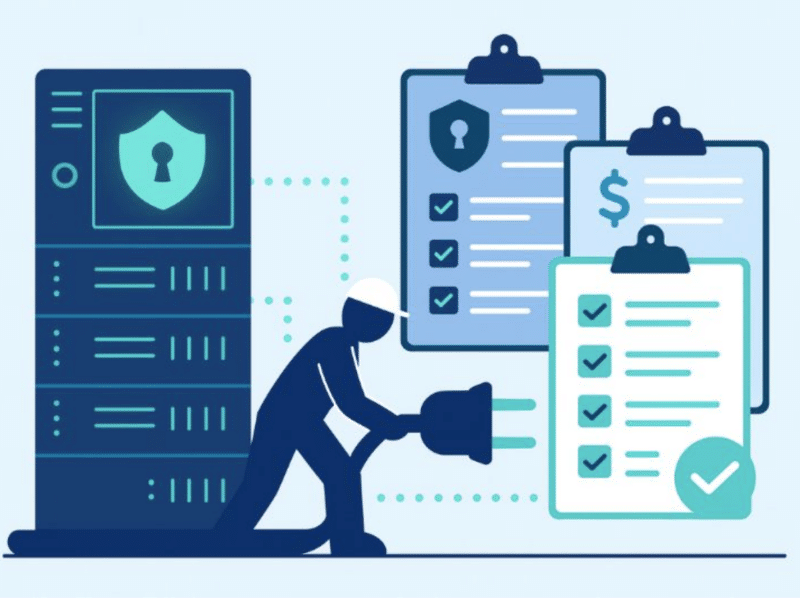
Sounds like a rookie question. It isn’t. “Where” decides custody, evidence, carbon, and cash. Pick wrong, and you don’t just risk data. You burn money and hand regulators a headline.
So let’s indulge the question. Let’s talk about where.
Key takeaway
The data center decommissioning process works anywhere—onsite, offsite, or hybrid—if chain of custody stays unbroken, data sanitization is provable, and retired assets move first toward reuse and resale, with only true end-of-life gear routed to certified recycling facilities.
On-site vs off-site

Think of this as the binary most teams wrestle with first.
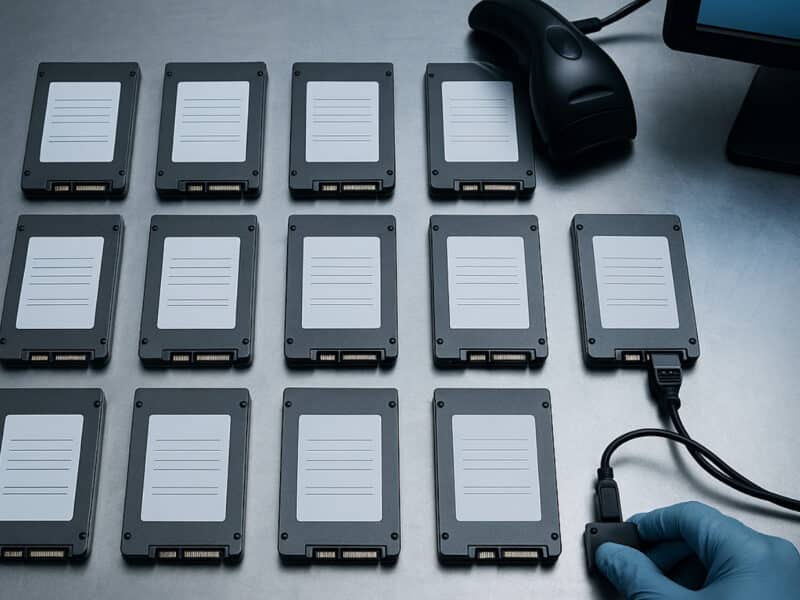
On-site means everything happens inside your walls. Drives are wiped where they sit, racks are powered down under your access rules, and nothing leaves without a serialized certificate. The upside is obvious: maximum control, minimum chance for a breach. The tradeoff? Cost and efficiency. On-site projects are slower, more expensive, and put more strain on your teams. But for healthcare systems, government agencies, or banks with strict privacy laws, that control is non-negotiable.
Off-site flips the equation. Equipment is deinstalled, sealed, and transported to a certified facility designed for scale. Off-site workflows move faster, cut costs, and free up your people. The risk, of course, lives in the gaps: every transfer, every truck stop, every intake point. If custody isn’t airtight, you’re back to relying on faith instead of proof.
The reality for most enterprises is a hybrid model. High-risk assets are wiped in place before leaving the room, while lower-sensitivity gear goes into sealed transport for processing. It’s a middle path: on-site where the data risk demands it, off-site where efficiency makes sense.
Reconext often pairs on-site rack-level wipes (Rackwipe) with off-site high-volume testers (Proteus) to make hybrid models workable at scale.
What makes a facility trustworthy

Let’s say you do send assets off-site. How do you know the facility is more than just a warehouse with a shredder?
The basics are certifications: R2v3, e-Stewards, ISO 9001/14001, ADISA, plus data sanitization frameworks like NIST and IEEE. If they can’t show you those, the conversation’s over. But certifications alone are table stakes. Real trust comes from how the facility operates.
Look for continuous custody intelligence. Not just “checked in, checked out,” but constant digital oversight. No blind spots between intake and final disposition. If there’s a gap in verification, that’s where assets go missing or get swapped.
Second, demand segregation. Sensitive IT assets should never be mixed with general scrap streams. It’s not just sloppy; it’s a compliance risk. One SME put it bluntly: hyperscalers don’t shred because wiping doesn’t work, they shred because they don’t trust custody.
Third, personnel. Facilities worth their salt vet their staff with background checks and training designed for high-risk environments. The weakest link is always human; the best partners recognize that and build systems around it.
Finally, transparency. A credible facility doesn’t ask you to take their word for it. They offer tours, real-time tracking dashboards, and reconciliation reports that hold up under audit. If you can’t walk in and see clear lines of custody, you’re not in a secure facility. You’re in a liability factory.
Global vs regional factors

Where the work happens geographically matters just as much as whether it’s on-site or off-site.
Regulations are the first driver. Europe operates under GDPR and strict e-waste directives. Asia-pacific is a patchwork: Singapore’s data protection act looks nothing like India’s, and both differ from Australia’s. The U.S. is even more fragmented, with HIPAA for healthcare, PCI DSS for payment data, state-by-state privacy laws, and federal agencies that add their own rules. If you’re multiregional, the weakest jurisdiction defines your overall risk.
Logistics come next. Moving racks across town is one thing. Moving them across borders introduces customs delays, bonded warehousing, and the nightmare of explaining to a border agent why your shipment of “dead servers” needs tamper-proof custody. Some firms try to dodge the hassle by shredding everything on site. That solves one problem (customs) by creating another (value destruction).
Carbon math is the under-discussed factor. Every mile of transport adds emissions. Every shredder run adds waste. But refurbishing and redeploying servers cuts manufacturing demand, which more than offsets those emissions. Smart operators don’t just report “we recycled.” They calculate avoided production carbon against transport emissions, showing net reduction. This isn’t greenwashing; investors, regulators, and customers are asking for the numbers.
Practically, the global vs regional question boils down to: where can you process assets close enough to reduce custody risk and carbon, while still meeting regulatory requirements? For multinationals, that usually means regional hubs with certified partners, and not a single global facility, not every site doing its own thing, but a balanced network.
The role of custody infrastructure
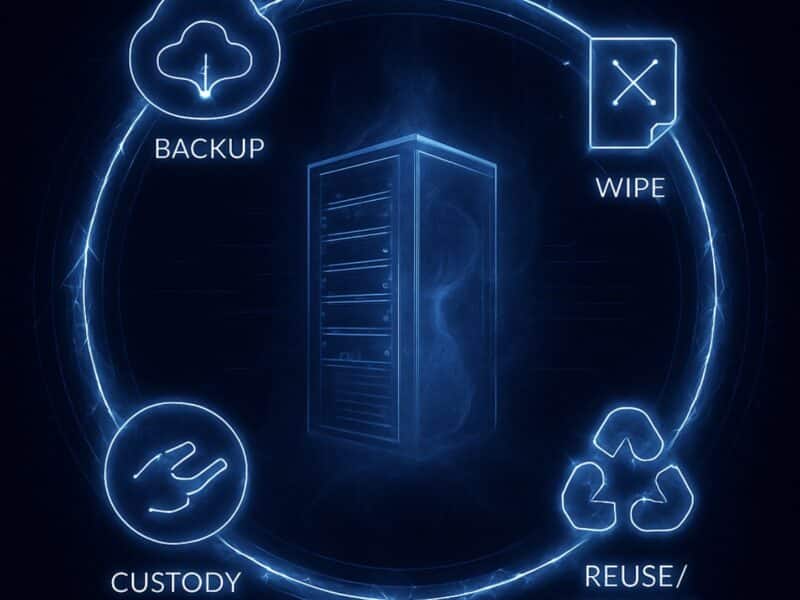
Whether you’re working on-site or off-site, local or global, custody is the thread that stitches the process together.
In the old model, chain of custody meant “sign here when it leaves, sign there when it arrives.” Everything in between? A black box. Acceptable inefficiency, they called it. Auditors tolerated it because there wasn’t a better option.
Today, Continuous Custody Intelligence (CCI) makes that excuse obsolete. Assets are profiled at pickup: serials scanned, configs verified, anomalies flagged. That digital profile travels with the asset. At intake, the system checks it again. If one digit is off, the process halts.
During transport, GPS and cellular tags stream real-time location. Sealed containers prevent tampering. For high-risk loads, some carriers split shipments: mechanical drives in one vehicle, logic boards in another. Intercepted cargo becomes useless without both halves.
Inside facilities, custody zooms in further. Parent-child tracking ties every disassembled component — drives, boards, memory sticks — back to the original asset. Recycling doesn’t mean losing provenance; every harvested part carries its lineage.
This infrastructure isn’t just about trust. It’s about proof. Regulators don’t accept “we think it was fine.” Boards don’t either. What they want is reconciled inventories, serialized certificates, and custody logs that close every gap.
And here’s the kicker: custody systems double as efficiency drivers. By making verification continuous, you remove the need for endless reconciliation exercises. Work flows instead of stalling at checkpoints. Boring, predictable, reliable – which, in this line of work, is the gold standard.
Site-specific considerations
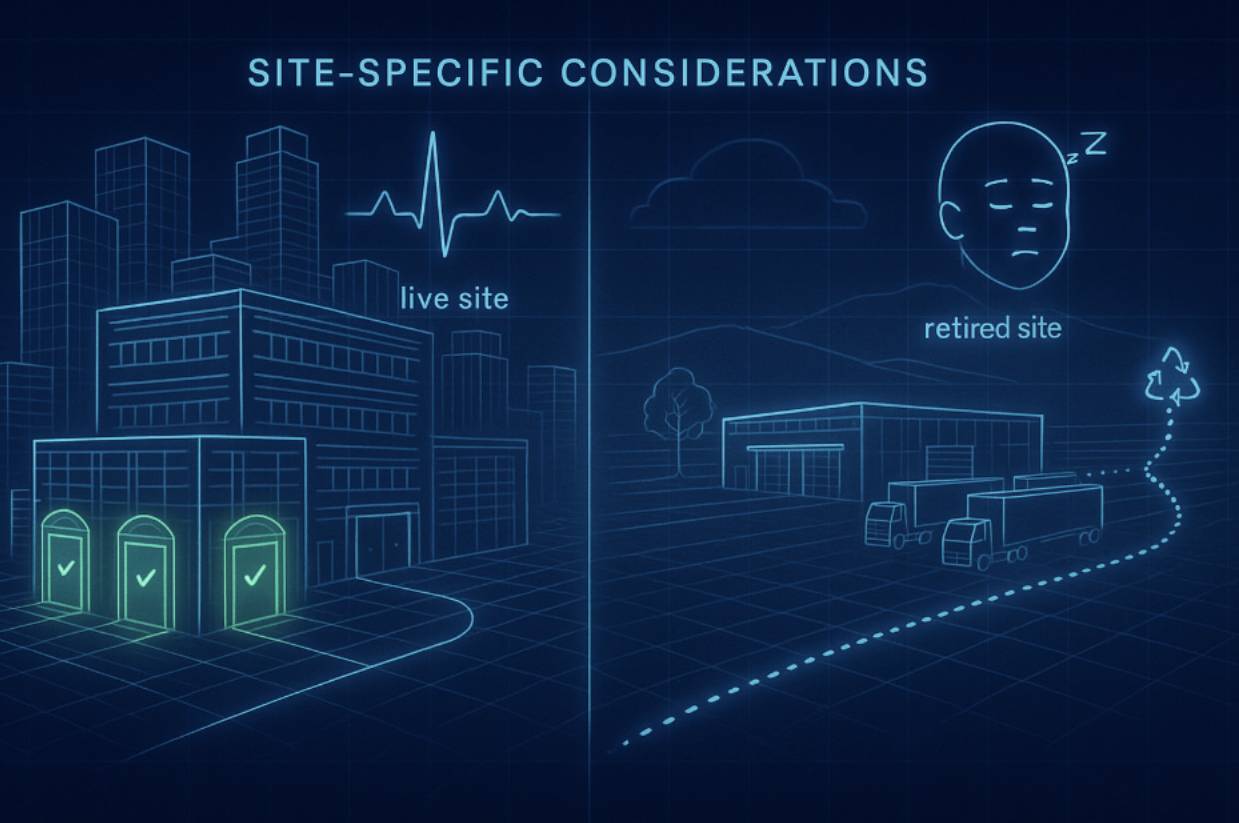
Every facility has its quirks. Ignoring them is how projects stall.
Urban vs rural sites play by different rules. In a city, access windows are narrow, loading docks are shared, and security wants three layers of approval before a crate moves an inch. Rural facilities offer more space and less bureaucracy, but often lack nearby certified recycling facilities, which stretches custody chains.
Live vs retired environments also change the calculus. Decommissioning a cold site (everything powered down, no active workloads) is straightforward. Working inside a live environment means staged access, rack-level mapping, and constant escorts so no active system gets touched by mistake.
Leased vs owned equipment is another wrinkle. You don’t get to shred leased servers. They have to be wiped, tested, and returned in near-new condition or you’ll eat penalties. That means cosmetic refurbishment and detailed reporting, not just secure erasure.
Compliance overlays are the final variable. some industries demand offline wipes with no internet access. Others require redundant sanitization methods — wipe, verify, then shred if verification fails. The site dictates which rules apply, and trying to shortcut those rules always costs more in the long run.
Choosing partners without regret
Vendors love to sell the same story: certifications, scale, global footprint. All important, none sufficient.
The better question is: how do they behave when something goes wrong?
A strong partner puts cut-lines on paper before the work starts: which standards apply, which deliverables matter, who owns which risks. Blurred cut-lines are where projects collapse into finger-pointing.
Look at tooling. rack-level wipes (Rackwipe) and high-volume testers (Proteus) are what keep racks from squatting for weeks. If a provider’s still using the one-drive-at-a-time USB stick method, you’re buying risk disguised as thrift.
Scrutinize custody systems. Are they still running sign-in/sign-out logs, or do they have continuous custody intelligence with real-time verification? Trust should never rest on paperwork alone.
And don’t skip people. Certifications cover processes; they don’t cover judgment. Ask how staff are vetted, how anomalies are escalated, and how the provider prevents data-bearing gear from mixing with general scrap. One sloppy handler can unravel months of planning.
Finally, demand transparency. If they won’t let you tour the facility, or if dashboards stop at “shipment received,” you’re in the wrong relationship. In this industry, opacity equals liability.
The best partners make a decommissioning project feel boring. Uneventful. Like nothing happened. Which is exactly the point.
Measuring success and closeout

If decommissioning is done right, the story at the end is… nothing. No outages,
no breaches, no surprises. But “nothing happened” isn’t enough of a metric. Success has to be proved in
numbers.
Data security is the first benchmark. Every data-bearing device either has a serialized certificate of sanitization or a destruction log. No gaps, no exceptions. If a regulator or auditor can’t follow the trail, you failed.
Asset recovery is the next one. How much equipment was wiped and redeployed, resold, or harvested for components? How much value came back compared to what was written off? Scrap rates should be the minority, not the majority.
Environmental compliance follows. Recycling partners should be R2v3 or e-Stewards certified, with documented volumes of metals, plastics, and hazardous materials recovered. ESG teams aren’t satisfied with “we recycled responsibly.” They need the actual reports.
Operational efficiency is another marker. How long did racks sit idle before being cleared? Was the project completed in the expected 8–12 week window, or did approvals and process gaps drag it into months of overhead?
And finally, site restoration. A clean handoff means the floor is cleared, the fixtures are removed, and the space is ready for whatever comes next, whether that’s repurposing, handover to a landlord, or demolition. Unfinished cleanup is the detail that derails otherwise clean projects.
Closeout is both physical and documentary. Reconciled inventories, certificates bundled, custody logs intact, resale reports delivered. When the board asks, “what happened to our data center?” The answer should be a neat packet that leaves no questions unanswered.
Conclusion
“Where” isn’t scenery. It’s the script.
Get it wrong and you get chaos: lost
approvals, missing assets, scrap where value should be. Get it right and nothing happens. No drama, no gaps.
data erased, assets reconciled, value back.
Boring, predictable, provable. The way it should be.
Contact Reconext to design a decommissioning plan tailored to your facility.
FAQs
Yes, phased access windows and rack-level mapping allow decommissioning without disrupting active workloads.
They can’t be shredded. They’re wiped, tested, cosmetically refurbished, and returned to the lessor with detailed reports.
Through R2v3- or e-Stewards-certified recycling partners and reports that document volumes of metals, plastics, and hazardous materials recovered.
Data destruction is the process of permanently eliminating all sensitive data from storage devices so it cannot be recovered. This can include software-based wiping (following standards like NIST 800-88), degaussing, or physical destruction methods such as shredding or crushing. Proper data destruction ensures compliance and protects against data breaches.