Most teams don’t plan for the day they have to move a data center.
Then a lease ends.
Or power density hits a ceiling.
Or growth quietly outpaces the facility that was supposed to support it.
Suddenly, a normal quarter becomes a countdown.
That’s the real beginning of a data center migration. Not when the first server is unplugged, but when leaders realize that systems, data, and physical infrastructure are about to move at the same time, under pressure, with very little margin for error.
At Reconext, we’ve supported migrations that felt almost boring and others that felt like solving a puzzle while the pieces were still moving. The difference is never luck. It’s preparation, visibility, and knowing where risk actually lives.
This guide walks through what a data center migration really involves. Not just the technical steps, but the operational decisions that protect uptime, data, and reputation. We’ll cover why organizations migrate, how migrations unfold in practice, where risk concentrates, and why the final stages like data center decommissioning and asset handling often determine whether a project truly succeeds.
The goal is simple: help you move with confidence and come out the other side stronger than when you started.
What is a data center migration?
A data center migration is the structured movement of IT infrastructure – servers, storage, networking, workloads, and supporting systems – from one environment to another.
That environment might be:
- A new on-premises facility
- A colocation site
- A cloud or hybrid architecture
- Or a consolidated footprint following a facility exit
What matters is not the destination, but the transition itself.
Migrations force change. Systems that have been stable for years are touched, moved, reconnected, or reconfigured. Hidden dependencies surface. Old assumptions get tested. Decisions that were once theoretical become very real, very quickly.
A successful migration is not defined by speed. It’s defined by control: maintaining service continuity, protecting data, and preserving optionality as infrastructure evolves.
Why organizations migrate data centers
Every migration starts with a reason. Sometimes it’s obvious. Sometimes it sneaks up slowly.
Operational efficiency
Facilities built ten or fifteen years ago were never designed for today’s compute density or energy expectations. Cooling inefficiencies, aging power infrastructure, and rising maintenance costs eventually outweigh the comfort of staying put. Newer environments do more with less and reduce the daily operational strain on teams.
Scalability and performance
Growth changes everything. Workloads expand. Applications multiply. What once felt like headroom becomes constraint. At some point, scaling inside an aging footprint becomes harder than starting fresh in an environment designed for modern loads.
End-of-lease and end-of-life events
Leases expire. Warranties end. Vendors sunset platforms. These moments impose timelines whether teams feel ready or not. Migration becomes mandatory, not optional.
Cloud and hybrid strategy
Many organizations now operate across multiple environments. Some workloads stay on-premises for latency, compliance, or control. Others move to cloud platforms for elasticity. Migration becomes an ongoing capability rather than a one-time project.
Resilience and redundancy
Distributed architectures reduce single points of failure and strengthen disaster recovery. Moving systems can be an opportunity to redesign for resilience rather than simply replicating old fragility in a new location.
Cost and sustainability goals
Energy efficiency and carbon reduction are no longer side conversations. Newer facilities consume less power and enable more responsible end-of-life handling of retired equipment. When decommissioning is done correctly, migrations contribute measurable ESG value instead of waste.
Different motivations. Same reality. Infrastructure evolves, and migration is how organizations keep up.
The core phases of a data center migration
Migrations feel overwhelming when they’re treated as one giant event. In practice, they succeed when broken into clear, disciplined phases – each with its own objectives and proof points.
01 Assessment and discovery

Before anything moves, teams need to understand what actually exists.
This phase is about visibility. Hardware inventories. Application mappings. Dependency discovery. Capacity analysis. Identifying what’s critical, what’s fragile, and what no one remembers owning.
The most common mistake here is assuming documentation is complete. It rarely is. Mature environments accumulate exceptions, workarounds, and undocumented connections. Discovery tools and stakeholder interviews surface these realities early, when they can still be addressed safely.
A clean migration depends on an honest map of the current state.
02 Planning and coordination

Once the landscape is visible, information turns into a plan.
This is where roles are defined, timelines are sequenced, and decision authority is clarified. Change windows are agreed upon. Rollback paths are documented. Communications protocols are established.
Security, compliance, and facilities teams belong here as much as IT. Migration is not just a technical exercise. It’s an operational one. Bringing every stakeholder in early prevents late-stage friction.
03 Preparation
Preparation is where intent becomes tangible.
Target environments are validated for power, cooling, and connectivity. Backup and recovery systems are tested, not assumed. Equipment is labeled, logged, and staged for transport. Cutover rehearsals identify gaps before production workloads are involved.
When preparation is thorough, execution becomes repetition rather than improvisation.
04 Migration and transition execution

This is the moment everyone thinks of as “the migration,” but by now, most of the real work is already done.
Workloads move in controlled sequences. Systems are monitored in real time. Validation checks confirm functionality before the next wave begins.
The best migrations feel uneventful. That’s not an accident. It’s the result of disciplined planning and controlled execution.
05 Decommissioning and asset handling

After the new environment stabilizes, the old one still holds risk.
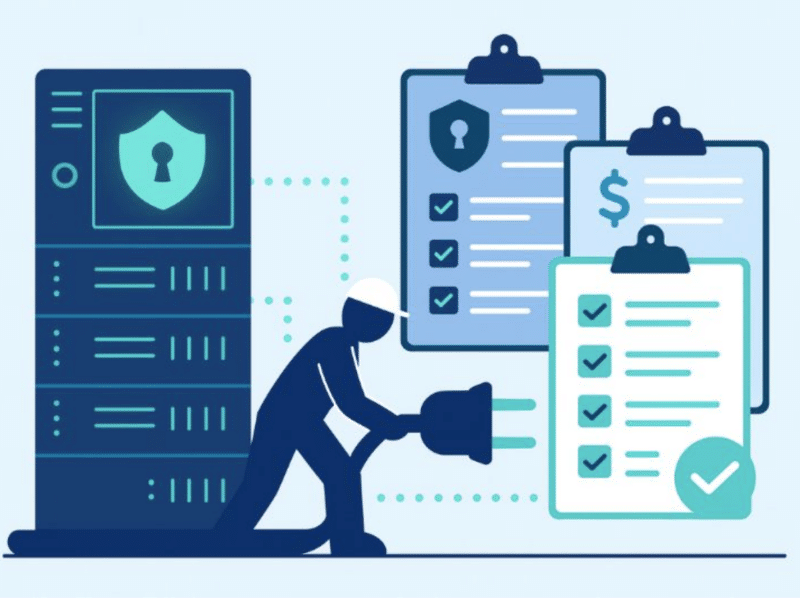
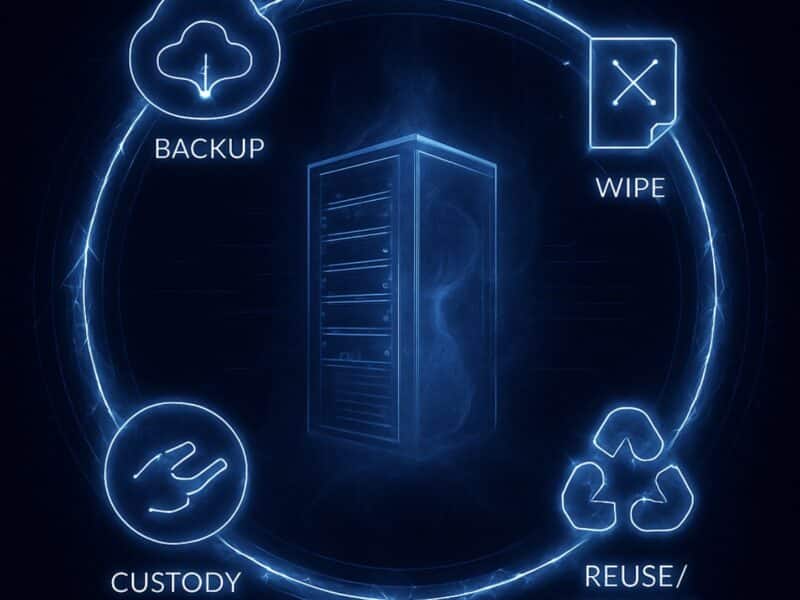
Servers, drives, and network equipment that once ran production workloads now contain residual data and latent value. Each asset must be tracked, sanitized, reused, or destroyed under verifiable chain-of-custody controls.
This phase is where Reconext often becomes deeply involved. Secure erasure, functional testing, component recovery, and responsible recycling turn what could be a liability into measurable value.
Skipping or rushing decommissioning is one of the most expensive mistakes teams make.
06 Optimization and stabilization

Once everything is live, teams tune.
Performance baselines are reviewed. Capacity assumptions are validated. Lessons learned are documented. The organization leaves the project not just migrated, but smarter about its own infrastructure.
Migration becomes an investment, not just a move.
Choosing the right migration approach
There is no universal migration strategy. The right approach depends on business priorities, risk tolerance, and time constraints.
Lift-and-shift
The fastest path. Systems move as-is with minimal change. This approach minimizes complexity but postpones optimization.
Replatforming
Applications are adjusted to take advantage of newer infrastructure. More effort upfront, better long-term efficiency.
Phased migration
Workloads move in waves. Risk is contained, and teams learn as they go. Common in complex enterprise environments.
Hybrid bridging
Old and new environments run in parallel for a period. Higher coordination overhead, smoother user experience.
Complete facility decommissioning
Full exits combine migration, logistics, and asset recovery into a single program. Complex, but clean when executed well.
The right choice is the one that aligns infrastructure change with business continuity.
The most common risks in data center migration
Most migration failures don’t come from bold decisions. They come from small oversights.
Data integrity is first. Backups that have never been restored are a gamble. Validation is non-negotiable.
Hidden dependencies follow closely. Systems communicate in ways that documentation rarely captures. Discovery tools and dependency mapping surface these risks early.
Physical constraints matter. Power density, cooling, and rack weight change between facilities. Verification prevents unpleasant surprises.
Security exposure peaks during movement. Serialized tracking, access controls, and escort protocols close that gap.
Compliance and data handling cannot be deferred. Drives retain regulated data long after systems shut down. Reconext follows NIST SP 800-88 Rev. 1 and IEEE 2883:2022 standards to ensure erasure outcomes are auditable and globally recognized.
Schedule compression quietly magnifies every other risk. Late starts lead to rushed finishes. Realistic planning protects everything downstream.
For a deeper dive into these issues, see our article on data center migration challenges.
Where external expertise becomes essential
Even the strongest internal teams reach limits.
Data-bearing hardware handling is one of them. Certified erasure, forensic verification, and chain-of-custody documentation are specialized disciplines. Reconext’s systems log every outcome with evidence that stands up to audit.
Global and multi-site programs add complexity. Regional regulations, logistics constraints, and physical security standards must align. Reconext operates under ISO 27001 physical security controls across facilities worldwide, ensuring consistency regardless of geography.
Finally, asset recovery changes the economics of migration. Securely wiped and tested equipment retains value. Materials recovered responsibly support sustainability reporting. What was once treated as waste becomes measurable return.
External expertise doesn’t replace internal teams. It protects their work and preserves the gains they’ve already made.
What success looks like today
Success used to mean systems came back online and users stopped calling.
That’s no longer enough.
Today, success means:
- Improved performance and stability
- Clear compliance documentation
- Verified data handling outcomes
- Measurable financial and environmental recovery
- And a team better prepared for the next change
A good migration strengthens the organization. A great one leaves it more resilient, more informed, and more confident.
Closing thoughts
A data center migration tests more than infrastructure. It tests planning discipline, communication, and trust in process.
The pattern is consistent. Early discovery prevents late surprises. Structured execution replaces urgency with control. Thoughtful decommissioning turns risk into value.
At Reconext, we help organizations connect every phase – from inventory and migration through erasure and recovery – so that nothing is lost, misplaced, or left undocumented.
If you’re planning a data center migration, bring us in early. We’ll help you move deliberately, close out cleanly, and finish with proof, not just promises.