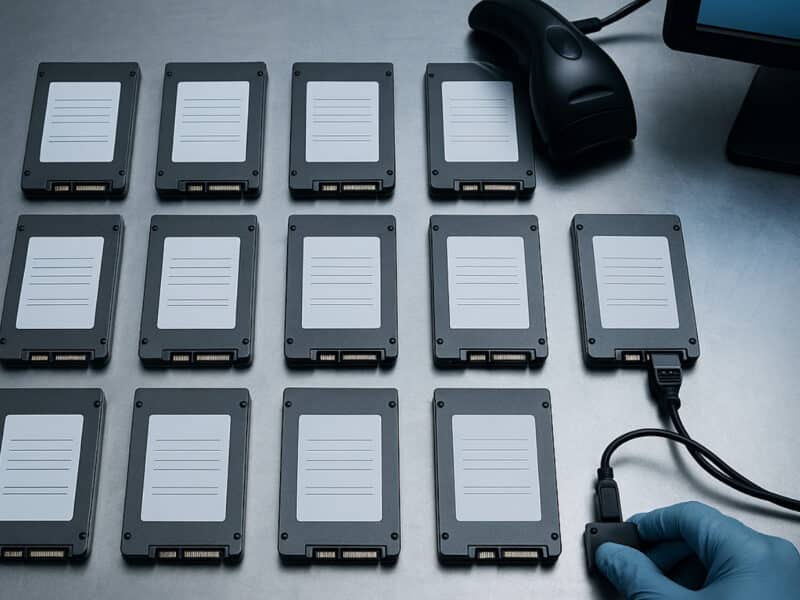
Why IT asset disposition became a critical market, not a back-office task
Modern data centers retire IT assets constantly. Servers get refreshed. Storage devices get pulled. Network gear gets swapped as requirements shift. In large environments, this is routine. It is also where risk shows up.
Retired assets still contain sensitive data. They often still contain recoverable value. And if they are handled casually, they can create real exposure, from compliance issues to avoidable waste.
That is why the data center IT asset disposition market exists.
IT asset disposition, usually shortened to ITAD, covers the controlled exit of equipment from production. In data center environments, it goes beyond recycling and beyond destruction. It is data sanitation you can prove, chain of custody you can defend, and disposition outcomes that align with both regulatory compliance and value recovery.
Done well, ITAD reduces breach risk, supports circular economy practices, and helps organizations recover value that would otherwise be written off. Done poorly, it creates the kind of “one small miss, big consequences” problem nobody wants to explain later.
Next, it helps to get specific about what the market actually includes.
Understanding the data center ITAD market

At its simplest, IT asset disposition describes what happens to IT assets after they are removed from active use. In data center environments, that definition needs to be much tighter.
The data center IT asset disposition market exists to manage the controlled exit of infrastructure at scale. That includes protecting data, meeting regulatory and environmental obligations, and deciding whether assets should be reused, recovered, or permanently destroyed. It is not a final cleanup step. It is a distinct phase of the asset lifecycle with its own risks and consequences.
For data center operators, disposition begins before equipment ever leaves the floor. Assets must be identified accurately. Data-bearing components must be separated from non-storage hardware. Movement must be tracked. Outcomes must be documented in a way that holds up under audit.
That combination of scale, sensitivity, and proof is what separates IT asset disposition from general recycling or waste management. The market has grown around the need to reduce risk first, then recover value where possible.
What IT asset disposition includes in practice
Modern IT asset disposition services bring several functions together into a single, controlled workflow.
The starting point is data sanitation. Storage devices must be cleared using approved data erasure methods that align with internal policy and external data security regulations. In data center environments, the ability to prove data erasure is just as important as the erasure itself. Serialized reporting and certificates are now expected, especially for large enterprises and regulated industries.
When data erasure is not viable, secure data destruction becomes necessary. This may be due to asset condition, encryption status, or policy requirements. Destruction removes data risk, but it also eliminates any remaining asset value. For that reason, many operators now treat destruction as a last step rather than the default outcome.
Asset recovery and resale form another core part of the market. Servers, GPUs, SSDs, and other components often retain meaningful secondary market value when they are tested, certified, and handled correctly. In high-volume programs, recovery decisions can materially affect the overall economics of decommissioning.
Responsible disposal and e-waste management remain essential for assets that cannot be reused. Materials must be processed in line with environmental regulations and circular economy practices to avoid regulatory exposure and environmental harm.
Holding all of this together is chain of custody. Tracking assets from removal through final disposition reduces loss, limits exposure during transport, and provides the documentation needed for audits and compliance review. Without that visibility, even well-intentioned programs can become difficult to defend.
Why data center assets shape a distinct market
Data center IT assets behave differently from typical enterprise or end-user equipment, and the ITAD market has evolved around those differences.
Scale is the most obvious factor. Hyperscale and large enterprise data centers retire assets in volume, often across multiple locations at once. Processes that work for small batches do not survive that level of throughput.
Sensitivity is just as important. Data center assets are far more likely to include high-density storage devices and infrastructure components that carry significant data security risk if mishandled. The impact of a single failure is magnified.
Value density also plays a role. Many data center components retain recoverable value well beyond their primary service life. Treating all retired assets as waste increases cost and environmental impact at the same time.
Finally, regulatory exposure is higher. Data center operators operate under strict data protection regulations, contractual requirements, and audit expectations. Disposition failures tend to surface quickly and carry real consequences.
Taken together, these factors explain why the data center IT asset disposition market has become a specialized segment with its own service models, certifications, and operational standards. They also explain why market growth closely follows data center expansion and refresh activity.
That growth, and what it signals for operators, is the next piece of the story.
Market size and growth outlook

The IT asset disposition market has expanded steadily over the past decade, but its recent momentum is closely tied to the way data center infrastructure is evolving. As capacity scales and refresh cycles shorten, more IT assets exit service every year, and each one brings data, value, and compliance obligations with it.
That reality is what underpins market growth.
You can debate exact figures or methodologies. What matters operationally is direction. Global data center build-out continues, hyperscale environments are refreshing equipment more frequently, and regulatory expectations around retired IT assets are rising. The asset disposition market grows because those inputs keep increasing.
Growth follows infrastructure, not headlines
Data centers are being built, expanded, and modernized to support cloud services, AI workloads, and increasingly dense compute environments. Each of those changes accelerates hardware turnover.
Servers, storage devices, and network equipment are cycled out not because they have failed, but because efficiency, performance, or power requirements have shifted. As a result, asset lifespans shorten and the volume of retired IT assets rises year over year.
For data center operators, this means IT asset disposition is no longer an occasional event. It is a continuous operational function that scales alongside infrastructure investment. Market growth mirrors that reality.
Why this growth is structural
The current growth trajectory of the IT asset disposition market is not driven by short-term demand spikes. It reflects long-term changes in how data centers are designed and governed.
Hardware refresh cycles continue to compress. Data security regulations extend responsibility beyond active systems to include retired assets. Environmental and sustainability commitments increasingly apply to end-of-life outcomes, not just procurement.
None of these pressures are likely to reverse. Together, they create sustained demand for IT asset disposition services that can operate at scale, across regions, and under consistent standards.
This is why the market continues to expand even when other parts of the technology sector fluctuate. Asset disposition sits downstream of infrastructure growth, not discretionary spending.
What the growth outlook signals for operators
For data center operators, market growth is less about opportunity and more about expectation.
As volumes increase and oversight tightens, informal or fragmented disposal practices become harder to justify. Programs that rely on manual tracking, inconsistent documentation, or default destruction tend to create hidden cost and risk over time.
By contrast, organizations that treat IT asset disposition as part of asset lifecycle management gain better visibility, stronger audit posture, and more control over environmental impact. They are also better positioned to recover value from retired IT assets rather than writing it off.
The market’s growth signals a shift in how ITAD should be approached internally. It is moving from an operational afterthought to a required capability.
Understanding why that shift is happening requires a closer look at the specific forces driving demand, starting with data security.
What’s fueling the demand for data center ITAD
The growth of the data center IT asset disposition market is not being driven by a single trend. It is the result of several pressures converging at the same time, each reinforcing the others. Together, they have made informal or inconsistent disposal practices increasingly difficult to defend.
Data security remains the primary driver

Data security concerns continue to sit at the center of ITAD demand.
Retired IT assets, particularly storage devices, remain a persistent source of exposure. Drives removed from service can still contain readable data, even after systems are powered down or decommissioned. In large data center environments, where thousands of assets may exit service during a single refresh cycle, that risk scales quickly.
The problem is rarely widespread failure. It is usually a small miss. One overlooked drive, one undocumented handoff, or one incomplete erasure can result in a data breach with outsized consequences.
As a result, secure data sanitation and verified data erasure have become baseline requirements. Organizations are no longer satisfied with assurances that data was wiped. They expect proof that links individual assets to documented outcomes.
At data center scale, that level of proof depends on purpose-built systems for inspection, tracking, and verification, such as Reconext’s data center recovery tooling.
This expectation has pushed many operators toward certified ITAD providers with mature, auditable processes designed to reduce risk at scale.
Regulatory compliance and enforcement pressure
Regulatory pressure has amplified data security concerns and extended them across the entire disposition process.
Data protection regulations increasingly hold organizations accountable for how retired IT assets are handled, not just how active systems are protected. Failure to implement secure disposal practices can be interpreted as a failure of data protection obligations.
For global data center operators, regulatory fragmentation adds complexity. Requirements for data destruction, recycling, and reporting vary by region. In practice, this often means designing programs to meet the most stringent applicable standard everywhere, rather than tailoring processes country by country.
This environment favors IT asset disposition services that are built for consistency and audit readiness. Providers that cannot demonstrate regulatory alignment or produce defensible documentation struggle to scale with large, distributed operators.
Sustainability expectations and environmental accountability
Sustainability has become an operational requirement rather than a branding exercise.
E-waste management failures now carry real environmental and reputational risk, particularly for large enterprises and hyperscale data centers that face public and regulatory scrutiny. At the same time, circular economy initiatives are influencing how organizations think about asset lifecycles and end-of-life decisions.
These pressures have shifted expectations around IT asset disposition. Organizations are increasingly expected to show that retired IT assets are handled responsibly, with reuse and recovery prioritized wherever possible.
This has driven demand for ITAD models that support sustainable asset recovery and reduce unnecessary destruction, while still meeting data security and compliance requirements.
Shorter hardware lifecycles increase volume
Hardware lifecycles in data centers continue to shorten.
Performance requirements, energy efficiency targets, and workload specialization all contribute to faster refresh cycles. Equipment is often retired while it is still functional, simply because it no longer meets evolving infrastructure needs.
As asset volumes increase, the consequences of inefficient or poorly controlled disposition become more visible. Manual processes and fragmented workflows struggle to keep up, increasing both risk and cost.
This shift has made scalable IT asset disposition services essential for organizations managing large and continuous asset flows.
Residual value and the economics of asset recovery
At the same time that volumes rise, the residual value of many data center assets remains significant.
GPUs, SSDs, servers, and other components often retain strong secondary market demand when tested and processed correctly. Treating all retired assets as waste leaves that value unrealized and increases the total cost of infrastructure refresh programs.
This economic reality has changed how many organizations view ITAD. Asset recovery is no longer a secondary benefit. It is a key factor in offsetting capital investment and supporting more sustainable lifecycle management.
Together, these forces explain why demand for data center IT asset disposition services continues to grow. They also set the stage for how the market is responding in practice.
That response is visible in the trends reshaping ITAD today.
Key trends reshaping the ITAD market
As demand for IT asset disposition services grows, the market is changing in practical, observable ways. These shifts reflect what happens when ITAD moves from the margins of operations into a governed, repeatable function tied directly to risk and value.
The trends reshaping the market are less about novelty and more about discipline.
The shift from shred-first to reuse-first
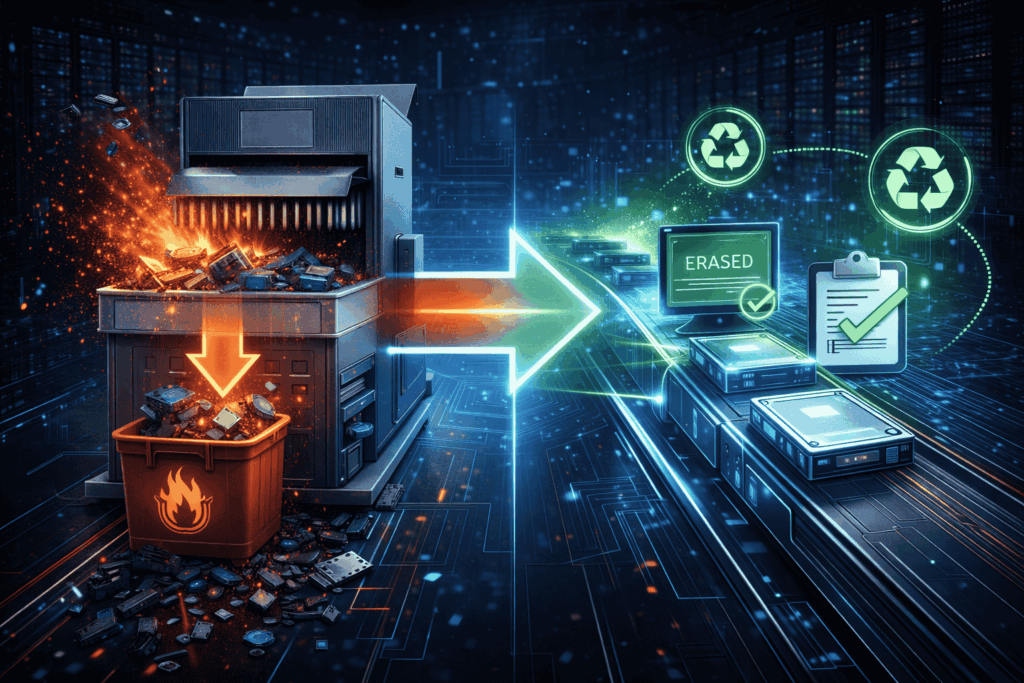
One of the most important changes in the ITAD market is the move away from default destruction.
For years, physical destruction was treated as the safest option for data center assets. It eliminated data risk, but it also eliminated any remaining asset value and increased environmental impact. As data erasure standards improved and verification became more reliable, that tradeoff became harder to justify.
Reuse-first approaches now prioritize secure data sanitation, functional testing, and certification before destruction is considered. Assets that can be safely reused or resold are returned to circulation. Only assets that fail security, condition, or policy thresholds are destroyed or recycled.
This shift aligns security, sustainability, and economics. When implemented correctly, reuse-first models reduce risk while preserving value rather than forcing a choice between the two.
Documentation and audit readiness as core requirements
Another defining trend is the elevation of documentation from administrative task to operational requirement.
Data center operators increasingly expect ITAD programs to produce clear, defensible records that link each asset to a verified outcome. This includes certificates of data erasure or destruction, serialized asset reporting, and consistent documentation across sites and programs.
Audit readiness is no longer limited to regulated industries. It has become a standard expectation for large enterprises and global operators managing high volumes of retired IT assets.
As a result, ITAD providers are being evaluated not just on technical capability, but on their ability to produce reliable, reviewable proof at scale.
Chain of custody as an operational control
Chain of custody has shifted from a logistics concern to a primary risk control.
In high-volume ITAD programs, assets move through multiple stages, facilities, and hands. Each transition introduces the possibility of loss, mishandling, or incomplete documentation.
Robust chain-of-custody systems reduce that exposure by providing continuous visibility into asset location, status, and responsibility. This visibility supports data security, simplifies compliance, and makes exception handling more manageable when issues arise.
For data center operators, chain of custody is increasingly viewed as infrastructure, not an add-on.
Circular economy models move from theory to practice
Circular economy principles are now shaping how ITAD programs are designed, not just how they are described.
Extending asset lifespans, recovering valuable materials, and minimizing waste deliver tangible financial and environmental benefits at data center scale. These outcomes are no longer limited to pilot programs or sustainability initiatives. They are being integrated into mainstream asset lifecycle management.
In practice, this means greater investment in asset upcycling services, component-level recovery, and structured resale programs that operate alongside secure disposal workflows.
Geographic expansion and standardization pressure
The ITAD market is also becoming more global. Supporting those programs requires ITAD partners with established global recovery operations and the ability to apply consistent standards across regions.
Growth in hyperscale data centers and digital infrastructure continues across APAC, the Middle East, and other emerging regions. At the same time, multinational operators are working to standardize IT asset disposition practices across their global footprints.
This creates pressure for ITAD providers to operate consistently across borders while navigating different regulatory and recycling environments. Programs that rely on region-specific workarounds become harder to manage as scale increases.
As a result, global consistency is emerging as a competitive advantage in the ITAD market.
Challenges the market still faces

Even as the IT asset disposition market matures, several challenges continue to limit consistency and scalability. These are not edge cases. They are the points where programs tend to strain under volume, complexity, or regulatory pressure.
Understanding these constraints helps explain why outcomes vary so widely across organizations, even when intentions are aligned.
Data sanitization at scale remains difficult
Data sanitation is still one of the hardest parts of IT asset disposition to execute reliably at scale.
Data center environments contain a wide mix of storage devices, interfaces, and configurations. Asset condition can vary significantly, even within the same refresh cycle. Some devices support secure data erasure cleanly. Others fail partway through the process or cannot be erased due to hardware or policy limitations.
As throughput increases, the risk shifts from technical capability to process control. Identifying every data-bearing asset, applying the correct erasure method, and verifying outcomes consistently requires industrialized workflows, purpose-built tooling, and tight chain-of-custody discipline. Manual checks and fragmented processes struggle to keep up.
This complexity is one of the main reasons organizations move away from informal, in-house, or lightly automated disposal approaches as volumes grow, and toward ITAD programs designed specifically for data center scale.
Regulatory fragmentation creates operational friction
Regulatory requirements around data protection, recycling, and reporting remain fragmented across regions.
For global data center operators, this creates a practical challenge. Different jurisdictions impose different rules on data destruction, environmental handling, and documentation. In some cases, requirements overlap. In others, they conflict.
Most organizations respond by designing programs to meet the strictest applicable standard across their footprint. While this reduces compliance risk, it also increases operational complexity and cost.
Providers that lack experience navigating these differences often struggle to support global programs consistently, leading to gaps that surface during audits or reviews.
Logistics and chain-of-custody risk persist
Physical movement remains one of the most exposed stages of IT asset disposition.
Once assets leave the data center floor, they pass through multiple hands and locations. Each transfer introduces the potential for loss, damage, or incomplete documentation. At scale, even small inconsistencies can become difficult to trace.
Cross-border logistics add further complexity, including customs processes, security controls, and varying standards for handling electronic assets. Without robust tracking and accountability, these factors increase both data security and compliance risk.
This is often where otherwise well-designed ITAD programs encounter their greatest stress.
Taken together, these challenges explain why navigating the IT asset disposition market effectively requires more than good intentions. It requires deliberate program design, clear ownership, and partners capable of operating under real-world constraints.
That brings the focus to what data center operators can do to engage the market more effectively.
How enterprises can navigate the ITAD market more effectively
As the IT asset disposition market grows more complex, the difference between strong programs and fragile ones usually comes down to how deliberately they are designed. For data center operators, navigating the market effectively is less about optimizing for cost and more about controlling risk, maintaining visibility, and preserving value across the asset lifecycle.
Choose ITAD partners built for data center scale
Not all ITAD providers are equipped to handle data center environments.
Data center operators should prioritize partners with experience managing high-volume, high-sensitivity infrastructure assets. That includes familiarity with hyperscale and large enterprise data centers, complex refresh cycles, and programs where thousands of assets may be retired in a compressed window.
More importantly, partners should be able to demonstrate how their processes work in practice. This includes how data-bearing assets are identified, how chain of custody is maintained across locations, and how documentation is produced at scale. The goal is not just capability, but consistency under load.
In effective programs, the ITAD provider operates as an extension of data center operations rather than a downstream vendor that introduces uncertainty.
Look beyond certifications alone
Certifications matter, but they are not a substitute for operational discipline.
Certified ITAD service providers typically align with recognized standards for data security, environmental handling, and process control. These certifications help establish baseline expectations and reduce risk during vendor selection.
That said, certifications should be treated as a starting point. Data center operators still need to understand how certified processes are implemented day to day, across different sites and asset types. Inconsistent execution can undermine even well-documented standards.
The most reliable programs combine formal certification with transparent workflows and reporting that can be reviewed and challenged when needed.
Treat chain of custody as a control layer
Chain of custody is one of the most important controls in any data center ITAD program.
Knowing where assets are at each stage of disposition reduces exposure during transport, storage, and processing. It also provides the documentation needed to respond confidently to audits, internal reviews, or incident investigations.
Effective chain-of-custody systems track assets from removal through final disposition, capturing each handoff and action in a way that can be verified. This visibility supports data security and compliance while also improving coordination across teams.
For data center operators, chain of custody should be treated as infrastructure, not overhead.
Design programs to capture value, not just avoid risk
Navigating the ITAD market effectively also means recognizing the economic dimension of disposition decisions.
Many retired data center assets retain meaningful value when handled correctly. Servers, storage devices, GPUs, and components can often be reused or resold when they pass security and condition thresholds.
Organizations that integrate IT asset disposition into broader asset lifecycle management are better positioned to make these decisions deliberately. They can balance reuse, resale, and destruction based on risk, value, and sustainability goals rather than defaulting to a single outcome.
Over time, this approach reduces total cost of ownership, supports circular economy practices, and turns ITAD into a contributor rather than a necessary expense.
With these disciplines in place, organizations are better prepared for what comes next as the market continues to evolve.
The future of the data center ITAD market

The forces shaping the data center IT asset disposition market are not temporary. They are tied directly to how data center infrastructure is built, refreshed, and governed. As those systems scale, ITAD will continue to move closer to the center of operational planning.
The future of the market is likely to be defined less by new service categories and more by higher expectations around control, transparency, and consistency.
Regulation will continue to tighten
Data security and environmental regulations are unlikely to loosen. In many regions, they are still evolving.
As enforcement becomes more consistent and reporting requirements become more explicit, data center operators will be expected to demonstrate how retired IT assets are handled, not just state that they were disposed of responsibly. Informal processes and undocumented outcomes will become harder to defend.
This trend favors ITAD programs built around verifiable workflows, standardized documentation, and the ability to withstand scrutiny across regions and audits.
Automation and analytics will play a larger role
As asset volumes continue to rise, manual processes will become less sustainable.
Automation and analytics are increasingly being applied to asset identification, data sanitation workflows, and chain-of-custody tracking. The goal is not novelty, but control. Better visibility, fewer handoffs, and more consistent execution at scale.
Over time, these capabilities are likely to improve decision-making around reuse, resale, and disposal by helping organizations assess asset condition and risk more reliably.
For large data center environments, this kind of operational intelligence will be necessary to maintain consistency without adding friction.
Sustainability and reuse will become the default
Sustainability expectations are continuing to move upstream into operational decisions.
Reuse-first approaches, asset recovery programs, and responsible disposal methods are becoming standard practice rather than optional enhancements. As circular economy practices become more embedded in enterprise governance, IT asset disposition outcomes will play a more visible role in environmental reporting and performance measurement.
For data center operators, this means disposition strategies will increasingly be evaluated alongside procurement, deployment, and refresh planning.
Secondary markets will continue to expand
Demand for refurbished and redeployed IT equipment is expected to grow alongside global digital infrastructure.
Emerging markets, in particular, continue to rely on tested, certified IT assets to support expansion. This creates ongoing opportunities for value recovery when ITAD programs are designed to support reuse and resale at scale.
For global operators, consistency across regions will be critical. Programs that can apply the same standards, controls, and documentation everywhere will be better positioned to participate in these markets without increasing risk.
Conclusion
The data center IT asset disposition market is growing because the responsibilities tied to retired IT assets have grown with it. Data security concerns, regulatory compliance requirements, and sustainability expectations have reshaped how disposition is managed and why it matters.
For data center operators, the takeaway is practical. Organizations that approach IT asset disposition deliberately reduce exposure to data breaches, improve audit readiness, and recover more value from retired assets. Those that treat it as an afterthought often inherit unnecessary risk and cost.
As the market continues to mature, verified, reuse-first approaches are becoming the norm. IT asset disposition is no longer a peripheral function. It is a core part of asset lifecycle management in modern data center environments.
Organizations looking to manage this transition securely and at scale can learn more about Reconext’s approach to data center decommissioning.