Banks routinely refresh tech assets like laptops, servers, and storage devices to maintain security and regulatory compliance. But retiring IT assets isn’t as simple as just removing them from service.
Decommissioned devices may contain sensitive customer information or proprietary business data. Without proper controls, a single oversight during disposal risks damaging security and consumer trust.
This is why many financial institutions invest in bank-specific ITAD solutions. These specialized services help organizations securely track, sanitize, remarket, recycle, and dispose of retired equipment while maintaining a documented chain of custody and supporting regulatory requirements.
In this article, we’ll explore the key components of an effective ITAD solution for banks and what financial institutions should look for when selecting an ITAD provider.
Key Takeaways
- Since financial institutions handle highly sensitive customer information, banks must use specialized ITAD vendors that guarantee a documented chain of custody and certified data destruction to comply with strict laws such as GLBA and SOX.
- An effective ITAD program also helps banks recoup funds by refurbishing and remarketing enterprise-grade hardware.
Why Banks Need Specialized ITAD Solutions
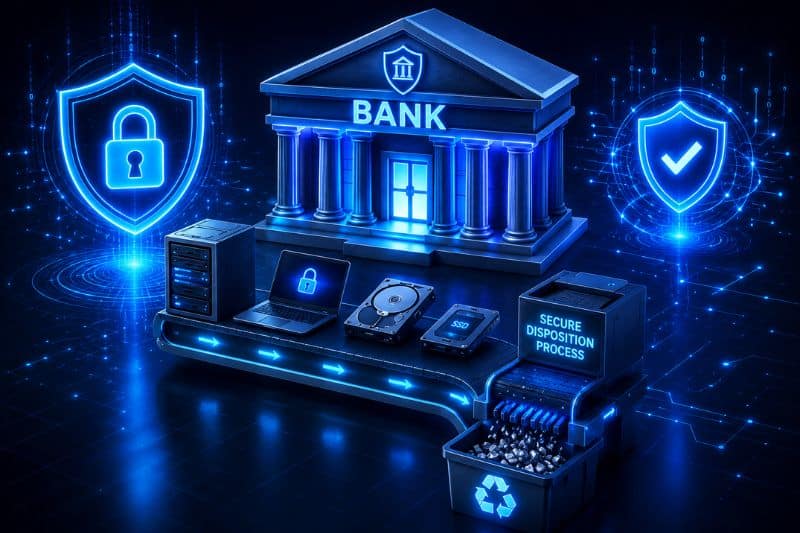
Banks need specialized ITAD solutions because they operate in one of the most heavily regulated industries in the world. Retired IT assets often contain sensitive customer information and financial data that must be handled securely throughout the disposition process.
Financial institutions must also comply with regulations such as the Gramm-Leach-Bliley Act (GLBA), Sarbanes-Oxley Act (SOX), and SEC regulations, all of which place strict expectations on data protection, recordkeeping, and risk management. As a result, banks need ITAD providers that understand these requirements and can support compliance through documented processes, secure data destruction, and comprehensive reporting.
In addition to security and compliance concerns, banks frequently manage large volumes of retired equipment across branches, offices, and data centers spanning multiple countries. When different regional vendors handle disposition, chain-of-custody documentation fragments, compliance standards vary, and audit trails become harder to defend. Financial institutions need a single ITAD partner with genuine global reach, like Reconext, which operates across 22 locations worldwide, to maintain consistent processes and documentation standards regardless of where assets are retired.
Finally, many retired banking assets still retain market value. Experienced ITAD providers can help banks maximize returns through refurbishment, remarketing, and responsible recycling programs, helping offset technology refresh costs while supporting sustainability initiatives.
What an Effective ITAD Solution for Banks Includes
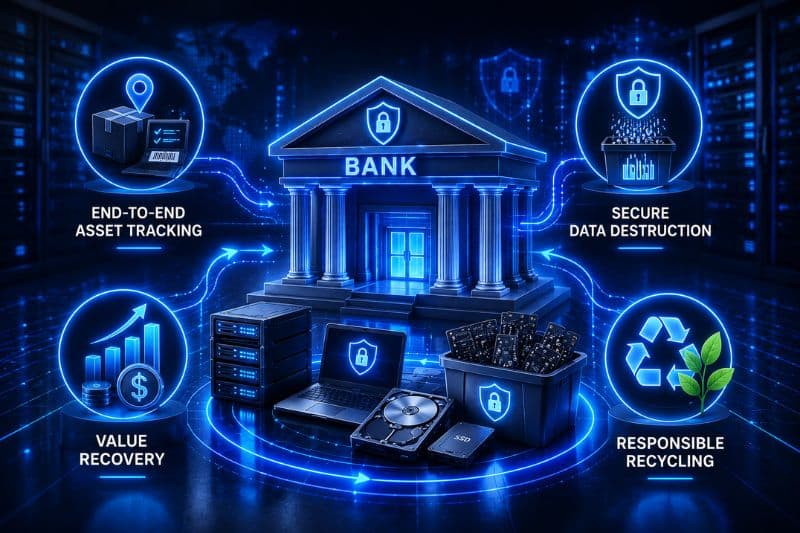
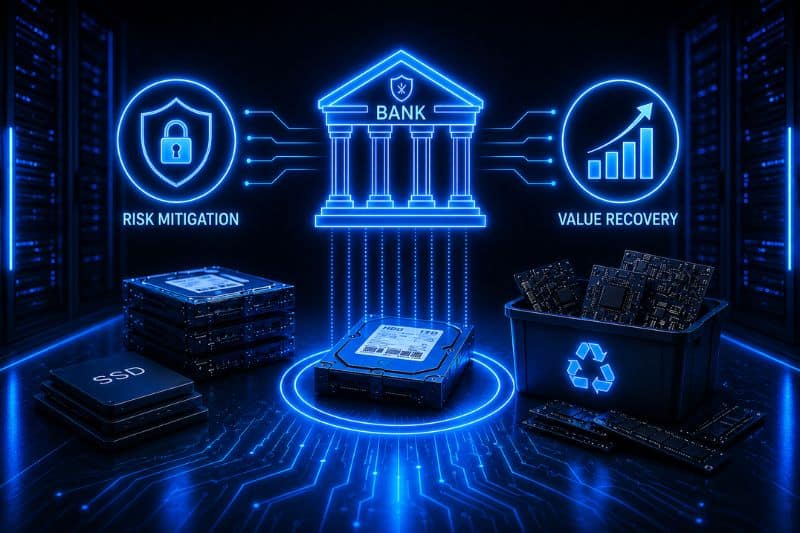
An effective ITAD solution for banks does more than securely dispose of retired equipment. It helps financial institutions manage retired equipment with less risk. Sensitive data is protected, compliance obligations are easier to meet, and remaining asset value can be recovered. From collection through final disposition, the equipment is handled in a controlled and responsible way.
End-to-End Asset Tracking
Banks need complete visibility into retired IT assets from the moment they leave service until their final disposition. Tracking helps identify the location, movement, and status of retired assets throughout the process. This is done using hardware tags and serialized tracking for extra visibility.
Reconext’s serialized audit logs connect asset tracking directly to erasure records, so the chain of custody documents not just where an asset was but what was done to it.
Through end-to-end asset tracking, banks can maintain a documented chain of custody from asset collection to final disposition.
Secure Data Destruction
Banks collect and store sensitive nonpublic personal information (NPI), which is strictly protected by privacy laws such as the Gramm-Leach-Bliley Act (GLBA). If this information is not completely destroyed, its leak could cause serious data security issues.
To eliminate this risk, ITAD providers use certified data destruction methods designed to make information permanently unrecoverable. The appropriate sanitization method depends on the device type and the organization’s security requirements. Lower-risk assets may be handled through data overwriting or crypto-erase. Higher-risk assets may require degaussing or physical destruction.
At Reconext, we perform enterprise drive erasure through Proteus and rack-level erasure through Rackwipe, both operating to NIST 800-88, IEEE 2883, and ISO 27001 standards.
Once the process is complete, banks should receive a Certificate of Destruction (CoD) documenting that the data was securely destroyed according to industry standards.
Value Recovery
Most banks retire laptops, mobile phones, monitors, and other IT equipment. All these devices can be refurbished or harvested for parts rather than thrown into landfills. The other major route to value recovery is asset remarketing.
The primary goal of value recovery is to maximize the financial return from retired IT assets before they are recycled or destroyed.
When banks refurbish laptops and resell them in secondary markets, they recover some of the initial purchase cost.
Responsible Recycling
To support sustainability goals, many banks choose responsible recycling as the final step in the ITAD process.
Responsible recycling focuses on managing electronic waste safely and in an environmentally conscious manner. Rather than sending retired equipment directly to landfills, ITAD providers follow the 3R framework (reduce, reuse, and recycle) to minimize waste and recover materials whenever possible.
How Bankers Choose an ITAD Provider

When choosing an ITAD partner, banks tend to look beyond price. They focus on how the provider manages risk throughout the process. The right partner must support regulatory compliance, protect sensitive data, maintain a documented chain of custody, and execute each stage reliably from collection through final disposition.
Most banks start by evaluating certifications. They make sure the vendor has credentials such as NAID AAA, R2v3, and ISO certifications, which indicate that the vendor follows a structured process that ensures data security throughout.
Vendors who have industry experience tend to be the best bet for most banks. They know that these vendors understand the strict regulations mandating data privacy in banking and the financial institution’s workflows.
Bankers also factor in transparent and detailed reporting when choosing an ITAD provider. Bankers require transparent reporting on the chain of custody succession, processes used, and anything else. These serve as critical documentation for audit readiness.
Conclusion
Managing retired IT assets in the financial sector requires more than secure disposal. Banks must protect sensitive customer data, meet regulatory requirements, maintain a documented chain of custody, and maximize value recovery wherever possible.
A specialized ITAD solution helps financial institutions achieve these goals while reducing risk throughout the asset disposition process. By partnering with an experienced, certified ITAD provider, banks can put a more controlled retirement process in place. That process strengthens data security, creates better support for audits, and helps preserve customer trust.
With more than 14 years of ITAD experience, Reconext provides the transparency, reporting, and chain-of-custody controls organizations need to manage retired IT assets with confidence. Learn how Reconext can help your institution securely and compliantly manage end-of-life IT assets.