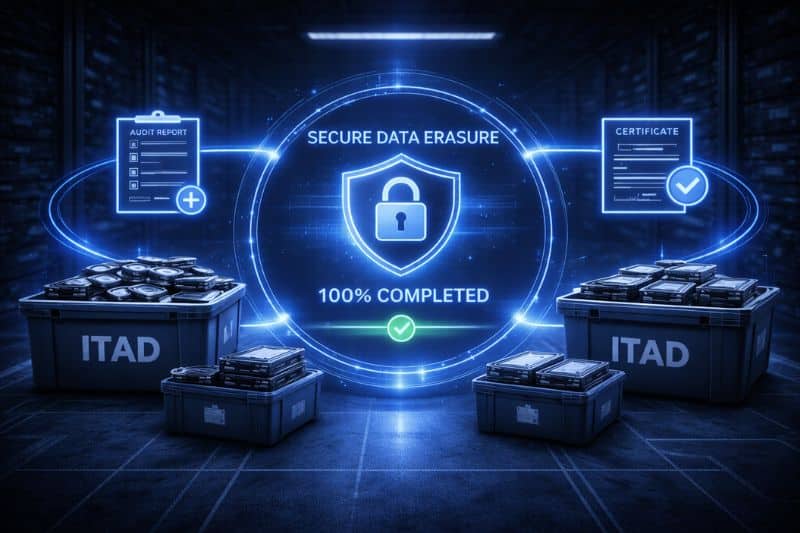
Sensitive data lives across every device in an organization’s fleet. Laptops, servers, mobile devices, and storage media all accumulate years of business-critical information. When those assets reach end-of-life, that data does not disappear on its own.
Retired IT equipment that leaves an organization without verified data removal can become a direct path to exposed sensitive information. A single breach tied to a discarded asset can trigger regulatory penalties, legal action, and lasting reputational damage that is difficult to contain.
This guide explains what ITAD data sanitization involves, where organizations typically fall short, and what a structured, compliant process looks like from first inventory through final certification.
What Is ITAD Data Sanitization?
IT Asset Disposition (ITAD) is the structured process of retiring, recycling, reselling, or destroying IT hardware at the end of its useful life. Data sanitization is the stage of that process dedicated to permanently removing data from storage devices before they leave an organization’s control.
A widely held assumption is that standard deletion is sufficient. Deleting files, performing a factory reset, or formatting a drive removes the file system’s reference to the data, not the data itself. With freely available recovery tools, that information can be retrieved by anyone who acquires the device afterward.
Proper sanitization makes data unrecoverable by any practical means. It follows recognized standards such as NIST SP 800-88 Rev. 2, produces verifiable results, and generates documentation that holds up under regulatory scrutiny. Organizations should also consider applicable regulatory and industry requirements.
For example, healthcare organizations subject to HIPAA must protect electronic protected health information (ePHI), while organizations operating in the European Union must comply with GDPR. Businesses certified to ISO/IEC 27001 should also follow documented information security controls for media handling and disposal. Standard deletion does not provide the level of assurance or documentation needed to support these requirements.
A well-executed ITAD data sanitization program protects customer information, employee records, financial data, and intellectual property throughout the full disposition lifecycle.
What Happens When Data Isn’t Properly Sanitized
Organizations that skip or underinvest in sanitization create exposure that can surface months or years after a device leaves the building. The risks are specific, and so are the failure points.
Incomplete wiping is one of the most common problems. Organizations that rely on operating system-level deletion or basic formatting utilities believe the job is done when it is not. Without overwrite protocols aligned to recognized standards, residual data remains on the drive and is recoverable using tools that require no specialized expertise.
Poor asset tracking creates blind spots in the disposition process. If an organization cannot account for every device from deployment through decommissioning, it cannot confirm sanitization was completed on every asset. A single untracked device containing sensitive data is a compliance liability until proven otherwise.
Lack of verification makes it impossible to confirm the wipe was successful. Completing a wipe process without validating the output produces no evidence that it worked. Regulated industries require that evidence. An unverified process gives auditors and regulators nothing to work with.
Unverified vendors may handle disposal, but your organization still owns the risk. Handing retired assets to a third-party provider without reviewing their certifications, processes, and chain-of-custody procedures does not transfer regulatory liability. If that vendor mishandles your devices and a breach occurs, the exposure stays with your organization.
The downstream effects of poor sanitization include data breaches, regulatory fines, civil liability, and the kind of reputational damage that takes years to recover from. A structured process addresses each of these failure points before they become incidents.

ITAD Data Sanitization Process and Methods
Effective ITAD data sanitization follows a defined sequence. Each stage builds on the one before it. Skipping steps introduces gaps that audits will surface and that bad actors can exploit.
Asset Inventory and Tracking
Sanitization begins before anyone touches a drive. Every device scheduled for retirement needs to be identified, logged, and assigned a unique identifier that follows it through the entire disposition process.
The inventory captures device type, serial number, asset tag, assigned user, location, and relevant history. This information establishes the chain of custody and makes it possible to confirm, at any point, that a specific device was processed by a specific method on a specific date.
Organizations processing large volumes of retired assets often automate inventory and chain-of-custody activities to improve accuracy and visibility. Reconext’s AI-powered Pegasus receiving platform captures device identity, serial numbers, and arrival condition while creating image-verified records at intake, reducing manual data entry. Reconext also uses RFID-enabled asset tracking to provide real-time visibility as assets move through the disposition process. Together, these technologies help maintain accurate inventory records and support documented chain of custody across the ITAD lifecycle.
Data Classification and Risk Assessment
Not every device carries the same level of risk, and sanitization decisions should reflect that difference. Before selecting a method, each asset is evaluated based on the type and sensitivity of the data it held.
A workstation used in a finance department presents different risks than a kiosk used for general office access. A server that stored patient health records requires a different approach than a device used only for internal scheduling. Applying the same method uniformly across all asset types wastes resources on low-risk devices and may underprotect high-risk ones.
This stage also maps compliance obligations to specific assets. Devices that fall under HIPAA, GDPR, or other regulatory frameworks may have sanitization, documentation, and reporting requirements defined by applicable regulations. Medical devices that store or process patient information require the same level of control, including secure data handling, documented chain of custody, and compliant disposition. Organizations managing these assets often work with medical device disposition providers like Reconext that maintain the quality management systems and certifications needed to process medical devices compliantly.
Selecting the Right Sanitization Method
Choosing a sanitization method requires matching the approach to the asset type, the sensitivity of the data, the intended disposition path, and applicable compliance requirements.
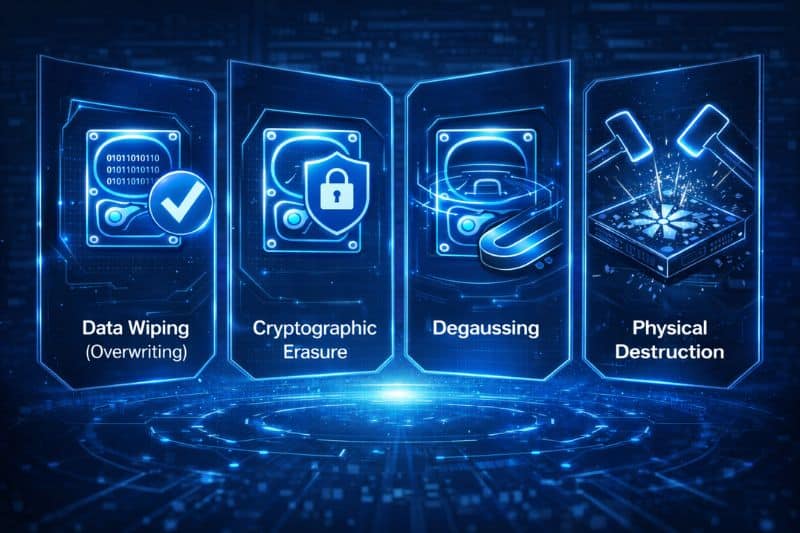
Each sanitization method serves a different purpose. Physical destruction is typically used for non-functional media or assets requiring permanent destruction. Data wiping supports the reuse or resale of compatible storage devices. Cryptographic erasure is well suited to encrypted storage, while degaussing is used for magnetic media such as hard disk drives and tapes. Organizations should select the method that aligns with their security, compliance, and operational requirements.
| Sanitization Method | Recommended For | Supports Reuse? | Typical Use Case |
| Data Wiping (Overwriting) | Functional hard drives | Yes | Devices being redeployed, refurbished, or resold |
| Cryptographic Erasure | Encrypted SSDs, self-encrypting drives, and mobile devices | Yes | Encrypted devices where encryption keys can be securely destroyed |
| Degaussing | Magnetic hard drives and tapes | No | Retirement of magnetic media |
| Physical Destruction | Failed drives or highly sensitive assets | No | Non-functional or highly sensitive assets |
Data Wiping (Overwriting)
Software-based overwriting replaces existing data with patterns of ones, zeros, or random characters across every addressable location on the drive. Depending on the standard applied, this may run in multiple passes. NIST SP 800-88 Rev. 2 provides guidance on media sanitization based on media type and risk level.
Overwriting is appropriate for functional HDDs intended for reuse or resale. After the process completes, a read-verify pass confirms the overwrite pattern is present and that original data cannot be reconstructed. That verification output becomes part of the compliance record.
This method is less reliable for solid-state drives. SSDs manage writes differently at the hardware level, which means standard overwrite tools may not reach every addressable memory location.
Cryptographic Erasure
Cryptographic erasure works by destroying the encryption key used to protect data on a device rather than overwriting the data itself. When the key is permanently deleted, the remaining ciphertext is computationally unrecoverable by any practical means.
This method is well-suited to SSDs, NVMe drives, self-encrypting drives, and mobile devices where full-disk encryption was applied from the start. It is also practical in cloud environments where physical overwriting is not an option.
The prerequisite is that encryption must have been in place before sanitization begins. Cryptographic erasure applied to unencrypted storage provides no data security benefit.
Degaussing
Degaussing exposes magnetic storage media to a powerful electromagnetic field that disrupts the magnetic domains used to store data, rendering the drive permanently unreadable. It is effective for HDDs and magnetic tape.
The limitations are significant. Degaussing destroys the drive’s firmware along with its data, meaning the device cannot be reused, resold, or verified after the process. It also has no effect on SSDs, USB drives, or optical media, since those formats do not store data magnetically.
Degaussing suits scenarios where magnetic media needs to be retired with no intent of reuse, or as an additional assurance step before physical destruction in high-security environments.
Physical Destruction
Shredding, crushing, and disintegration reduce storage devices to fragments too small to read or reassemble. Industrial shredders can reduce hard drives to particles measured in millimeters. Crushing deforms platters and memory chips beyond any possibility of recovery. Disintegration is reserved for assets requiring the highest security classifications.
Physical destruction is required when a drive is non-functional and cannot be wiped, when data classification demands absolute certainty, or when an asset has no remaining reuse or resale value. Organizations with sustainability goals should apply physical destruction selectively rather than as a blanket default, since it eliminates any opportunity for responsible recycling or value recovery.
Verification and Validation
Completing a sanitization step and confirming it was successful are two separate requirements. Verification is what connects them.
For overwriting, verification involves a read-pass over sanitized sectors to confirm the overwrite pattern is present and original data is absent. For higher-sensitivity assets or regulated environments, independent forensic validation may be required, where a third party attempts data recovery using specialized tools to confirm irrecoverability.
In high-volume programs, validating every individual device may not be practical. Statistically representative sampling protocols allow organizations to test a meaningful portion of a batch and confirm the process performed consistently across all assets.
Verification outputs are captured as part of the compliance record. A sanitization event that cannot be verified provides no defensible evidence during an audit or legal proceeding.
Documentation and Certification
Every stage of the sanitization process needs to be captured in an auditable record. That record includes the asset inventory, data classification, sanitization method applied, the technician or system that performed the work, the date and location, and the verification outcome.
Certificates of data destruction are issued for each device or batch, confirming sanitization was completed according to a named standard. For physically destroyed assets, a certificate of destruction serves the same function.
These documents are what regulators, auditors, and clients request when reviewing end-of-life data handling practices. Organizations that treat documentation as secondary often find during an audit that they cannot account for hundreds of decommissioned devices, and no amount of retroactive explanation fills that gap.
Should You Handle ITAD In-House or Outsource It?
Organizations can manage data sanitization internally or work with a specialized ITAD provider. The right approach depends on asset volume, internal capacity, and the regulatory environment the organization operates in.
An in-house program gives direct control over the process and chain of custody. For organizations with a small, predictable asset volume and existing compliance infrastructure, this can be a workable option. The challenge is sustaining it. Certified wiping software, physical destruction equipment, trained personnel, audit-ready documentation, and ongoing alignment with standards like NIST 800-88 Rev. 2 all carry real cost and require dedicated attention.
Outsourcing to a certified ITAD partner shifts execution to specialists with that infrastructure already in place. A provider holding certifications such as R2, e-Stewards, or NAID AAA has been independently audited against recognized standards for data security and environmental responsibility. Chain-of-custody documentation, certificates of destruction, and compliance reporting come as part of the service rather than as additional overhead your team has to build and maintain.
For organizations managing large fleets across multiple locations or operating under strict compliance requirements, certified ITAD providers with automated test solutions and multiple service locations can deliver consistent processing, standardized reporting, and scalable support across sites.

Conclusion: Secure Data Beyond Device Lifespan
Retiring an IT asset does not end the responsibility to protect the data it contains. Decisions made during decommissioning determine whether sensitive information remains secure or becomes a future liability.
A structured ITAD data sanitization program covers every stage from inventory and classification through method selection, verification, and documentation. It protects the organization from breaches, satisfies regulatory requirements, and produces the auditable evidence that compliance frameworks demand. Treating end-of-life devices as a low-priority operational task creates exposure that can surface long after the hardware is gone.
If you’re looking to reduce risk and ensure compliance at scale, working with a trusted ITAD partner like Reconext can provide the expertise, infrastructure, and certification required to manage the process end-to-end. Contact Reconext to learn how our ITAD solutions can support your organization.