


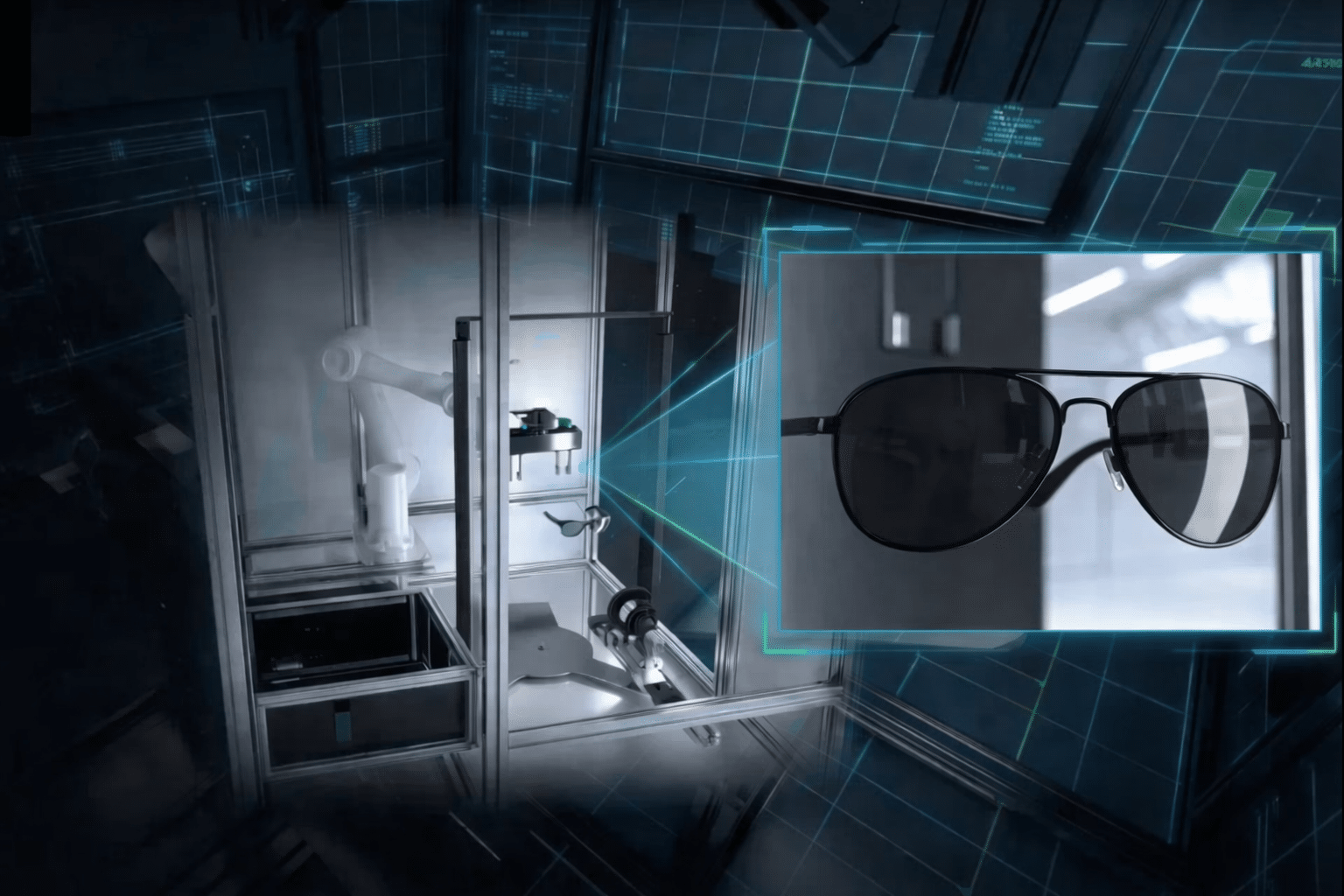
Digital twins have already become standard practice in the most demanding engineering environments in the world. Automotive manufacturers simulate crash physics before building a prototype. Semiconductor fabs model production lines before installing a single machine. Aerospace companies run virtual stress tests before a component reaches the factory floor.
The organizations that simulate first and build second make better decisions, move faster, and spend less.
Reconext has brought that same discipline into the electronics lifecycle services industry. Using NVIDIA Omniverse, Reconext has built a high-fidelity digital engineering environment connecting product design, inspection system development, automation validation, and AI training into a single photorealistic virtual world, and has been using it to deliver programs for clients today.
Design, Test, and Optimize Before It Exists
In electronics manufacturing and lifecycle services, engineering programs tend to follow the same costly arc: a new product arrives, a setup is designed, and equipment is ordered and built. Then the real learning can begin.
A camera angle produces a blind spot. A lighting configuration generates reflections that obscure defects. A robotic arm falls short of its required range.
Each discovery triggers a rework loop: diagnose, modify, rebuild, retest. Every iteration consumes engineering hours, delays timelines, and requires material expenditure that produces no lasting value.
When AI-based inspection systems enter the picture, the effect compounds further. Those systems depend on training data that can only come from running production, so AI development is locked out until hardware is already operational, pushing launch readiness even further down the timeline.
This is the model Reconext has moved beyond.
A Digital Twin Simulation Environment That Reflects Reality
The foundation of this capability is the fidelity of Reconext’s virtual models. NVIDIA Omniverse uses physically based rendering, meaning light, shadow, reflection, and material behavior follow the same optical laws that govern the real world.
That means a brushed aluminum laptop lid reflects light, a glass lens refracts, or a matte plastic surface scatters. Engineers can make real design decisions from what they see on screen, with confidence rather than assumption.
Reconext builds two categories of digital twins: machine twins, which are virtual replicas of test equipment, inspection cells, and automation systems, and product twins, which are high-fidelity models of customer devices capturing precise geometry and optical response.
Together, these two layers allow Reconext to simulate the complete interaction between a product and the systems designed to handle and inspect it, before either one exists in physical form. Engineering decisions that once required physical hardware can now be made entirely in simulation.
| -40% Reduction in prototype and setup cost |
+30% Faster new product introduction cycles |
95% First-pass success rate at physical deployment |
Four Capabilities, One Connected Environment
The Omniverse environment serves as a connective layer across four engineering disciplines that have historically operated in isolation.
| Vision System Design Camera placement, lens selection, lighting configuration, and reflection control all validated in simulation before hardware is specified. |
Automation Validation Robot motion, cell layout, clearance, and sequencing verified virtually before capital is committed to physical installation. |
| Synthetic Data Generation Scalable AI training datasets produced from photorealistic defect rendering, eliminating dependence on rare physical failure samples. |
Virtual Prototyping New product introduction cycles compressed through early simulation, reducing physical iterations and accelerating program readiness. |
1. Vision System Design and Optimization

Camera-based inspection performance depends on the precise interaction of camera placement, lens selection, lighting angle, and surface reflectivity. Under a traditional approach, all of that is tuned physically, iteratively, and expensively.
Inside the Omniverse environment, Reconext engineers test every meaningful variable before hardware is ordered. Camera positions are evaluated against realistic product surfaces, lighting is tuned until reflection artifacts are eliminated, and fixture concepts are assessed for clearance and accessibility.
By the time a physical inspection cell is built, its optical configuration has already been proven in simulation. This is one of the ways our digital twin capability strengthens programs across testing and grading and beyond.
2. Automation Cell Validation
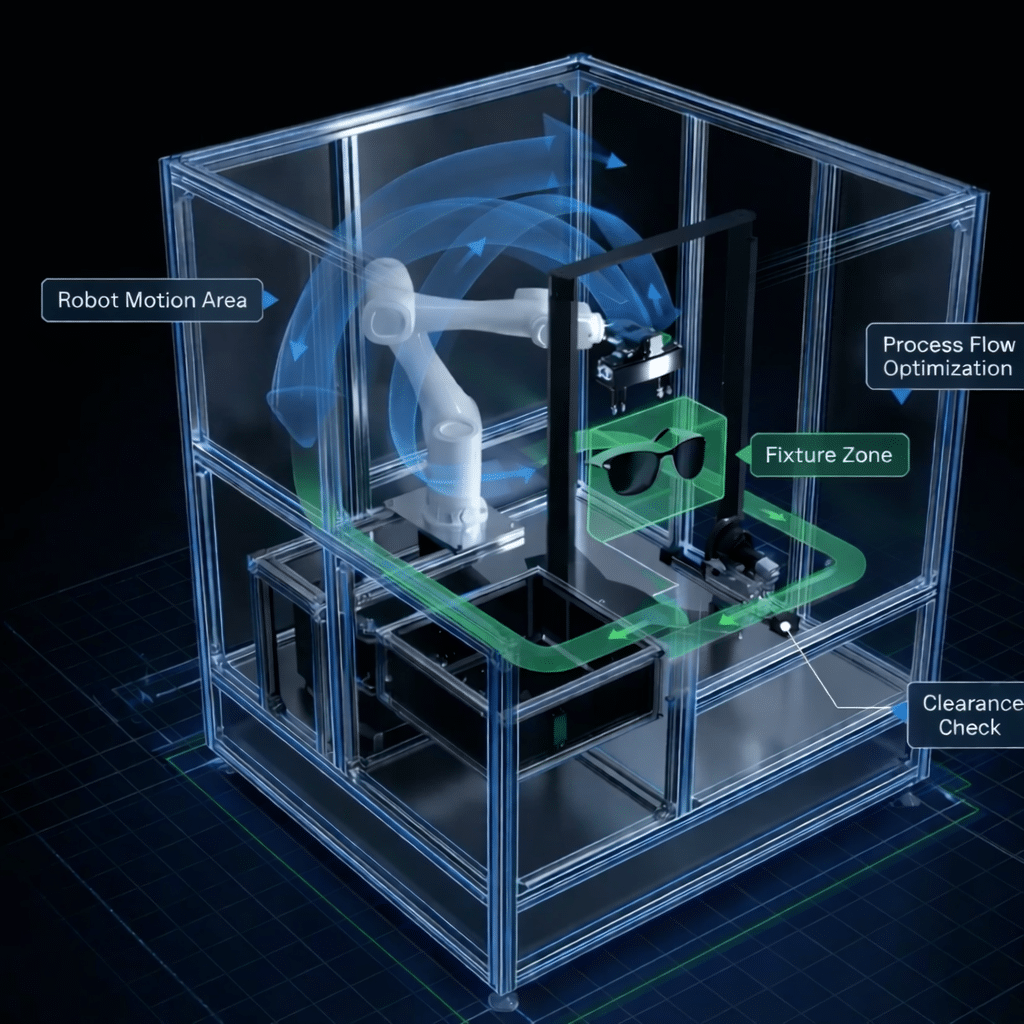
Robotic automation requires that arms reach every position without collision, that machines sequence correctly without interference, and that cell layouts provide adequate access for maintenance and product flow. These interactions are difficult to anticipate on paper and traditionally surface only during physical integration, when the cost of fixing them is already significant.
In the Omniverse environment, complete automation cells are modeled as working virtual systems. Sequencing logic and layout decisions are validated by mechanical, automation, and vision engineers in the same shared digital space, before capital expenditure is committed. Across operations including repair and refurbishment, this translates directly into faster deployment and fewer integration surprises.
3. Synthetic Data Generation for AI Inspection
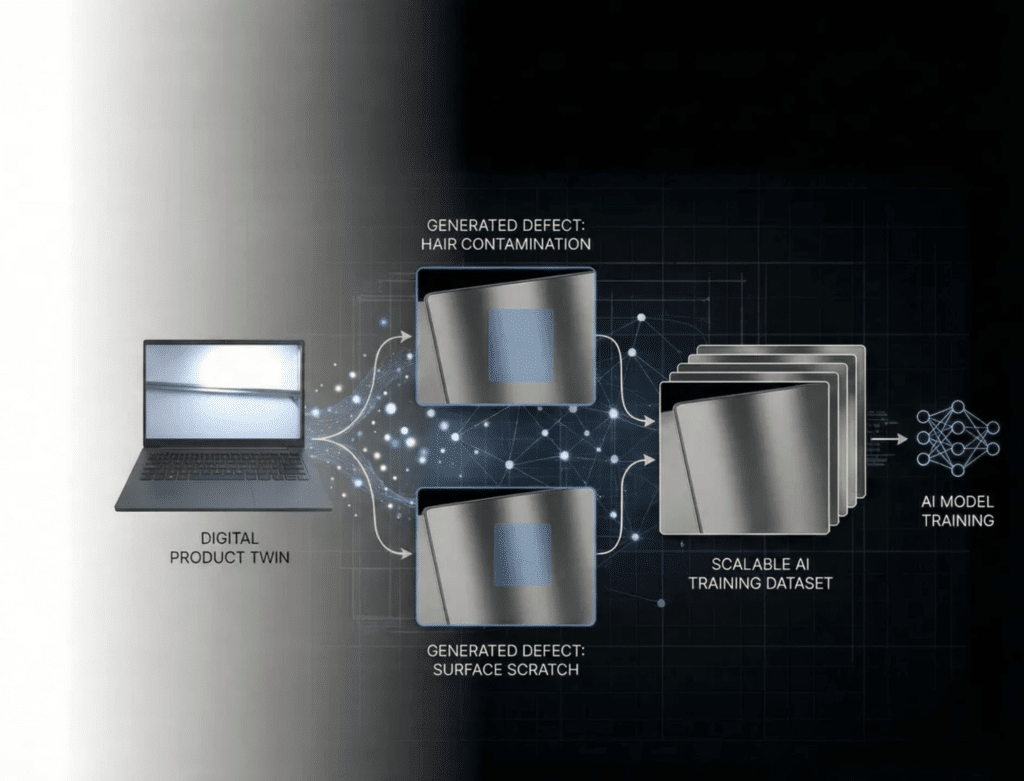
Training a reliable AI inspection model for grading requires thousands of labeled images across a wide range of defect types. Rare defects are the hardest to collect: they appear infrequently, so accumulating enough real examples requires extended production runs.
Using photorealistic product twins, Reconext engineers generate controlled defect variations rendered with physical accuracy under any validated lighting condition and camera configuration. AI model development moves earlier in the program, and inspection models reach readiness faster and with broader defect coverage.
4. Virtual Prototyping and NPI Acceleration

New product introduction is where engineering uncertainty is highest. The conventional path requires building physical setups, discovering incompatibilities, and iterating until the system performs. Each iteration compresses the launch window and adds unplanned cost.
In the Omniverse environment, a new product twin is modeled, placed into existing machine twin environments, and evaluated against multiple configurations before any physical work begins. What previously took weeks of iteration now takes days of simulation. For process-intensive programs like repair and refurbishment, this means validated workflows are in place well before physical operations begin.
A Compounding Advantage Over Time
The value of this capability accumulates across programs. Every machine twin, product twin, and validated configuration becomes part of a reusable engineering library.
When a new program begins, engineers draw on existing models and proven configurations rather than starting from scratch. The starting point for each program is higher than the one before it.
A common simulation environment also aligns teams that have historically worked in sequence. Mechanical, automation, vision, and AI engineers work within the same virtual space simultaneously, identifying conflicts earlier than any sequential physical process allows.
Over time, this shared infrastructure becomes a durable operating advantage: an organization that gets structurally faster and less expensive to run with every program it completes.
What This Means for Clients
Most services partners will tell you they move fast and deliver quality. The more revealing question is where their engineering certainty actually comes from.
If the answer is physical iteration, rework loops, and post-installation tuning, then those speed and quality claims are downstream of a process that is structurally slow and expensive by design.
With Reconext’s Omniverse environment, programs that previously absorbed weeks of physical iteration move through engineering in simulation. Inspection systems arrive at deployment already proven. AI inspection capability is developed in parallel with hardware, reaching readiness at launch rather than months after it.
The result is a 40% reduction in prototype and setup cost, a 30% acceleration in new product introduction timelines, and a 95% first-pass success rate at physical deployment.
Automotive, aerospace, and semiconductor manufacturing adopted digital twins because organizations that validate in simulation before committing to physical build make fewer mistakes, move faster, and spend less. Reconext has brought that same rigor to electronics lifecycle services, changing what clients should expect from a services partner.
The question for any organization evaluating a services partner is straightforward: would you rather discover your engineering problems in simulation, or on the factory floor?
Learn how Reconext’s digital twin environment can reduce cost, compress timelines, and bring greater certainty to your next program. Speak with our team today.


