Retired IT assets continue to pose a data security risk to your organization long after they leave the enterprise.
Laptops, servers, drives, mobile devices, and networking equipment can still hold regulated data, intellectual property, credentials, customer information, and internal records. Without a secure and compliant IT asset disposition (ITAD) process, the result can be a reportable data exposure, an audit finding, a contractual breach, or a reputational event.
ITAD data security compliance helps organizations reduce these risks by combining certified data sanitization, documented chain-of-custody procedures, and verifiable audit records throughout the asset disposition lifecycle. It also supports responsible recycling and value recovery without compromising data security.
This guide explains the best practices for maintaining ITAD data security compliance, the standards and certifications that matter most, and how to evaluate whether an ITAD provider can protect your organization throughout the entire disposition process.
Key Takeaways
- Secure ITAD practices protect sensitive data through certified sanitization methods, a documented chain of custody, and comprehensive audit records.
- Evaluate ITAD providers based on independent certifications, transparent processes, and verifiable evidence of compliance throughout the asset disposition lifecycle.
Why ITAD Data Security Compliance Matters
ITAD outsourcing cannot be considered a transfer of data security accountability. Even when an ITAD service provider manages secure ITAD and final disposition, the original asset owner may still face regulatory, contractual, and reputational exposure if sensitive information is exposed. While certified vendors follow data protection laws, the RCRA and state laws will hold the organization, not the ITAD vendor, liable.
Beyond any legal liabilities, data breaches are financially draining. According to Verizon’s 2026 Breach Impact Study report, business interruption and extortion together account for over half of total financial losses in breach claims.
Failing to comply with data security requirements causes operational momentum loss. For instance, product releases get delayed if audits stall over missing documentation. These blockers compound over time, creating additional liabilities for the organization.
An organization can also lose IP, consumer trust, and brand reputation if it fails to maintain data security. This can be more damaging than pure financial loss, and takes years to repair. These ripple effects are impossible to evade once retired IT assets are handled without maintaining data security.
Best Practices for ITAD Data Security Compliance
To ensure data security compliance, organizations must move beyond simple logistics and treat ITAD as a strategic business operation. Doing so ensures minimal exposure to threats, thereby reducing risks.
Maintain a Secure Chain of Custody
A secure chain of custody is the first line of defense against unauthorized access to sensitive data. For most ITAD operations in high-risk industries, this is a requirement. There needs to be complete visibility from the moment assets leave the premises through to final disposition.
Maintaining a strict chain of custody starts with inventory management. Each asset needs a unique identifier, like an RFID tag or barcode, that is synced with a real-time dashboard. This dashboard is accessible only to a limited number of vetted personnel, and supports the retrieval status of every unit at all times.
To avoid blind spots, signed custody transfers are also recommended at every handoff point during transit to provide an unbroken audit trail that is defensible during an audit.
Use Tamper-Evident Packaging
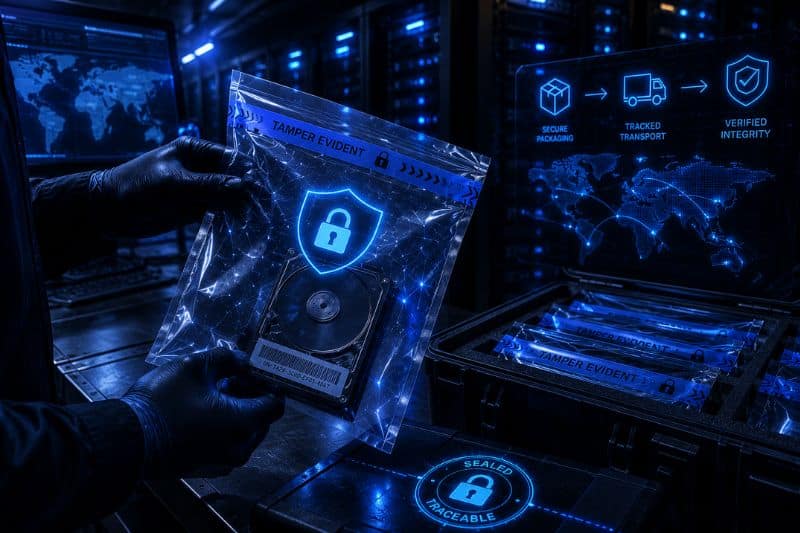
A secure chain of custody reduces risk, but it does not eliminate the possibility of asset misplacement during transfer. Tamper-evident packaging adds another layer of control by using lockable collection bins and tamper-proof seals to protect decommissioned assets before and during transport.
Secure logistics should include controls that make asset movement visible during transport. GPS-enabled vehicles, shipment tracking, and asset-level scans help verify custody, identify exceptions, and reduce the risk of loss or unauthorized access.
Use Certified Data Sanitization Methods
Certified data sanitization methods ensure storage devices are handled in accordance with data protection laws such as HIPAA.
NIST SP 800-88 Rev. 2 is the best data sanitization framework for organizations. This framework has three levels of sanitization: clear, purge, and destroy, which are chosen based on the level of data security and asset value.
For most assets, clearing and purging are sufficient sanitization methods, as they ensure a storage device remains usable afterwards. Destroy is best for critical data centers where vendors and customers want to dismantle data completely.
As data storage technologies become more advanced, more effective data wiping technologies and standards are emerging. For instance, the IEEE 2883-2022 standard is being used to clear data in NVMe drives. This standard is an alternative to the NIST 800-88, providing guidelines for emerging technologies.
Follow Recognized Compliance Standards
Technical sanitization guidelines and third-party certifications can guarantee regulatory compliance. The guidelines stipulate standard procedures, while certifications provide proof and legitimacy of their adherence.
When working with ITAD service providers, it is recommended to require at least NAID AAA or R2v3 certifications. The former signals verified data destruction practices, while the latter signals responsible and secure IT asset management. An ITAD partner with these certifications will ensure secure destruction methods at all times.
It is also essential to ensure compliance with ISO standards, such as ISO 27001 for information security, ISO 14001 for environmental management, and ISO 9001 for auditable quality processes. These ISO certifications prove that the ITAD provider’s internal SOPs follow international best practices.
Keep Complete Audit Documentation

Each stage of the disposition process should generate audit documentation, including certificates of destruction. Each certificate should be serialized at the asset level and supported by the corresponding chain of custody record. A shipment-level certificate may not provide enough traceability for auditors because it does not prove what happened to each individual asset.
Organizations should also provide 24/7 access to a secure client portal where audit records, chain-of-custody reports, and CoDs are stored. Instant access to this documentation enables IT and compliance teams to quickly produce evidence of proper disposal during GDPR, HIPAA, or FOIA requests.
Destroy Media That Cannot Be Sanitized
Failed drives and other storage media that cannot be sanitized should be identified during planning and routed for physical destruction. Shredding or disassembly ensures stored data is unrecoverable when standard data wiping or data erasure methods cannot be used.
Destruction methods should also be adaptive to the type of storage device and data stored. For instance, high-risk solid-state drives require granular shredding to ensure storage arrays are completely dismantled.
Government agencies should also ensure that ITAD service providers follow industry-specific standards to maintain compliance, such as the NSA/CSS Policy Manual 9-12 and NISPOM 32 CFR Part 117. These standards ensure that highly classified data is destroyed in a completely confidential manner.
Work with Compliant ITAD Vendors
When vetting an ITAD partner, IT managers should distinguish between a vendor’s stated practices and its verified credentials. A standard describes a process or requirement, while a certification provides independent evidence that the provider has been assessed against defined criteria.
While many providers claim NIST 800-88 “compliance,” it is essential to recognize that NIST 800-88 is a self-applied framework and not a certification. Since there is no governing body that issues NIST certificates, any vendor can claim to follow them without external oversight.
To ensure true data security, organizations must prioritize vendors with third-party certifications that involve rigorous, recurring validation. NAID AAA and R2v3 are the only widely recognized credentials that require regular, independent audits to prove that data destruction and recycling protocols are actually being followed.
These credentials are renewed periodically, so their status must be verified directly with the issuing bodies rather than accepting copies or verbal assurances at face value.
How to Evaluate an ITAD Provider

Choosing an ITAD provider should involve more than comparing pricing or turnaround times. Since the provider will handle data-bearing retired assets, you need to verify that its security, compliance, and reporting practices align with your organization’s requirements.
Use the following seven questions to assess whether a provider can support a secure and compliant ITAD program.
- Can you provide verifiable copies of R2v3, NAID AAA, and ISO certifications?
- Where exactly is the data destroyed? On-site, at your facility, or both?
- What specific NIST or IEEE standards do you follow for various media types?
- Who are your downstream partners, and are they also certified?
- Do you provide a serialized Certificate of Destruction for every single asset?
- Do you have Environmental and Cyber Liability insurance, and at what limits?
- Can you provide client references within my specific regulated industry?
Conclusion
ITAD data security compliance protects sensitive information throughout the asset disposition process. It relies on secure data destruction, documented procedures, and verifiable audit records that demonstrate regulatory compliance.
These best practices reduce data security risks while giving organizations confidence that retired assets are handled responsibly.
Reconext meets these requirements through certified ITAD services, secure data destruction, and comprehensive audit reporting. Contact Reconext to learn how your organization can strengthen its ITAD data security compliance.