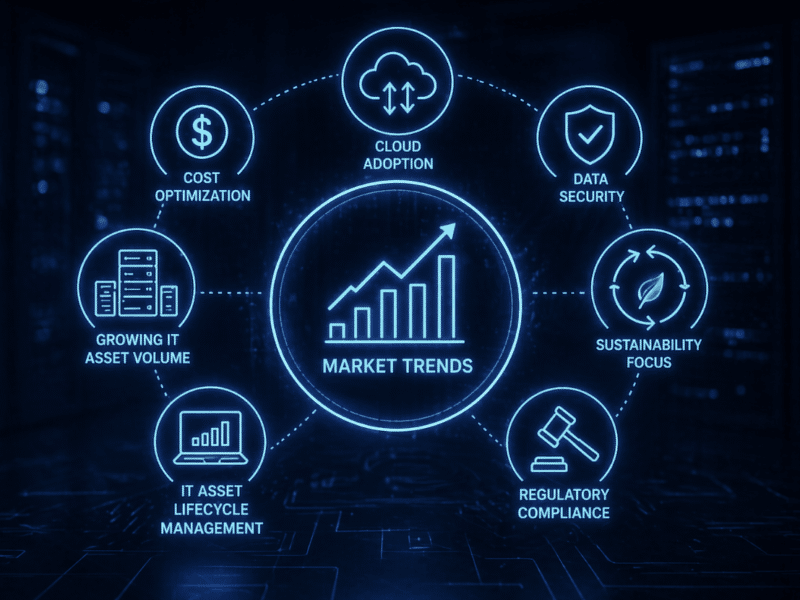
Multinational organizations often manage retired IT assets through a patchwork of regional vendors, local procedures, and disconnected reporting systems. The result is limited visibility, inconsistent data security controls, and difficulty proving compliance across countries.
A global IT asset disposition program addresses this problem by establishing one governance framework for asset tracking, data security, reporting, and provider accountability, while allowing local execution to reflect each country’s regulations, tax structures, and logistics environment.
This guide explains how enterprise organizations can standardize global ITAD, manage regional complexity, and maintain control over retired assets across multiple countries.
Key Takeaways
- Global IT asset disposition is about creating one consistent governance framework while adapting operations to local regulations, logistics, and compliance requirements.
- Successful programs prioritize chain of custody, data security, standardized reporting, and clear accountability across every country.
- The most effective global ITAD strategies combine centralized oversight with local execution to reduce risk, improve compliance, and maintain operational consistency.
What Does a Global IT Asset Disposition Program Look Like?
When people think about IT asset disposition, they often picture a company replacing laptops or retiring old servers. A global IT asset disposition (ITAD) program is much bigger than that.
Most multinational ITAD projects begin with a large enterprise operating across multiple legal entities, regions, and local offices. While every location may have its own way of handling retired equipment, the corporate team is usually looking for three things: greater control, consistent reporting, and a single provider that can manage the entire program.
That need for control is really what drives a global ITAD strategy. Without a standardized approach, every office tends to develop its own process. One country might use a local recycler, another might keep retired devices in storage, another could sell assets independently, while another simply scraps everything. Before long, reporting becomes inconsistent, security gaps appear, and it becomes difficult to prove exactly what happened to every asset.
A successful global program brings those different approaches together under one controlled framework. The goal isn’t simply to collect equipment; it’s to ensure every asset follows the same governance, reporting, and compliance process, regardless of where it originates.
The equipment itself is usually workplace technology. Laptops, desktops, monitors, mobile phones, printers, and supporting IT hardware make up the bulk of most programs.
Importantly, global ITAD isn’t about cherry-picking the devices with the highest resale value. Almost anyone can recover value from premium laptops or newer hardware. The real challenge is managing the complete asset stream, including damaged equipment, older devices, low-value assets, and hardware that still presents operational or data security risks.
Most multinational programs span North America, Europe, and Asia, with some extending into the Middle East. Latin America and Africa are less common, not because organizations don’t operate there, but because those regions often introduce additional logistical and regulatory complexity.
That’s where many organizations discover that “global” doesn’t mean every country can be treated the same. Brazil, for example, presents significant tax and import-export challenges that can make moving equipment impractical, while India has its own complexities around imported assets, government documentation, GST requirements, and free trade zones.
Every country introduces different legal, tax, customs, and infrastructure considerations that influence how assets should be managed.
Ultimately, there is no such thing as a “typical” multinational ITAD project defined by a certain number of countries or assets. The common thread is that organizations are trying to manage IT assets consistently across regions with very different legal, logistical, tax, and operational realities.
The Biggest Challenges of Global IT Asset Disposition

Managing retired IT assets across multiple countries introduces operational, regulatory, and security challenges that don’t exist within a single market.
One Global Process Doesn’t Work Everywhere
One of the most common mistakes organizations make is assuming that a global ITAD program can be designed around a single set of rules. On paper, it sounds efficient to define one pickup SLA, one reporting model, one turnaround time, and one pricing structure for every country. In practice, those expectations often fall apart as soon as the program begins operating internationally.
A four-hour pickup window or a three-day turnaround may be perfectly achievable in parts of Europe or North America, but far less realistic elsewhere. In countries such as Japan or the Philippines, equipment may need to pass through multiple documentation checks, customs processes, transport providers, and export requirements before it even reaches a processing facility. In some cases, the paperwork alone can take several days.
Every Country Has Different Compliance Requirements
Regulatory compliance adds another layer of complexity. A global program that works well in one region may not satisfy the legal requirements of another. European operations, for example, must account for GDPR obligations, while other countries may have entirely different import-export controls, taxation rules, government invoicing systems, or restrictions on transporting used electronic equipment. Ignoring these regional differences during the planning stage often creates problems later, forcing providers to either explain why certain requirements cannot be met or redesign the program after implementation.
Commercial and tax considerations can also influence how a global ITAD program operates. A provider may have trusted partners in a particular country without having its own legal entity there. That affects how contracts are structured, how services are billed, and how funds move across borders. These commercial realities are rarely visible in a procurement spreadsheet, but they can significantly impact the success of a multinational program.
Maintaining a Secure Chain of Custody
Security introduces another set of challenges. Maintaining a complete chain of custody is critical because organizations need to know exactly where every asset is from collection through to its final disposition. If 100 devices are collected but only 98 can be accounted for, those two missing assets could represent the organization’s greatest data security risk. The goal isn’t simply to move equipment—it is to prove, at every stage, what happened to each individual asset.
Transportation itself can also present security concerns. Depending on the sensitivity of the equipment, additional controls may be required during transit. For particularly sensitive storage devices, organizations may choose to separate key components before shipping so that intercepted hardware cannot be used on its own. While no process can eliminate risk entirely, well-designed controls can significantly reduce it.
Data Exists in More Places Than You Think
One of the most overlooked challenges is identifying which assets actually contain data. Most organizations immediately think of laptops, desktops, servers, and mobile phones, but data often resides in devices that receive far less attention. Printers and photocopiers may contain internal storage or memory buffers that retain sensitive documents, while removable media, SD cards, external drives, and other storage devices are easily forgotten during large-scale asset refreshes. Overlooking these assets can create security exposures long after equipment has left the workplace.
What Makes a Successful Global ITAD Program?

The success of a global IT asset disposition program is rarely determined by what happens after the assets are collected. More often, it’s decided long before the first device is picked up.
Organizations that run successful global ITAD programs invest time in planning before they go to market. Clear objectives, realistic regional expectations, and a thorough understanding of local requirements provide the foundation for everything that follows.
Start With Clear Objectives
Before designing a global ITAD program, organizations need to understand what success actually looks like.
For some, the priority is maximizing value recovery. Others are primarily concerned with data security, sustainability, regulatory compliance, or creating consistent reporting across every region. In many cases, it’s a combination of these objectives, but they won’t always point to the same operational model.
For example, a program focused on maximizing resale value may move assets to centralized refurbishment facilities, while one focused on minimizing data risk may prioritize in-country data sanitization before equipment is transported. Likewise, a sustainability-driven program may determine that moving low-value equipment halfway around the world creates unnecessary cost and environmental impact.
Without clear priorities, it’s difficult to design the right program.
Build the Right RFP From the Beginning
One of the biggest factors influencing the success of a global ITAD program is the quality of the RFP.
If organizations don’t fully understand what they’re asking providers to deliver, they shouldn’t expect to receive the right solution. Unrealistic service levels, incomplete regional requirements, or poorly defined expectations often produce proposals that look comparable on paper but differ significantly in practice.
As the saying goes, garbage in, garbage out. If the RFP is flawed, the outcome is likely to be flawed as well.
Listen to Providers With Regional Experience
Experienced global ITAD providers deal with regional challenges every day. When they explain that a particular SLA works in Europe but not in Asia, or that a proposed logistics route creates customs or tax complications, they aren’t making excuses; they’re highlighting realities that could otherwise derail the program later.
The most successful organizations treat this expertise as part of the planning process rather than something to overcome during implementation. Adapting the program before launch is almost always easier than fixing problems after rollout.
Carry Out Thorough Vendor Due Diligence
Selecting a provider based solely on brand recognition or a global presence can create significant risk.
Organizations should validate much more than a provider’s marketing materials. That includes evaluating their operational systems, processing facilities, logistics capabilities, downstream partners, reporting platforms, data erasure processes, and overall governance model.
A company with offices or partners around the world isn’t necessarily operating one consistent global service. Understanding how the service is actually delivered is just as important as knowing where it is delivered.
Design for Outcomes, Not Just Procurement
One of the biggest differences between successful and unsuccessful programs is who shapes the project.
Procurement naturally plays an important role in managing contracts and tenders, but a global ITAD program shouldn’t be driven by procurement alone. The people responsible for managing exceptions, responding to audits, tracking assets, and maintaining compliance need to help define how the service will operate.
The strongest programs are outcome-led rather than RFP-led. They establish realistic expectations, build flexibility around regional differences, perform proper vendor due diligence, maintain a secure chain of custody, and create clear ownership from the beginning. Rather than trying to force every country into an identical process, they build a global framework that delivers consistent control while allowing execution to adapt to local realities.
What Should Be Standardized Globally, and What Should Stay Local?

One of the biggest misconceptions about global IT asset disposition is that every country should follow exactly the same process.
In reality, successful global ITAD programs don’t standardize every operational detail. They standardize the overall framework while allowing local execution to adapt to regional requirements.
Trying to force identical processes across every country often creates unnecessary cost, delays, and compliance issues. Instead, organizations should focus on standardizing the elements that provide control while remaining flexible where local laws and practical realities require different approaches.
Standardize Governance and Accountability
The global framework should remain consistent regardless of where assets are being managed.
This includes governance, reporting, chain of custody, service definitions, escalation procedures, provider accountability, and the overall control model. Every country should operate within the same structure so that the organization has consistent visibility into what happens to every asset throughout its lifecycle.
Using common terminology is equally important.
One example is the way organizations describe retired equipment. Many companies automatically classify assets as “waste” or “e-waste” at the beginning of the process. While this may seem like harmless terminology, it can have significant operational consequences.
In Europe, for example, once equipment is formally classified as waste, additional regulations may apply, including waste transfer documentation, Annex VII paperwork, notification requirements, and approval processes. Those requirements can introduce additional cost and delay before the equipment even begins moving.
Instead, equipment should first be assessed to determine whether it can be reused, refurbished, repaired, harvested for parts, resold, or recycled. Only once that assessment has been completed should waste classifications come into play.
Adapt Operations to Local Requirements
While governance should remain consistent, the way a program operates often needs to vary from one country to another.
Local regulations, tax requirements, logistics networks, customs processes, infrastructure, and commercial realities all influence how equipment should be collected, transported, processed, and ultimately disposed of.
Data-bearing assets are a good example.
For highly sensitive devices containing employee records, financial information, or other confidential data, it may make sense to sanitize or destroy the data within the country before the equipment is moved. In other situations, securely erasing the data locally before transporting the asset to a centralized refurbishment facility may provide the best balance between security and value recovery.
There isn’t a universal answer. The right approach depends on the type of asset, the sensitivity of the data, local regulations, commercial considerations, and the organization’s objectives.
Balance Sustainability With Commercial Reality
A global ITAD program should also make commercial and environmental sense.
Moving low-value equipment halfway around the world simply because it fits a standardized process rarely delivers the best outcome. The organization may spend more on transportation than the equipment is worth while simultaneously increasing its environmental impact.
Instead, decisions should balance value recovery, sustainability, logistics, and operational efficiency. In some regions, local processing may be the most practical solution. In others, centralized refurbishment or resale may provide greater long-term value.
Ultimately, the principle is simple: standardize the control objectives globally, but localize the operating method. Organizations should have one framework that provides consistency and accountability, while allowing transport routes, data handling, tax structures, customs processes, and final processing methods to adapt to the realities of each country.
Why Many Enterprises Choose a Single Global ITAD Provider

Managing IT asset disposition across multiple countries becomes increasingly difficult when every region uses a different vendor. Each provider may have its own systems, reporting methods, data erasure processes, logistics partners, and operational standards, making it harder to maintain visibility and control across the entire program.
This is why many enterprise organizations choose to work with a single global ITAD provider.
One Point of Accountability
The biggest advantage is accountability.
Rather than coordinating multiple regional vendors, organizations have one provider responsible for managing the service from end to end. If an issue arises, there is a single escalation path and one organization responsible for resolving it.
Consistent Reporting and Governance
A global ITAD program relies on consistent reporting as much as consistent operations. Different vendors often provide different levels of detail, making it difficult to monitor compliance, track assets, support audits, or measure performance across multiple countries.
A single provider with common systems and standardized reporting gives organizations one consolidated view of their global program while applying the same governance and service standards across every region.
Look Beyond the Global Brand
Choosing one provider only delivers these benefits if the provider operates as one global organization.
Some companies promote a global presence but rely heavily on regional partners or independent operations using different systems and processes. That’s why organizations should look beyond the map and understand who is actually delivering the service, which systems are being used, and who is accountable for the work.
Ultimately, the value of a global ITAD provider isn’t simply having fewer contracts to manage; it’s having one organization that can deliver consistent control, reporting, and accountability across every country.
Which KPIs Matter Most in Global IT Asset Disposition?
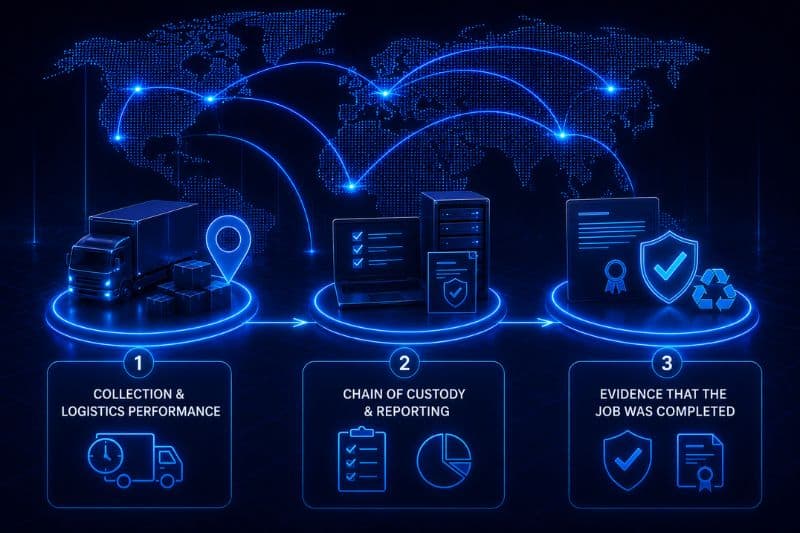
While value recovery is often associated with IT asset disposition, many enterprise organizations measure success quite differently. The most important KPIs aren’t just about financial returns; they demonstrate control throughout the entire asset lifecycle.
The strongest KPIs provide evidence that assets were collected, tracked, processed, and securely dispositioned exactly as intended.
Collection and Logistics Performance
The first set of KPIs focuses on how efficiently assets move through the program.
One of the most closely monitored metrics is the time between notification and pickup. Once assets are declared ready for collection, organizations want to know how quickly the provider can respond. This is particularly important for sites with limited storage space or where equipment handovers need to be coordinated with specific personnel.
The next key metric is the time between pickup and receipt at the processing facility. The longer assets remain in transit, the greater the perceived operational and security risk. Enterprise customers generally expect equipment to move through the logistics chain promptly rather than spending unnecessary time in transport.
Chain of Custody and Reporting
Visibility is equally important once assets arrive for processing.
Receiving reports should reconcile what the customer expected to ship with what was actually received, helping identify discrepancies as early as possible. From there, organizations need final disposition reporting that clearly shows what happened to every asset, whether it was reused, resold, redeployed, refurbished, recycled, destroyed, or otherwise processed.
For many organizations, this reporting is essential for compliance, audit readiness, sustainability reporting, and financial reconciliation.
Evidence That the Job Was Completed
Closing the loop is just as important as collecting the equipment.
Enterprise organizations typically require certificates of data erasure, certificates of destruction, and other supporting documentation to demonstrate that assets were processed correctly. For data-bearing devices, additional service levels may apply, such as requiring data erasure within 24 hours of the equipment arriving at the processing facility.
Ultimately, the best KPIs don’t simply measure activity. They prove that every asset was collected, accounted for, securely processed, and fully documented from beginning to end.
Conclusion
There is no universal blueprint for global IT asset disposition. Every country brings its own legal, logistical, tax, and operational realities, which is why the most successful programs don’t try to standardize every process, they standardize the framework. When governance, accountability, reporting, and chain of custody remain consistent, organizations can adapt locally without losing global control.
That’s where experience matters. Reconext works with multinational organizations to design and deliver global ITAD programs that balance security, compliance, sustainability, and operational efficiency across every region. Whether you’re consolidating regional vendors or building a global ITAD strategy from the ground up, our team can help you create a program that works in the real world, not just on paper.
FAQs About Global IT Asset Disposition
What is the difference between IT asset management and IT asset disposition?
IT asset management (ITAM) focuses on managing IT equipment throughout its useful life, from procurement and deployment to maintenance and tracking. IT asset disposition (ITAD) begins when equipment reaches the end of its lifecycle, ensuring retired assets are securely collected, data is destroyed or erased, assets are refurbished or recycled where appropriate, and disposal complies with regulatory and environmental requirements.
How do global ITAD services protect sensitive data?
Global ITAD services protect sensitive data by maintaining a documented chain of custody, using certified data destruction or secure data erasure methods, and providing auditable reporting throughout the IT asset disposition process. The appropriate approach depends on the type of asset, the sensitivity of the data, and local regulatory requirements.
How does IT asset disposition support sustainability goals?
A well-managed IT asset disposition process supports environmental sustainability by extending the life of IT equipment wherever possible through refurbishment, repair, redeployment, or resale before recycling becomes necessary. This approach helps reduce electronic waste, recover valuable materials, and supports broader circular economy initiatives.
Why is asset tracking important during the IT asset disposition process?
Asset tracking provides visibility throughout the entire ITAD process, helping organizations verify when equipment is collected, received, processed, and securely dispositioned. Combined with comprehensive reporting, asset tracking strengthens chain of custody, supports compliance, and provides the documentation needed for audits and internal governance.