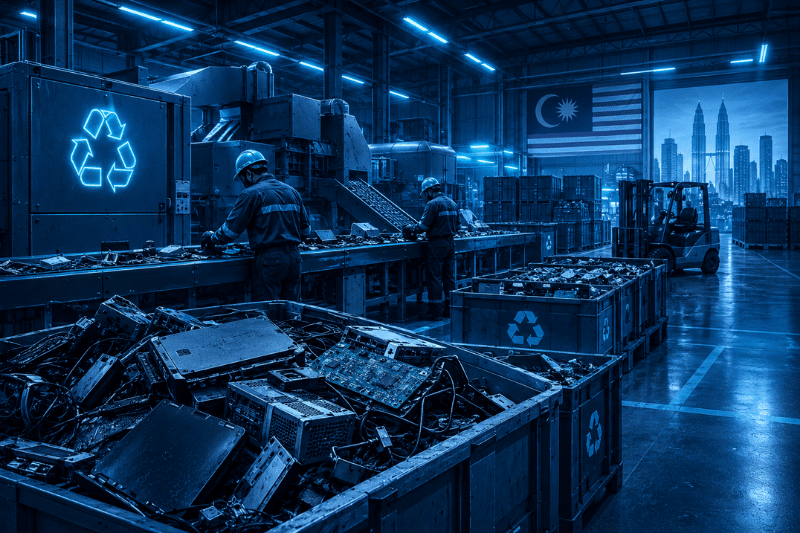
Malaysia generates 12.2 kg of electronic waste per person and ranks third among ASEAN countries by per-person e-waste, according to Global E-waste Monitor figures reported by The Star.
The Department of Environment (DOE) classifies e-waste as scheduled waste, so companies must follow handling and e-waste disposal rules. Retired servers and laptops also need secure data erasure to remove any sensitive information before they leave the company.
In this guide, we are discussing what counts as e-waste and the rules that apply to businesses. We will also cover how to choose a recycling or IT asset disposition (ITAD) partner.
Key Takeaways
- Business e-waste comes under the scheduled waste code SW 110. Generators must notify the DOE and follow rules for storage and transfer to a licensed facility, using a consignment note.
- Check the DOE license of the recycler or IT asset disposition (ITAD) provider to make sure they have the license for the waste they will handle. Ask how they record data erasure and what records they will give you after collection.
Electronic waste management requirements for Malaysian businesses
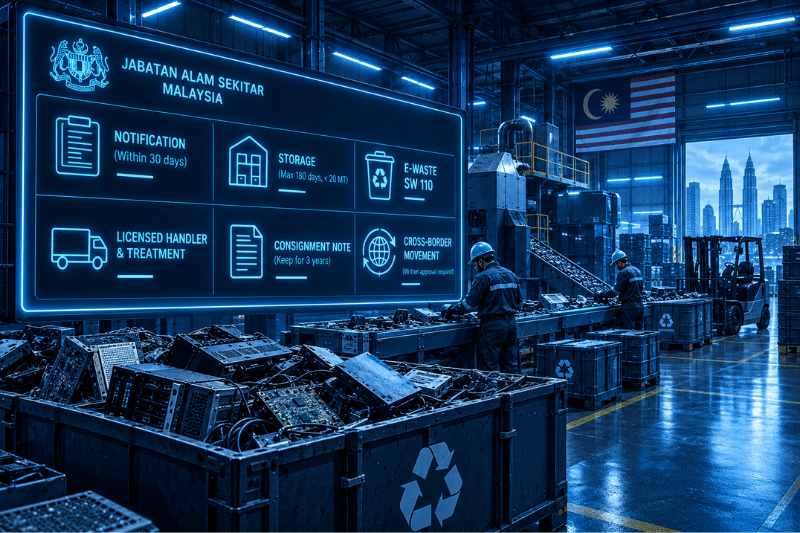
E-waste from businesses comes under scheduled waste rules in Malaysia. The management requirements from the Environmental Quality (Scheduled Wastes) Regulations 2005 and DOE guidance apply to the company generating the waste.
DOE e-waste clarification
Electronic waste is categorized as scheduled waste under code SW 110 on the DOE’s e-waste portal. Electrical and electronic equipment that has accumulators and mercury switches comes under this. The code also covers equipment contaminated by lead, mercury, cadmium, or other heavy metals.
It could include retired servers, network switches, laptops, mobile phones, monitors, printers, and circuit boards from test equipment.
The DOE has different arrangements for industrial and household e-waste, and its extended producer responsibility framework and the guidance for commercial and institutional entities cover household collection and e-waste recycling.
When the used equipment is not e-waste
A DOE guideline was issued in 2008 on classifying used electrical and electronic equipment, which excludes any working equipment intended for direct reuse from SW 110. But the equipment shouldn’t have any functional fault or damage that causes a safety risk, and companies uncertain about its classification should seek professional advice.
Any equipment that will be recycled or thrown away comes under e-waste. Equipment that has been securely erased and recorded as fault-free could be reused, and any units that fail testing are e-waste.
Who is responsible for the waste?
A generator is any person who generates scheduled waste, and they are responsible for the notification, storage, and consignment duties.
It is unclear who is responsible for the waste when devices are leased. So, the parties should put in writing who handles notification and consignment paperwork before the retirement project, and record the decision in the e-waste management procedure.
Notification and storage deadlines
A generator has to notify the DOE Director General of every new category of scheduled waste within 30 days of generating it using the form in the regulation’s Second Schedule.
Waste stored on site is to be removed within 180 days of generation, and the total amount stored can’t be more than 20 metric tonnes without written approval.
Containers need to have a label showing the waste generation date. The label should also include the SW code and the generator’s contact details. So, a plant clearing an old test lab in January needs to track that batch against the 180-day limit, and the container date should match the date of waste generation.
Licensed handlers and consignment notes
Scheduled waste has to be disposed of at licensed premises only. Treatment happens at prescribed premises or at an approved on-site facility, so the place taking the equipment needs the right DOE license for the work.
Every movement is recorded on a consignment note, which generators complete through the DOE’s electronic Scheduled Waste Information System (eSWIS). Each party keeps a copy of the note for at least 3 years after the receiving premises takes delivery.
A copy of the completed note is kept in the asset disposal record, and the quantities on it are checked against the equipment that left the building. Any mismatch between the paperwork and the collection should be resolved as soon as possible.
Moving electronic waste across borders
The import of e-waste is prohibited according to DOE guidance, but under section 34B of the Environmental Quality Act, scheduled waste can pass through or be sent out of Malaysia with written approval from the Director General. Export for recycling can also be allowed under conditions that include Basel Convention procedures.
A Penang manufacturer cannot ship retired equipment to a sister plant in Singapore without approval. Singapore also applies its own rules on arrival, which you can check on Reconext’s e-waste recycling in Singapore service page.
What goes wrong when e-waste disposal isn’t handled properly?
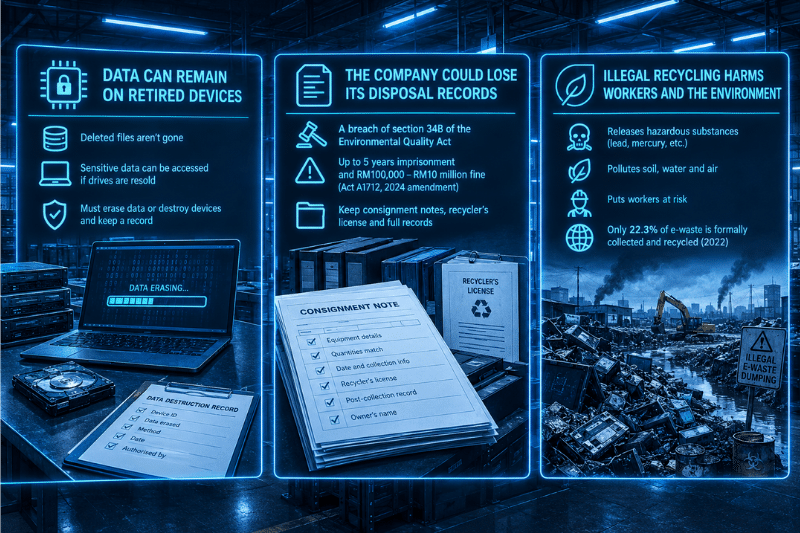
Once retired laptops leave the building without a record, nobody can say where they went. Improper handling causes sensitive data leaks and waste ending up in unsafe recycling operations.
Data can remain on retired devices
Deleting files or reformatting a drive doesn’t remove all data, so servers and laptops can leak customer information after they are retired. Sensitive information could get leaked if someone finds a drive that was handed to an unapproved scrap dealer.
The Personal Data Protection Act 2010 requires data controllers to protect personal data and delete anything they don’t need. From 1 January 2025, breaches can lead to a fine of up to RM1 million, up to 3 years in prison, or both. From 1 April 2025, data processors also have to follow the security principle.
So, data on retired equipment has to be erased or the device should be destroyed before recycling, and a record should show what happened to each device.
The company could lose its disposal records
Disposing of scheduled waste somewhere other than prescribed premises is a breach of section 34B of the Environmental Quality Act. Under the 2024 amendment (Act A1712), a conviction results in imprisonment of up to five years and a fine of RM100,000 to RM10 million.
The consignment note for each batch and a copy of the recycler’s license should be kept, as the company needs to show what left the site and where it went.
The record should show:
- The equipment went to a licensed handler
- The quantities on the consignment note match the collection
- Which equipment was collected and when
- The recycler’s license covered the work
- The company has a record of what happened after collection
The file should have the owner’s name so the company can check a disposal job if the owner has left the company.
Illegal recycling processes harm workers and the environment
Informal recycling methods release hazardous substances into the environment. According to the World Health Organization, e-waste has neurotoxicants like lead and mercury. Only 22.3 percent of the 62 million tonnes of e-waste generated in the world in 2022 was documented as formally collected and recycled
When companies don’t control the disposal of retired equipment, they lose visibility into what happens to it. Less visibility creates e-waste problems and security risks, as there can be data left on the equipment.
In December 2025, a Basel Action researcher told Bernama that e-waste has been dumped in rivers and oil palm plantations in Malaysia. They also reported that illegal scrap yards were operating without wastewater treatment and air pollution control and violating worker safety rules, increasing awareness of the risks associated with improper e-waste handling.
How to assess an e-waste recycling partner
In July 2025, the DOE reported that licensed e-waste recovery facilities have expanded to 128, and licensed premises processed over 536,709 tonnes of e-waste between January 2021 and June 2025.
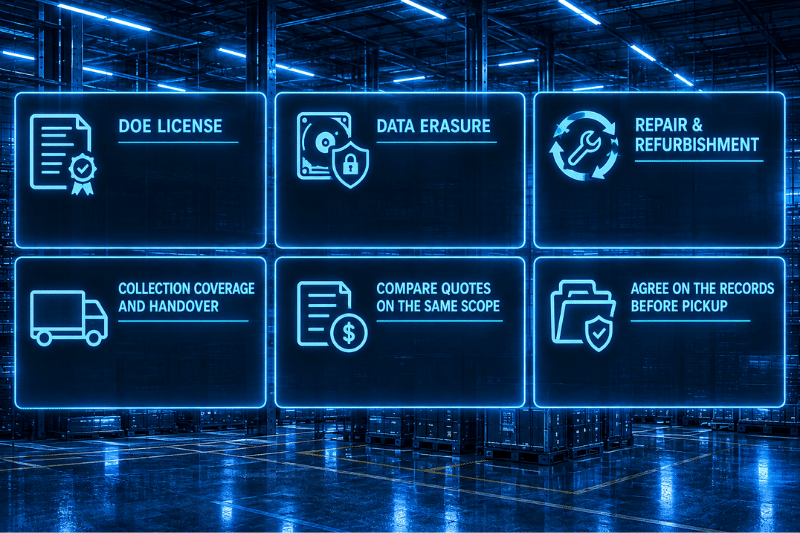
So the companies have a big pool of providers, but the quote doesn’t tell you how to assess your e-waste recycling partner. Here are some points that will give you clearer criteria for comparison.
DOE License
Check the license when choosing a recycling partner, and make sure they cover SW 110 and the work proposed. The DOE publishes lists of licensed full and partial recovery facilities, which companies can use to shortlist providers.
Don’t just check the facility name and quotation, as the license should match the legal entity and address receiving the equipment. Certifications like R2v3 or ISO 14001 give more audit evidence, but the DOE license is also required.
Check how data is erased
You should ask the provider how they handle data-bearing equipment like drives and a record. A recognized standard like the NIST SP 800-88 gives a useful benchmark. The report should identify each device by its serial number. A record that only says all drives on a pallet were erased gives an auditor nothing to check against individual devices.
You should include equipment other than servers and laptops in the review, as things like printers and network switches could also have important data. This IT asset disposition page describes a nine-step process that includes NIST 800-88 erasure and serial-level chain of custody.
Working equipment repair and refurbishment
Equipment like laptops and storage devices could be valuable after a refresh, so ask the provider how they test equipment before you decide to send it anywhere. You and the provider should agree on grading rules like device age, specifications, cosmetic condition, and battery health. Document the reuse decision and test results in the batch record.
Collection coverage and handover
Don’t assume a recycler can cover all sites. Always check that they can collect from all your sites before signing a contract.
Ask them if they have their own team or bring in subcontractors. If you’re clearing a server room, find out whether they will take out the racks and cabling or expect your staff to handle that part.
Check the equipment using the asset register on collection day and keep data-bearing devices locked until the team arrives. Record any equipment sealed in tamper-evident packaging and get the handover document signed before it leaves the site.
Compare quotes on the same scope
When you ask ITAD providers for quotes, make sure all of them cover the same scope and are pricing the same job. Include collection, data erasure, reporting, and what happens to the equipment after it has been tested.
Be careful with quotes that look low-cost, as a quote with a low per-kilogram rate could be leaving out erasure reports or there could be an addition of transport charges. You should also ask what they will do with devices that failed testing.
Ask how they calculate the amount to send you if some equipment is resold, and when you will receive it. Get these details agreed in writing before the work starts.
Agree on the records before pickup
Ask the provider to return these records for every job:
- A signed consignment note for each scheduled waste movement.
- A data erasure report or certificate with the serial number of every device wiped.
- A record showing what happened to each item and the test results for any reused equipment.
- A copy of the recycler’s current DOE license and any certifications the provider refers to.
Keep these records in the asset register so finance, IT, procurement, and auditors can check the paperwork internally and don’t have to contact the provider for any missing documents.
How Reconext can help with e-waste recycling in Malaysia
Reconext operates a service centre in Penang that supports businesses managing retired IT and electronic equipment. The facility provides ITAD and recovery services including secure data erasure, testing and grading, repair and refurbishment, component recovery, and responsible recycling.
For data-bearing equipment, Reconext can securely erase information using recognised standards such as NIST SP 800-88 and provide audit records showing how the equipment was handled. Devices can then be assessed for reuse, repair or refurbishment, while usable components can be recovered from equipment that is no longer viable as a complete system. Materials that cannot be recovered are sent for compliant recycling and disposal.
This gives businesses a clearer process for managing equipment from collection through final disposition, while maintaining records for data security, asset tracking, and waste management. Reconext’s Penang facility also works within Malaysia’s DOE requirements for handling hazardous and non-recoverable materials.
If your business is planning an IT refresh, clearing a server room or retiring a larger volume of electronic equipment, explore Reconext’s ITAD and lifecycle services to discuss your project’s collection, data security, recovery and recycling requirements.
Frequently asked questions
What is the difference between a collection center and a recovery facility?
A collection center collects household e-waste and sends it to a recovery facility. The treatment and recovery are handled by the recovery facility.
Is wiping a hard drive enough before recycling?
Wiping is enough when it follows a standard like the NIST SP 800-88 and the result is verified. But drives that can’t be wiped should be destroyed, and the destruction recorded for every serial number.
What happens to e-waste after a licensed recycler collects it?
The facility recovers materials from the equipment, and any waste that has to be disposed of goes to prescribed premises under the regulations. The provider should include the destination of each type of material in the final report.
Are UPS and server-room batteries classed as SW 110?
Standalone batteries don’t use SW 110. Lead-acid batteries come under SW 102, and cadmium-nickel, mercury, or lithium types come under SW 103.