Most people outside the industry picture decommissioning as a demolition job: pull the plugs, shred the drives, close the doors. Simple, right?
Not exactly.
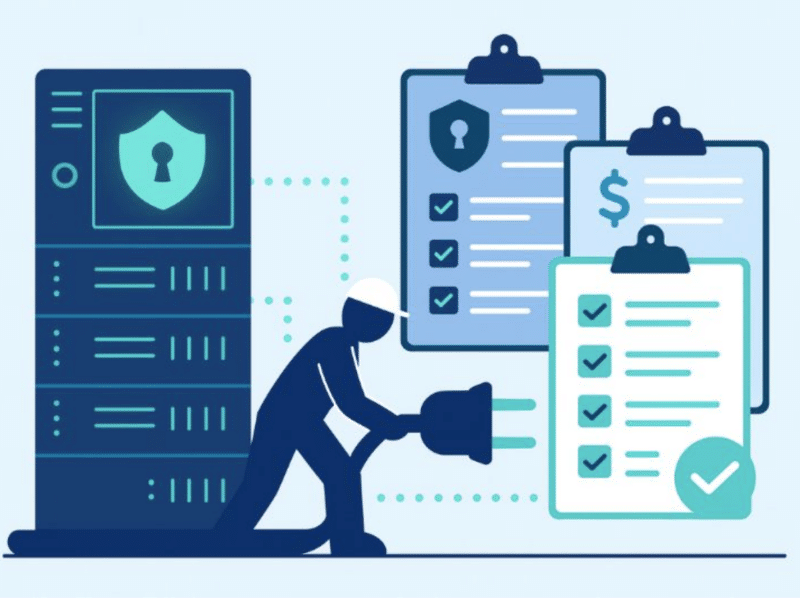
Inside a real data center, retiring equipment isn’t a smash-and-grab. A single rack can generate four, five, even 600 dependent tickets. Servers, applications, cables, door access, escorts, power downs, and safety sign-offs spawn their own approval.
Miss one ticket and the entire workflow halts. In some facilities, operators have literally been escorted out by security for lacking an approved door pass.
Handled poorly, the process turns chaotic: outages, audit failures, and racks full of hardware crushed for scrap that could have been resold. Handled well, it looks… uneventful. Almost boring. That’s the goal.
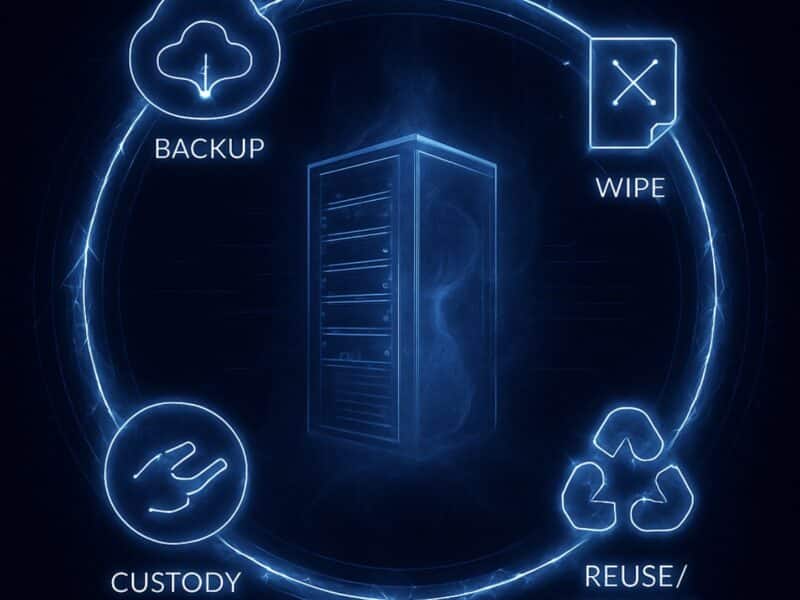
The data center decommissioning process only works when it’s treated as choreography. Governance, sequencing, resale-first disposition, airtight custody, and verifiable evidence — these are the moves that keep it smooth and safe.
Governance and Roles
Preventing the ticket storm
Every failed project starts the same way: no one knows who owns what.
IT assumes facilities will handle access approvals. Facilities assume compliance is checking the certificates. Compliance assumes IT has the evidence covered. Meanwhile, the vendor team shows up ready to work and can’t even get through the first door.
So roles must be defined. Up front. With no ambiguity.
- IT owns the inventory, workload migrations, and access tickets.
- Compliance translates regulations into operational standards and signs off on the certificates.
- Facilities controls escorts, power-downs, and safety.
- The vendor partner executes the wipes, manages custody, handles resale and recycling, and produces the reporting.
One customer’s decommission ballooned into 600+ tickets. The only way forward was embedding a Reconext operator directly into the customer’s ticketing system. Their entire job was just opening, pushing, and closing tickets to keep work flowing. Without that, the project would have ground to a halt.
Good governance is invisible. If the status channel is quiet, you’re doing it right.

Timeline and Critical Path
The unforgiving choreography
A data center decommissioning project is less checklist, more domino line. Each step depends on the last. Skip one and the whole thing collapses.
- Backups must be validated before anyone wipes a byte.
- Wipes must finish before racks are powered down and removed.
- Access tickets must be approved before operators set foot inside.
One missed approval can leave an entire row sitting idle for weeks. Typical projects last eight to twelve weeks. More heavily audited environments run longer, not because the work itself is slower but because every approval drags on.
Trying to speed this up by cutting corners doesn’t work. It just pushes risk down the road.
Rack dwell time is the hidden cost. Every day a rack sits “squatting” without being cleared is expensive real estate wasted. Traditional one-by-one wipes drag this out. Rack-level wiping clears half a row in hours instead of weeks. That’s why SMEs insist that timing isn’t just about planning; it’s also about method.
Once you’ve secured the sequence, the next question is: what actually happens to all that hardware?
Asset Disposition Strategy
Beyond the shredder reflex
The default reflex in most organizations is destruction. Shred the drives, crush the servers, sell the racks for scrap. It feels safe and definitive. It’s also wasteful.
A smarter default is wipe-to-resell. If a device can be sanitized, it should be reused, redeployed, or donated. Only failed or policy-bound assets should be destroyed.
Reconext runs dual toolchains to make this work at scale:
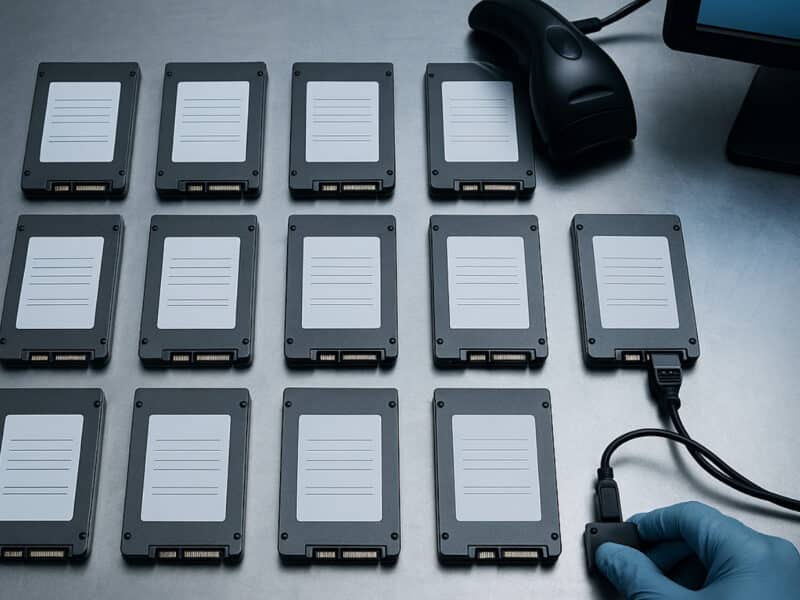
- Rackwipe wipes entire racks and switches in parallel.
- Proteus handles extracted drives asynchronously in 32- or 64-bay testers.
Reuse rates hit consistently above 90 percent.
And wiping preserves insight. Failed drives reveal patterns about supplier quality and lifecycle wear. Shredding deletes data that could have prevented the next round of failures.
There’s also risk in what destruction overlooks. One SME described a batch of switches resold without wiping IP configurations. The new buyers plugged them in, and the switches immediately started calling back to the original OEM. You can imagine the panic.
The choice is clear: resale versus scrap isn’t just financial — it’s strategic.
But resale-first only works if custody is airtight.

Chain of Custody
Trust as fragile currency
Custody is the fragile thread everything hangs on. Lose it, and the rest doesn’t matter.
Every asset must have a name and a trail:
- Tagged and serialized, tied to ticket IDs.
- Logged before removal, reconciled before outbound.
- Transport sealed, GPS-tracked, and double-checked at arrival.
- Two drivers, not one, to prevent tampering.
In some cases, HDD mechanicals are shipped separately from PCBAs so hijacked cargo is useless without Reconext’s process to recombine them.
One SME put it plainly: hyperscalers don’t shred because wiping doesn’t work — they shred because they don’t trust custody. A single broken seal is enough to ruin reputations.
Custody proves where data center assets went. Sanitization must prove what happened to the data.

Data Sanitization Controls
Proof, not faith
Data security comes from standards and evidence, not from faith in a “wipe complete” message.
The baseline is clear: NIST 800-88 still defines irretrievability for most auditors, though the DoD 5220.22-M method it replaced is now considered obsolete. The latest benchmark, IEEE 2883, goes further, covering modern SSDs and flash memory. Reconext systems are designed to meet or exceed all three, so customers stay compliant today and future-proof for tomorrow.
Methods vary:
- On-rack wipes are fastest and free racks quickly.
- Off-rack testers are used when racks can’t be accessed or policies forbid on-rack execution.
- PXE/offline wipes are mandatory in sites where internet access is banned. One SME described walking in with a single laptop and wiping racks entirely within the customer’s network fabric — no cloud connection, no external dependencies.
- Physical destruction remains the failsafe when wipes fail or policies demand it.
Some customers even demand multiple layers: wipe in place, then re-test storage units before they can leave the room.
Reconext’s wipe stack has been validated under IEEE-aligned ADISA reviews. Not just outcome-checked, but command-level tested: error handling, fail codes, bus behavior. Reviewers even called out the clarity of the codebase itself.
And when customers bring in their own forensic recovery teams, the process holds up. If their experts can’t recover data, the audit is over.
Controls, however, don’t enforce themselves. That’s what contracts are for.

Vendor SOW and SLAs
Ritualized mistrust as insurance
Scope creep and blurred cut-lines sink projects faster than any technical problem.
That’s why contracts have to codify expectations before anyone steps on the floor:
- Which standards are followed.
- Which deliverables are required (certificates, logs, reconciled inventories).
- Which access models are allowed (on-rack, off-rack, PXE offline).
- Which custody logistics apply (GPS, seals, rejection criteria).
Different customers want different scopes. Some only hand over storage. Others expect “door to dock” — everything handled end-to-end.
SMEs emphasize defining these cut-lines early. Without them, you end up with half-decommissioned racks and reopened tickets.
Think of it as ritualized mistrust. A good SOW puts responsibility on paper before blame is needed.
And when the paperwork is set and the racks are wiped, success is judged in hindsight.
KPIs and Closeout
Success in the rearview
Successful data center decommissioning doesn’t look like a story. It looks like nothing happened.
But you can measure the outcomes:
- Zero exposure of customer data and other sensitive information.
- High percentage of assets wiped vs. destroyed.
- Value recovered through resale.
- Rack dwell minimized.
- Minimal environmental impact; Carbon reduced; recyclers certified.
Compliance is measured three ways:
- Sanitization verified with certificates.
- Inventory reconciled against tickets.
- Resale reports delivered showing recovered value.
After the decom, factory testing isn’t about wiping. That’s already proven. It’s really about resale quality. Customers buying those units want assurance they work, not just that they’re clean.
Closeout isn’t just paperwork. It’s site restoration, reconciled inventories, bundled custody logs, and resale channels activated. A decom ends when the board can look at a packet and see nothing left unexplained.
And that loops back to the central truth: boring is the benchmark of success.

Routine as the Ultimate Achievement
Decommissioning is choreography: roles defined, tickets managed, racks wiped in parallel, custody sealed tight, standards enforced, contracts locked, and KPIs proven.
SMEs agree: governance, resale-first strategy, airtight custody, and verifiable evidence are what transform a once-in-a-decade risk into a weekly routine.
For most customers, decommissioning is a cliff dive. For Reconext, it’s just another Tuesday.
And in this business, boring is good.
[ Contact Reconext to design a decommissioning plan tailored to your facility ]
FAQs
1. Can we decommission gear while part of the data center stays live?
Yes. It’s done through phased access windows, rack-level mapping, and escorted entry so only retired gear is touched. The process works around uptime, not against it.
2. How do leased servers or storage get handled?
Leased data center equipment can’t be shredded. It’s wiped, tested, and returned with certificates — often with cosmetic checks too, since lease contracts require “like new” condition to avoid penalties.
3. Does decommissioning ever surface hidden risks?
Often. Wiping and testing can expose drive failures, supplier quality issues, or even networking gear still holding live IP addresses. Decommissioning tends to surface blind spots that operations overlook.
4. How do you keep sensitive assets from mixing with general scrap?
By running separate streams. Data-bearing devices are inventoried and processed under custody until sanitized or destroyed. Non-data gear like racks or cabling follows a different recycling path.
5. What if a drive can’t be wiped?
It’s escalated to destruction. Failed wipes are logged, flagged, and then crushed or shredded under the same custody and certification controls as the rest of the project.
6. How are decommissioned equipment and retired assets securely transported?
Secure logistics during a decommissioning project means more than moving boxes. All electronic devices and storage systems are sealed, barcoded, and reconciled against the asset inventory before leaving the site. Secure transportation uses GPS-tracked trucks, vetted drivers, and custody logs to ensure nothing is lost or tampered with. At arrival, reconciliation against the manifest confirms that every retired asset has been handled appropriately.
7. How does data center decommissioning support environmental sustainability?
Done right, decommissioning is a driver of environmental sustainability. Through responsible disposal and partnerships with certified recycling facilities, organizations can recover precious metals, plastics, and other valuable materials from old IT assets. Extending life through resale or reuse lowers demand for new manufacturing, which reduces energy consumption and emissions. The result: less electronic waste, more circularity, and measurable progress toward ESG goals.
8. What KPIs define a successful data center decommissioning?
A successful decommissioning project shows up clearly in the numbers. The asset inventory should be complete, with detailed asset information proving every device was accounted for. Reports must confirm environmental compliance and responsible recycling at certified facilities, while the balance sheet reflects the value recovered through asset disposal and resale. Just as important, the project should deliver all this without a single data breach or unplanned downtime. When those KPIs line up, you know the process turned retired assets into secure, compliant, and sustainable outcomes.