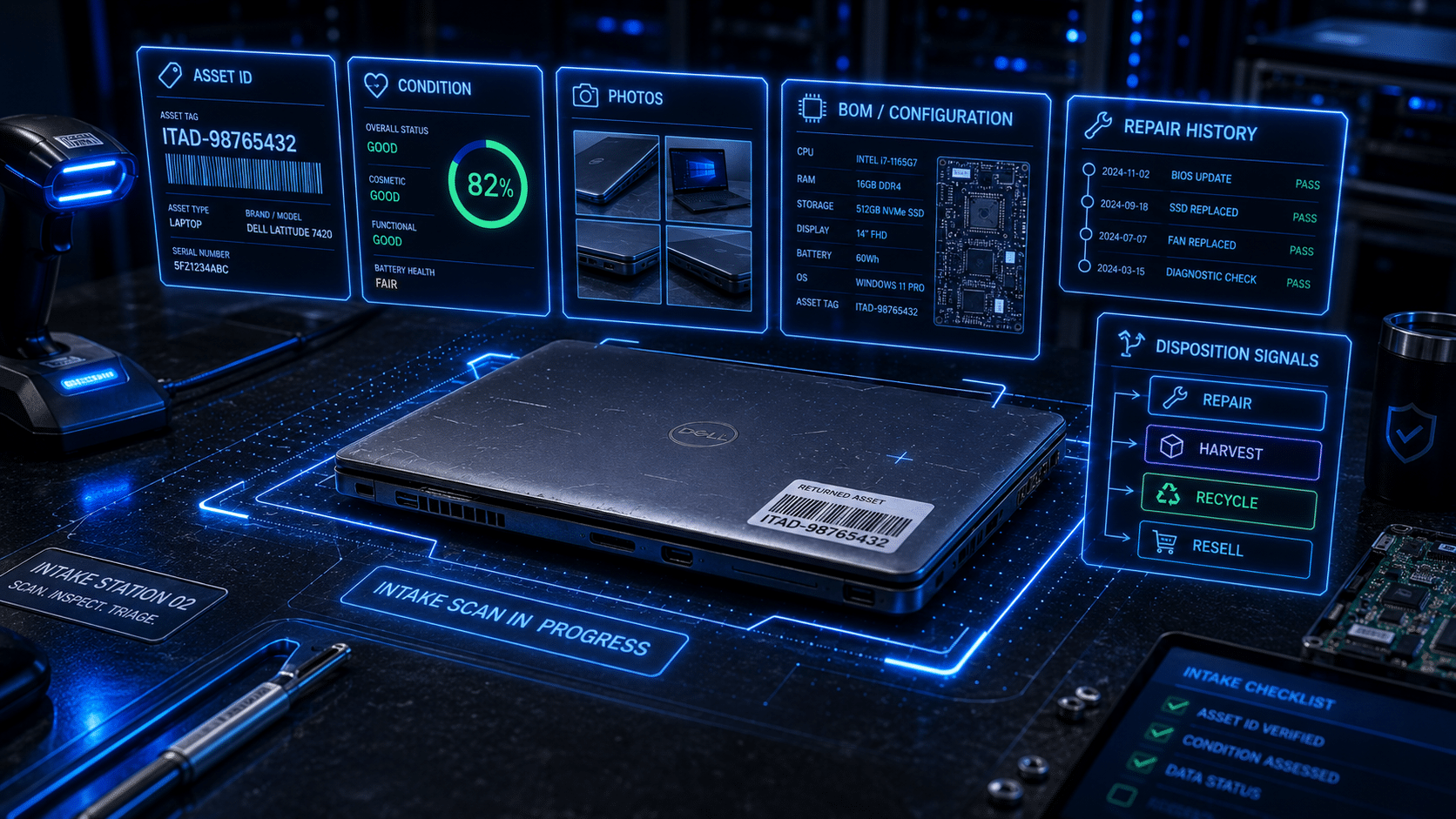
A returned device carries data about everything that happened to it. Typical reverse logistics operations capture only fragments.
Recorded data is often inconsistent, siloed by program, and locked in formats downstream teams cannot use. Each handoff compounds the errors before it:
- A bad receiving record corrupts repair routing.
- A missing condition photo weakens a carrier claim.
- A configuration mismatch stalls a unit on the bench.
- One program scraps an accessory while another reorders the same SKU.
These failures share one structural cause: reverse logistics runs on handoffs, and handoffs leave data gaps.
Reconext built an Intelligence layer to change that. Each step in the physical layer (from receiving to grading to repair and on) now generates structured data the next workflow can act on.
Reverse Logistics Is What Agentic AI Was Built For
Reverse logistics is unusually well suited to agentic AI.
Each unit follows a defined sequence, and every error has a measurable P&L impact. High transaction volume lets agents improve quickly: an agent trained on 100,000 receiving events can make better decisions than one trained on 1,000.
The following case studies come from live deployments across Reconext’s global operations.
Pegasus: Every Downstream Decision Starts at Intake
The Problem
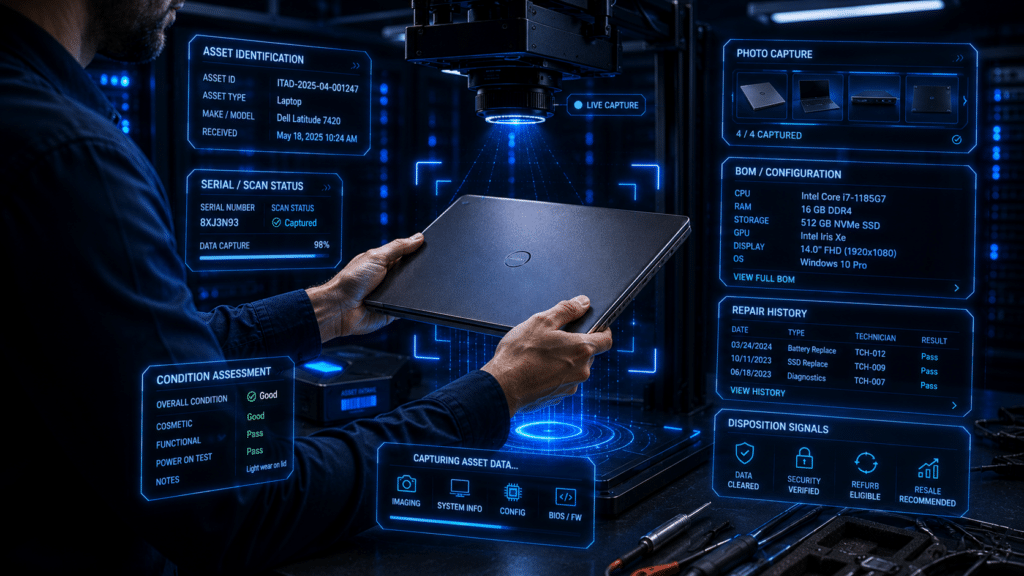
Receiving relied heavily on manual inspection and data entry. Teams documented damage inconsistently, struggled to substantiate carrier claims, and lost throughput to scanning errors.
What We Built
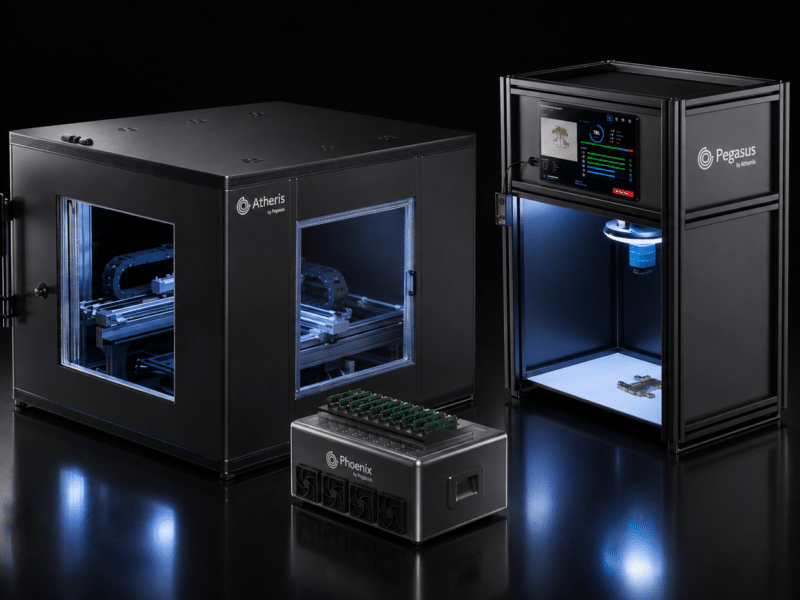
Pegasus uses on-camera vision models to capture asset identity, arrival condition, and shipment data in a single operator step. A capture agent validates metadata against the expected manifest. A claim agent assembles per-unit carrier-claim packets with photographic evidence. An audit agent correlates arrival damage against downstream test failures. A human reviewer approves claims before submission.
Results
Carrier claims now include structured, per-unit photographic evidence that improves defensibility. Pegasus detects missing components at intake instead of later in the workflow. Operator training now centers on one action: presenting the item to the camera.
Why It Matters
Pegasus creates the source record for the operation. Repair routing, carrier claims, discrepancy resolution, and inventory decisions all depend on the intake data it captures.
Opti-Z: Cosmetic Grading That Can’t Be Argued With
The Problem
Cosmetic grading depended on individual technician judgment, which made results inconsistent and difficult to audit at scale.
What We Built
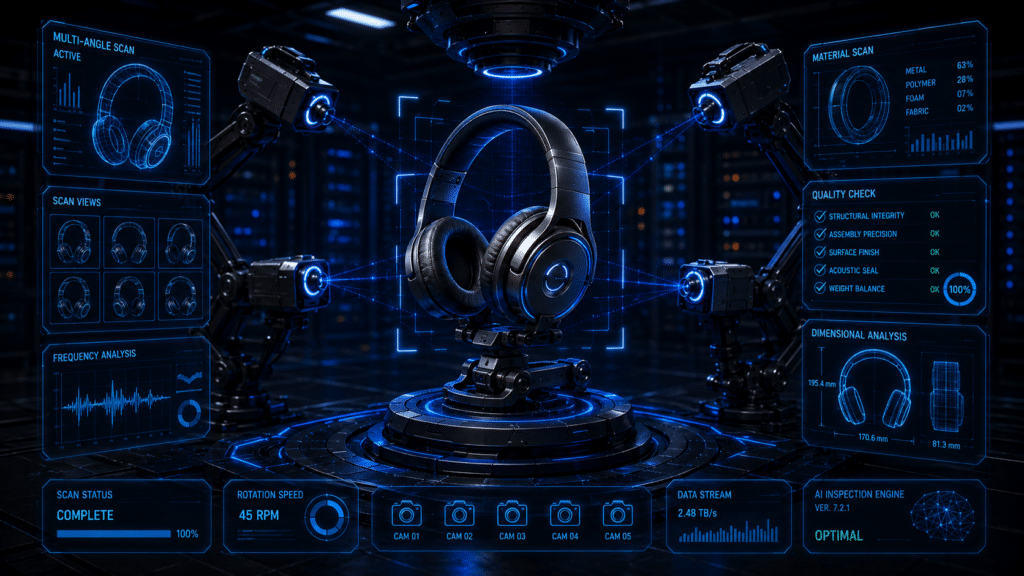
Opti-Z uses HD cameras, robotics, and Reconext-built AI vision to automate cosmetic grading. A robot presents each unit at multiple angles in a 60-second cycle. Gary, the automated grading intelligence, interprets the vision data and assigns criteria-driven grades. Aurora, the real-time process monitoring layer, watches for grading drift and flags exceptions for operators.
Results
Four systems are live at Grapevine, TX. Cosmetic inspection is 100% automated, with zero subjective human grades. Every decision is image-backed and auditable.
Why It Matters
Opti-Z turns cosmetic grading from technician judgment into an auditable process. Every grade is objective, criteria-driven, and defensible.
Quincy: Codifying Tribal Knowledge into a Learning Agent
The Problem
A greenfield facility opened in January 2025 with a first-pass yield of 37% against an 85% target. The gap traced back to physical-versus-virtual BOM mismatches, configuration misalignment, and the absence of institutional knowledge that incumbent operations had accumulated over time.
What We Built
Quincy reads different types of configuration errors, identifies the underlying data mismatch, and corrects the configuration in the customer’s system of record. It then re-runs validation and iterates until the unit resolves. Each correction improves the master data used to validate future units, so the agent improves as the operation runs.
Results
First-pass yield has nearly doubled since launch, rising from 37% in Q3 2025 to 75% by late May 2026. The backlog is down 28.6%, with 22,000 units now in finished goods inventory queued for sale.
Why It Matters
Quincy makes institutional knowledge portable. Configuration fixes that once lived with individual technicians now become structured logic Reconext can deploy across programs.
Quincy in Lease Return Operations: Reynosa, MX
The Problem
At launch, seven technicians worked repair stations with only 21% fault-code coverage and fully manual log-file interpretation. The operation lacked system-captured repair instructions and correlation analysis between diagnostic results and repair outcomes.
What We Built
Quincy operates between the diagnostic systems and the shop-floor execution platform, converting test results into natural-language operator instructions. An operator feedback loop calibrates output over time, continuously improving instruction quality.
Results
Fault-code coverage reached 75% within the first week, 95% within ten days, and 99% by Phase 2. Repair station headcount dropped from seven technicians to three. Productivity improved by approximately 58% across 9,070 repair attempts, with a 94.2% success rate and 100% parts-selection accuracy.
Why It Matters
Reynosa proved Quincy works on lease-return economics and can scale. Each new site plugs into the same agent stack, and the fault-code library becomes a shared diagnostic layer across the operation.
Melissa: The Inventory Problem Hiding in Plain Sight
The Problem
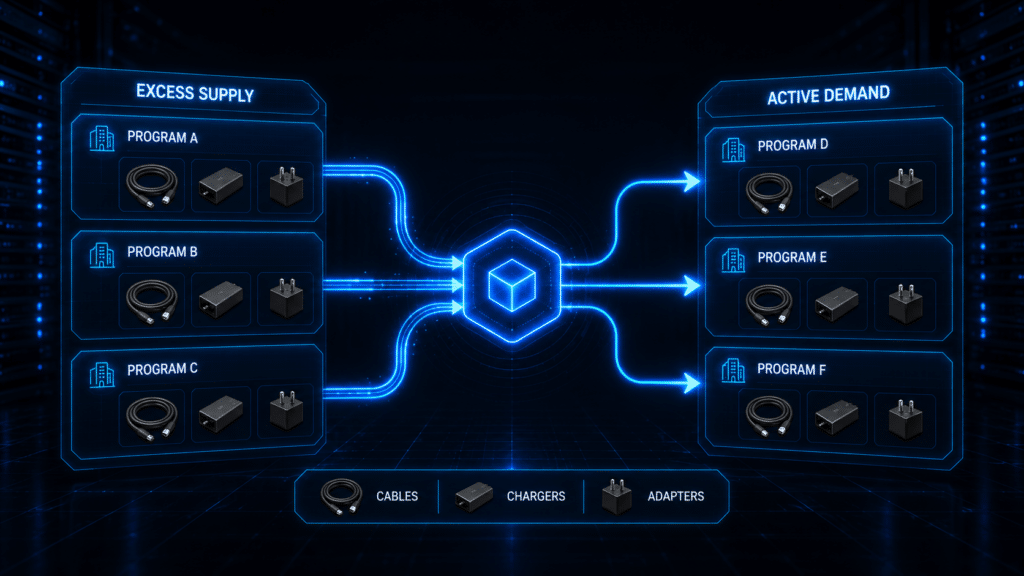
Multiple programs operated independently at the same site, with no shared visibility across inventory pools. One program scrapped new accessories while another bought the same SKUs. Manual PID lookup often cost more than the parts themselves.
What We Built
For accessory harvesting, Melissa runs a five-model vision cascade that resolves part IDs from Pegasus in real time. A label-read model extracts the PID. A demand-match step checks that PID against active demand by channel and site. A disposition engine returns REFRESH, SCRAP, or REVIEW in seconds, with an auditable record per part.
For cross-program inventory replanning, five agents work in sequence. An inventory agent normalizes and joins supply data across programs. A demand agent maps supply against service, refresh, and DLS channels. An allocation agent applies prioritization rules. Aurora provides natural-language access to the combined data. A human approves transfers before execution.
Results
Melissa processes approximately 400 units per hour with an auditable record per part. The scrap-all-new default has been eliminated; every accessory now receives a demand-matched decision. Cross-program inventory replanning has surfaced millions in recovery value, with every transfer auditable at unit level.
Why It Matters
Melissa replaces program-level inventory decisions with site-level demand matching. Parts no longer get scrapped in one program while another buys the same SKU.
Aurora and Discrepancy Management: Closing the Loop in Real Time
The Problem
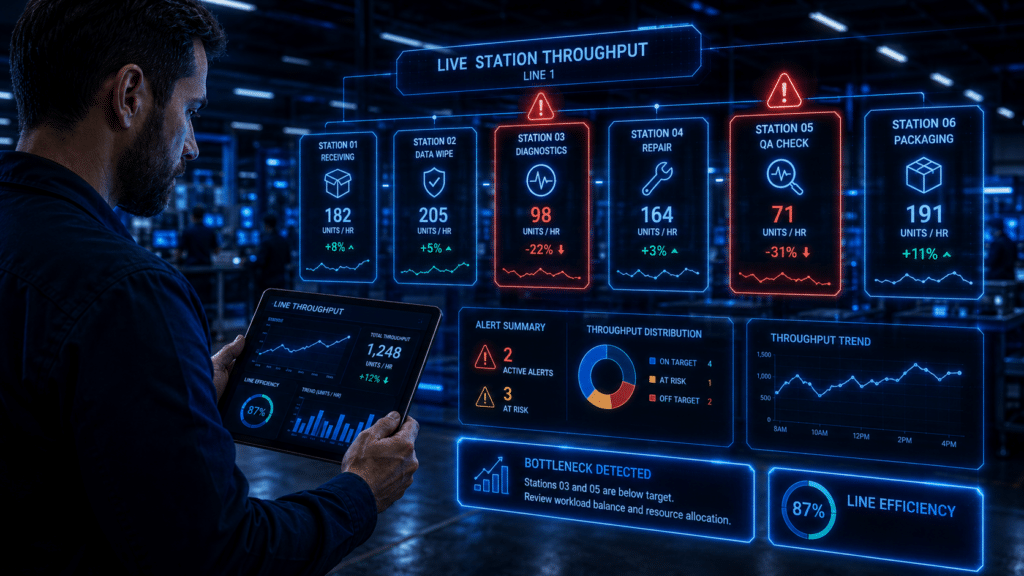
Line imbalance and cycle-time drift were not visible until teams reviewed performance reports the next day, after the productivity loss had already occurred. Discrepancy resolution depended on humans writing tickets, which made the process slow, inconsistent, and skill-dependent.
What We Built
Aurora captures station-level throughput continuously and runs anomaly detection against the live stream instead of a batch report. When a process drifts, Aurora catches it in-shift and surfaces a rebalancing recommendation for the line lead to validate.
For discrepancy management, the Reconext side of the workflow runs agent-to-agent. A discrepancy detected at intake automatically becomes a fully evidenced Jira ticket routed to a human reviewer, with state changes flowing back into the data layer for closed-loop tracking.
Results
Aurora now catches issues in-shift instead of the next morning’s report. Every discrepancy ticket carries the same structured evidence backbone regardless of who or what generated it. Aurora is on track to replace the daily manual spreadsheet reporting chain and push SLA performance directly to the right people.
Why It Matters
Aurora closes the operational loop in real time. Pegasus flags a unit at intake, Aurora catches line impact, and Quincy opens the ticket and updates Plus. No handoff gets lost because the workflow runs on structured data moving between agents.
Refurb Analytics into Product Design: The Longest Feedback Loop
The Problem
Field repair operations surface failure modes that product development testing often misses. But that signal lives in tickets, logs, and operator memory, and rarely reaches engineering teams in a format they can act on.
What We Built
Agents capture failures, component findings, and dispositions per unit at the service floor. They cluster patterns by component, lot, and root cause, flag emerging failure modes early, and roll findings into design-ready summaries with the underlying trace one click away. Customer engineering and Reconext engineering jointly interpret the findings.
Results
Reconext refurb analytics have already influenced next-generation product design decisions for a major consumer electronics customer operating across handheld, VR, and console programs.
Why It Matters
This capability is difficult for OEMs to replicate internally because they lack comparable service-floor data density. Reconext’s position in the reverse logistics chain creates the advantage. The AI layer makes that advantage usable.
Data Is the Strategic Moat
Individually, these deployments solve discrete operational problems. Together, they change the economics of reverse logistics.
Reverse logistics has historically been treated as a cost center, with the goal of minimizing spend rather than maximizing recovery. Reconext’s Intellegence layer inverts that model.
Every automated workflow generates structured data. Pegasus feeds Quincy. Quincy feeds Aurora. Melissa reads what Pegasus wrote and hands off demand conflicts to Quincy. Refurb analytics turn service-floor findings into product-design signals. The system compounds in value as more workflows connect to the same data fabric.
Reverse logistics has always generated more data than it uses. The operations that close that gap build an advantage that compounds with every unit that moves through the system.
Reconext has built that operation.