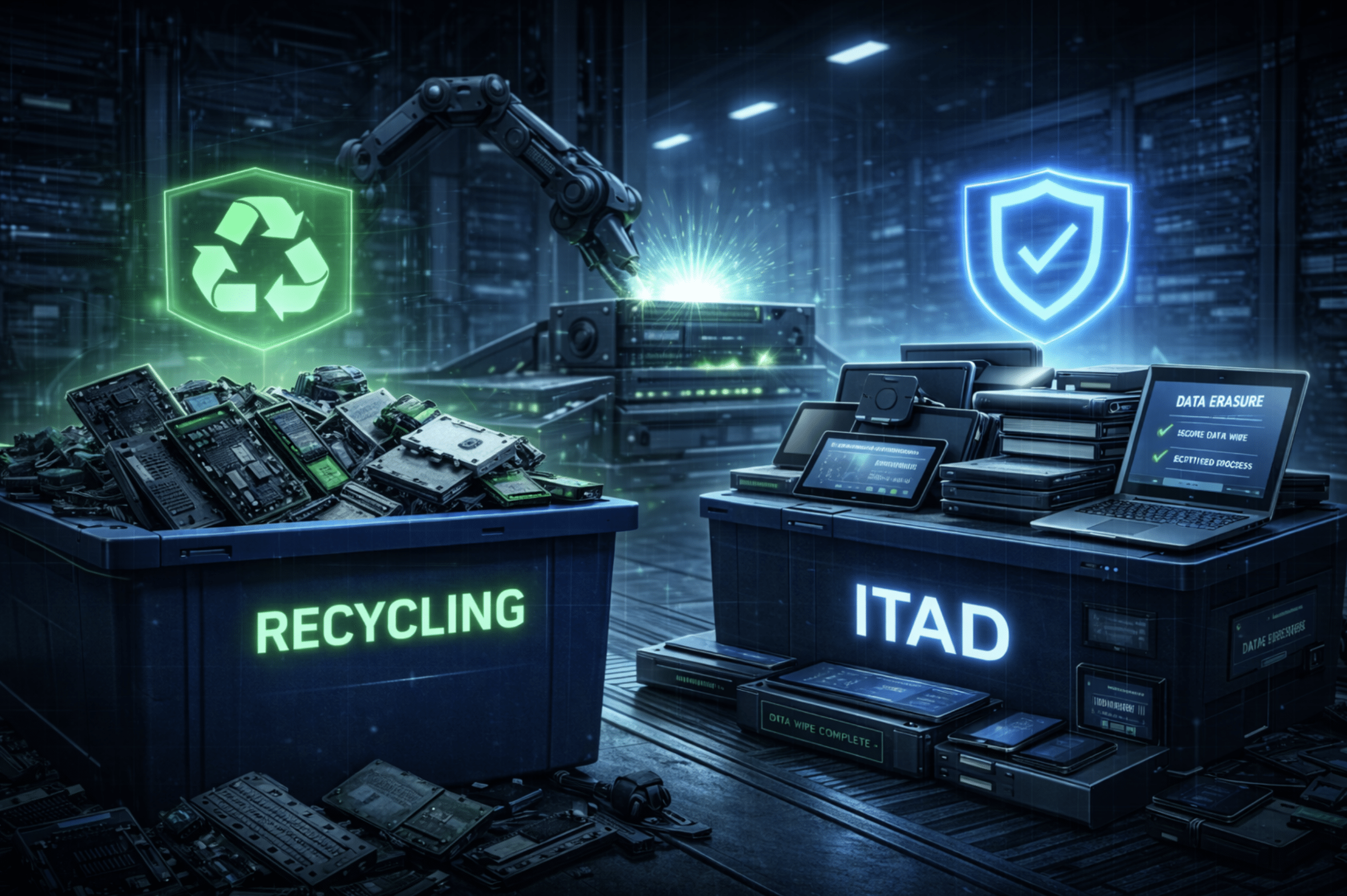
When IT equipment reaches the end of its lifecycle, many organizations default to simple recycling.
The decision appears straightforward. E-waste recycling is easy, fast, and inexpensive. It requires minimal internal coordination, fits neatly into existing disposal infrastructure, and is often free or subsidized. In some cases, it may even be profitable, generating a small rebate by monetizing the equipment’s raw commodity materials.
But what’s often missing from this decision is an evaluation of whether electronics recycling services are the best next step, or simply the most convenient one. By going directly to recycling, organizations bypass the more deliberate process of IT asset disposition (ITAD), which is designed to assess what should happen to equipment before it is destroyed.
Profitability depends on more than disposal cost or commodity recovery alone. The remaining value of the equipment, the effort required to manage it, and the risk associated with any residual data all shape the true financial outcome. In many cases, ITAD may even ultimately recommend recycling, but only after data has been handled properly and value recovery opportunities have been evaluated.
Rather than treating recycling and ITAD as competing choices, the goal is to understand how they relate.
The Simple Difference Between ITAD and Recycling
Recycling focuses on removing equipment quickly and recovering raw materials such as metals and plastics, with the primary goal of minimizing disposal cost. Once equipment enters the recycling stream, it is treated as waste and valued by weight. This simplicity makes recycling fast, but it also means limited tracking, minimal documentation, and little attention to risk beyond basic material handling.
IT asset disposition (ITAD) takes a broader approach by managing the entire end-of-life process for IT assets, not just their physical removal. It is a more structured and coordinated process that determines whether recycling is the right outcome or whether a more secure or more profitable option is available. Rather than being disposed of immediately, data is removed in a compliant manner, and the equipment is evaluated for reuse, resale, or redeployment before recycling becomes the final step.
| Recycling | IT Asset Disposition (ITAD) | |
| Primary goal | Remove equipment and recover raw materials | Manage the complete end-of-life of IT assets |
| Primary financial objective | Minimize disposal cost | Optimize total financial outcome at end-of-life |
| How value is generated | Metals and plastics sold as commodities | Reuse, resale, redeployment, and controlled recycling |
| Impact on total cost of ownership | Ends value at disposal | Offsets refresh and replacement costs |
| Process complexity | Simple and fast | More structured and multi-step |
| Tracking and documentation | Limited or none | Asset tracking, chain of custody, and reporting |
| Risk management | Minimal focus on data or compliance risk | Designed to reduce security, compliance, and audit risk |
| Potential downside | Lost asset value and unpriced risk | Higher process effort and coordination |
| Best financial fit when | Assets are fully depreciated and low risk | Assets retain value or carry meaningful risk |
In short: Recycling recovers an asset’s material value. ITAD recovers an asset’s remaining value.
How Recycling Makes Money
When an organization chooses recycling, any financial return comes primarily from the raw materials recovered from its equipment. Through the recycling process, devices are dismantled to extract valuable materials for reuse in manufacturing. Recyclers sell this metal and plastic into global commodity markets, and a portion of that value may be passed on to the disposing organization through low disposal costs or, in some cases, minor rebates.
Once equipment enters the recycling stream, it is priced based on the materials it contains, not what the device is or what it once did. A laptop, server, or printer is worth roughly the same as any other item with a similar material makeup. As a result, the organization’s returns from recycling are usually modest and predictable, driven by material weight and commodity prices rather than by the condition or functionality of the equipment.
When Recycling Is the Right Choice
Retired IT equipment that is obsolete or damaged is often best handled through recycling. Devices that are broken, outdated, unsupported, or too costly to repair typically have little reuse or resale potential. In these cases, recycling provides a straightforward way to recover basic materials like metals and plastics while responsibly removing the equipment from service.
Recycling is also well-suited to scenarios where speed and simplicity matter most. During office moves, facility closures, or large refresh cycles, organizations often just need equipment cleared quickly and predictably. If data has already been handled and detailed tracking or value recovery is no longer needed, recycling provides a fast, low-cost way to finish the process.
How ITAD Makes Money

When an organization chooses ITAD services, value is generated by managing equipment as an asset for as long as it remains useful. Rather than dismantling devices immediately, ITAD focuses on securely removing data, evaluating condition, and determining whether equipment can be reused, refurbished, or resold. This approach allows organizations to recover value based on continued usability and to ensure data security.
Devices that still function, or can be repaired economically, may be redeployed internally or sold into secondary markets. Because equipment is assessed individually, a working laptop, server, or printer can retain significantly more value than it would through recycling alone. Returns are driven by factors such as age, condition, and market demand rather than material weight or commodity pricing.
When ITAD Is the Better Option
IT asset disposal is most effective when equipment still contains data, remains usable, or is retired in meaningful volumes. In these situations, sending retired IT assets straight to recycling can either leave economic upside unrealized or introduce unnecessary risk.
Laptops, servers, and storage devices often retain sensitive data even after they leave service. ITAD provides the controls and documentation needed to address that exposure and limit security, compliance, and reputational risk to help avoid costly downstream issues. ITAD also preserves financial upside that would otherwise be lost if equipment were sent directly to recycling.
These advantages become more pronounced at scale. Large refresh cycles, data center decommissions, or fleet retirements magnify the impact of both risk reduction and reuse or resale opportunities. Applying consistent processes across thousands of assets improves predictability, oversight, and efficiency, making it easier to balance financial recovery with effective risk management in a repeatable, cost-effective way.
The Costs People Often Overlook
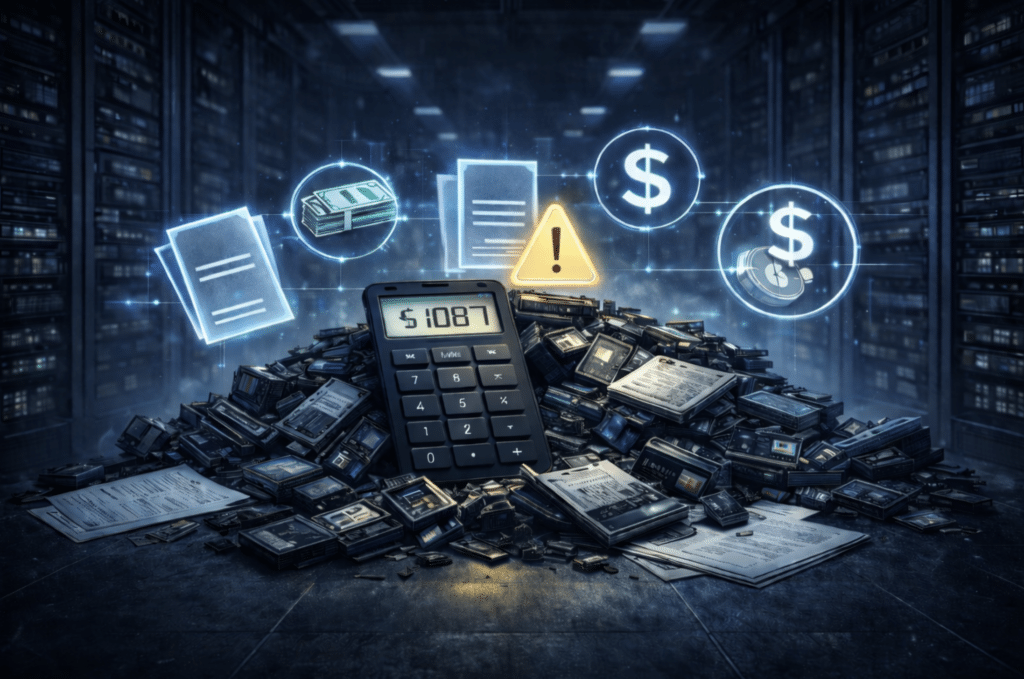
When deciding whether to send equipment straight to a recycler or use an ITAD provider, it’s important to account for costs that aren’t always obvious upfront.
Data risk is one of the biggest. Devices can still contain sensitive information after they leave service, and improper handling can lead to breaches, legal issues, or reputational damage. These costs quickly outweigh any savings from low-cost recycling.
Compliance and documentation gaps can also create exposure. Without clear records showing how equipment and data destruction were handled, organizations may struggle to pass audits or respond to customer and regulatory questions, increasing the risk of fines.
Organizations must consider the internal time and effort required to manage disposal as well. Coordinating logistics, confirming data handling, and addressing follow-up questions can pull staff away from higher-value work, quietly increasing the true cost of disposal.
Taken together, these hidden factors help explain why the cheapest option on paper is not always the most cost-effective in practice.
So, Which Is More Profitable?
It depends on the equipment and the organization’s priorities. Recycling tends to optimize for the lowest immediate cost, while ITAD optimizes for total financial outcome by combining recovered revenue with avoided risk and internal effort.
Recycling is designed to minimize disposal costs. For obsolete or damaged equipment with no remaining use, recycling can be the most economical option.
ITAD, on the other hand, can deliver greater overall financial benefit when equipment still has resale potential, contains data, or is retired at scale. These factors can materially affect the total financial outcome, even if they are not reflected in the initial disposal cost.
The more usable, data-bearing, or higher-volume the assets, the more likely ITAD is to be the more profitable choice.
Using ITAD and Recycling Together

Recycling remains a core part of a responsible ITAD program. ITAD does not replace recycling; it determines when recycling is the appropriate outcome. This ensures recycling is intentional, not automatic, while allowing organizations to recover value and manage risk before equipment reaches end of life.
How to Decide What’s Right for Your Organization

Choosing what’s right for your organization starts by stepping back and asking what you are really trying to accomplish when IT equipment leaves service. Is the goal simply to move equipment out the door, or to manage the broader responsibilities that come with retiring IT assets?
| Lean Toward Recycling When… | Lean Toward ITAD When… | |
| Asset condition | Equipment is broken, obsolete, or unsupported, with no realistic reuse or resale value | Equipment still functions, can be repaired, or has resale or redeployment potential |
| Data sensitivity | Data has already been removed or destroyed, and risk is minimal | Devices that handle sensitive, regulated, or customer data and require secure handling and proof |
| Scale / Volume | Only a small number of devices are being retired | Large refreshes, data center decommissions, or fleet retirements are involved |
| Risk tolerance | The organization prioritizes speed and low upfront cost | The organization prioritizes control, documentation, and risk reduction |
| Primary goal | Move equipment out quickly and inexpensively | Manage end-of-life responsibly while recovering value and reducing exposure |
True profitability at end-of-life is not defined by disposal cost alone. It is shaped by three factors working together: recovered value, reduced risk, and operational efficiency.
Most importantly, ITAD and recycling are not opposites. Recycling is often the final step within a responsible ITAD program, not an alternative to it. The most effective organizations use both intentionally: evaluating assets first, recovering value and managing risk where possible, and recycling only when it truly makes sense.
Smarter ITAD Decisions With Reconext
At Reconext, our ITAD approach is designed to securely recover the most value from your equipment before recycling becomes the final step. Using a data-driven decision engine, we evaluate each asset to determine the right outcome, whether that’s reuse, resale, or responsible recycling.
From secure intake and chain of custody to automated testing and grading, decisions are based on objective data rather than assumptions. Destruction is treated as a last resort, allowing us to maximize yield and reuse where others may scrap equipment prematurely.
Security and compliance are embedded throughout the process, supported by real-time tracking and clear documentation. If your organization is rethinking how it retires IT assets, Reconext can help you move beyond default recycling and make more intentional, profitable end-of-life decisions.