IT Asset Disposition Cost – A Guide to Secure Value Recovery
Replacing servers, laptops, and other technology is a normal part of running an IT environment. But when those devices reach the end of their lifecycle, many organizations underestimate the cost and complexity of retiring them securely.
IT asset disposition (ITAD) involves more than simply removing equipment from a data center. It includes secure data destruction, logistics, compliance requirements, and opportunities to recover value from retired hardware.
In this guide, we’ll break down the real factors that influence IT asset disposition cost, from transport and data destruction to remarketing and resale.
Quick Answer
- Financial Impact – Asset disposition recovers value from equipment, offsetting logistics costs.
- Security Impact – The destruction of the data eliminates financial and compliance risk.
Immediate Aspects Influencing IT Asset Disposition Cost
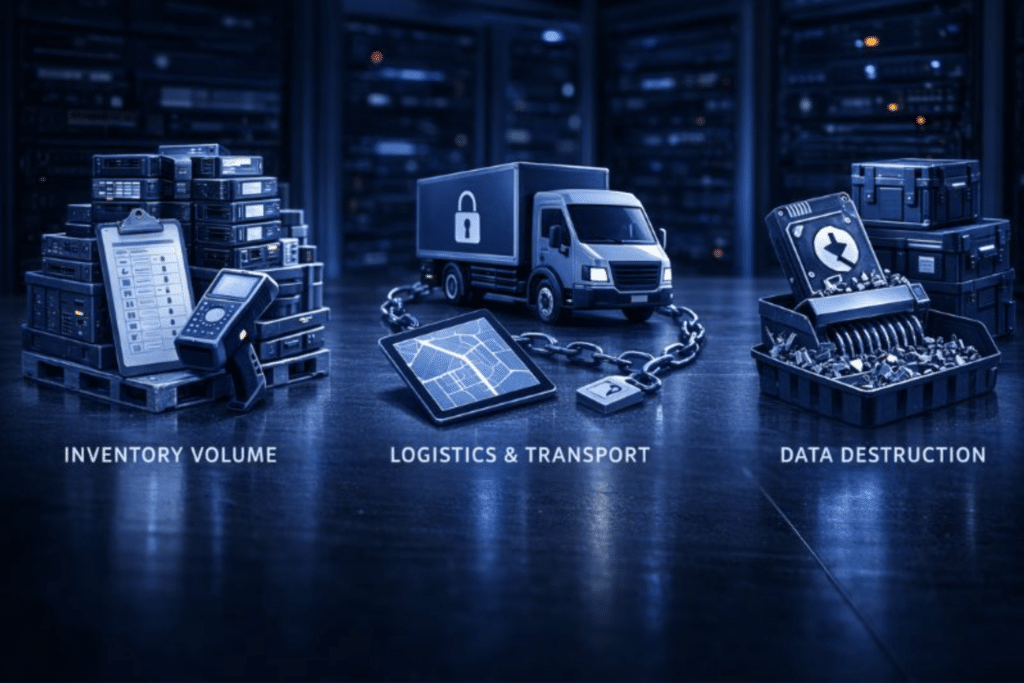
The cost for IT asset disposition is rarely a flat fee. Rather, it is calculated based on the volume, location, and the level of security needed for the handling of specific media.
Inventory Volume and Asset Management Intricacy
Scale dictates the economics of any asset disposition ITAD project. When dealing with a handful of laptops, fixed pickup fees keep the cost per unit high. But efficiencies kick in when moving hundreds or thousands of assets, dropping the cost per unit.
The challenge arises when an inventory includes a mix of hardware, because each requires a different handling and data destruction process. Proper asset tracking during decommissioning ensures every device is properly accounted for and processed.
Logistics, Secure Transport, and Chain of Custody Costs
A large part of the cost comes from moving the IT equipment from your data center to a processing facility. While shipping freight is cheap, it doesn’t offer security.
For higher-value data, that cost covers “white-glove” service, which includes a documented chain of custody that tracks every serial number of the equipment from the time it’s removed from the rack.
Specialized Data Destruction and Processing Requirements
General data erasure at the software level for a standard SATA drive is the most affordable, usually ranging from $4 to $15 per unit.
However, if a project demands physical destruction, services can cost more than 3x the price, depending on the volume and thickness of the required fragments. For instance, shredding physical drives into 2mm fragments could cost as much as $40 per unit.
Data Security Risks and Data Breach Liabilities
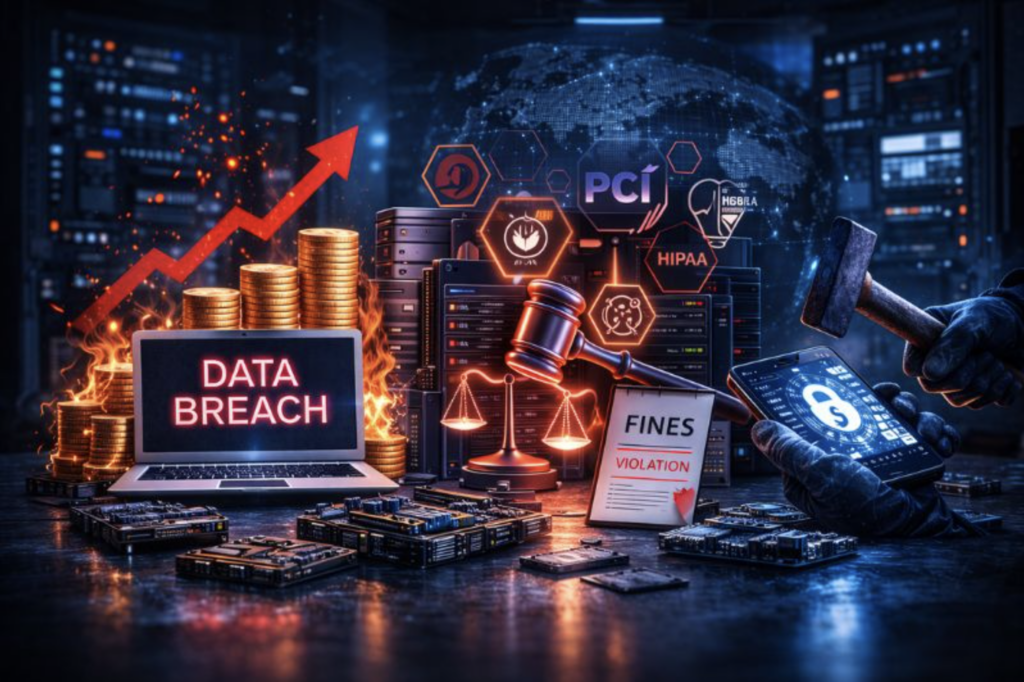
When businesses try to cut corners in asset disposal to save a little bit of money at the front end of the process, it usually results in a massive financial backfire. The cost of a professional ITAD vendor functions as an insurance policy against the higher costs of a future security breach.
The Escalating Financial Cost of a Data Breach
The financial risks associated with improperly retired hardware have never been greater. According to IBM’s 2025 Cost of a Data Breach Report, the average data breach in the United States now costs $10.22 million. If retired equipment enters the secondary market with data still intact, liability falls entirely on the original owner. In comparison, the cost of certified data destruction represents only a small fraction of the potential legal and financial consequences.
Compliance Requirements and Regulatory Penalty Mitigation
Regulatory bodies have moved beyond simple warnings. Under frameworks like GDPR and HIPAA, “improper disposal” is a specific violation that triggers heavy fines.
A certified ITAD provider offers audit-ready reporting, including Certificates of Destruction (CoD). This documentation acts as a legal shield, proving that the organization met all compliance requirements and took every reasonable step to protect sensitive data.
Is Your Data Truly Gone?
Don’t leave your reputation to chance. Secure your hardware retirement today with a certified ITAD process that guarantees secure data destruction and maximizes your recovery value.
[Get Your Custom ITAD Quote Now]
Data Sanitization versus Physical Destruction
Many organizations assume that shredding is the safest way to retire IT equipment. While physical destruction permanently eliminates the risk of data recovery, NIST 800-88–compliant data sanitization allows hardware to retain resale value. That means the true cost of shredding isn’t just the service: it’s the lost opportunity to recover value from usable assets.
Value Recovery Procedures in Asset Disposition ITAD
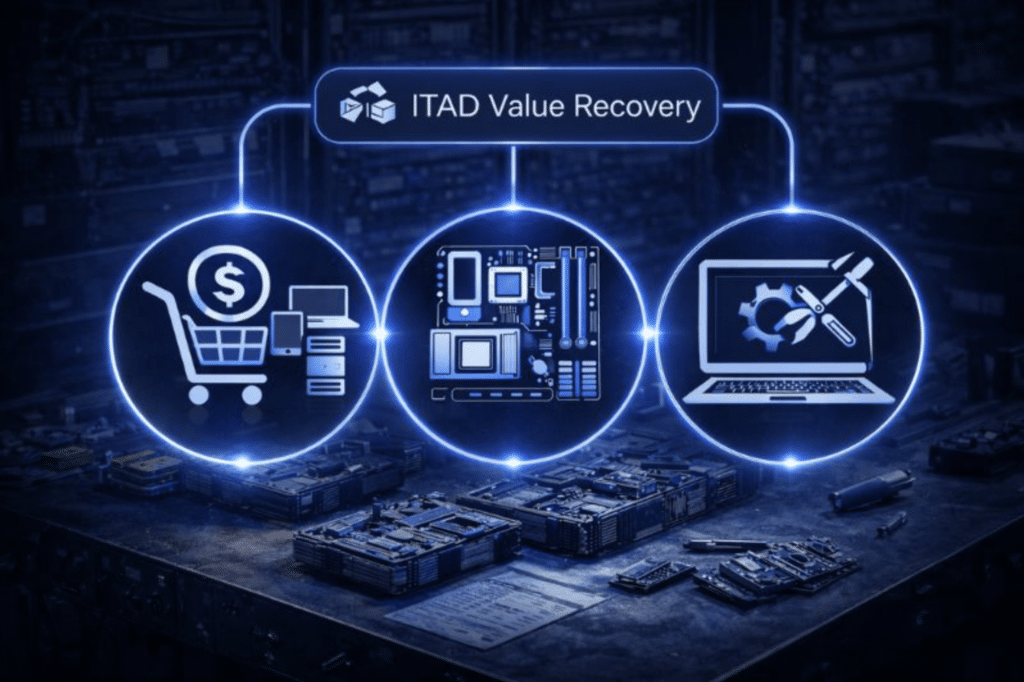
Smart IT asset disposition practices see hardware as a depreciation asset that still holds great value. When you focus on value recovery, you will find that these programs pay for themselves.
Maximizing ROI Through Remarketing and Resale Channels
Demand for old IT assets is tremendous. A surge in demand for AI-capable infrastructure has pushed the resale value of certain storage arrays and server configurations up by 300%. That means selling these old assets back into the global market can simultaneously offset IT asset disposition cost and return value to the IT budget.
Component Harvesting and Internal Reuse
You don’t need to send every device outside your building. Your IT teams can pull high-value components, like RAM modules and power supplies, from retired or spare machines. This hidden form of recovery extends the life of your existing IT equipment and reduces the need to procure new assets.
Strategic Refurbishment to Combat Hardware Obsolescence
The average corporate laptop lifecycle is shifting. Many enterprises are now pushing for a 4.3-to-5-year lifecycle by utilizing professional refurbishment. In turning aging units into reusable devices, companies delay asset disposal, spread capital expenditure over a longer period of time, and contribute to sustainability goals.
Hidden Costs of ITAD – Outside the Quote

Although the line-item costs are visible, the real financial impact of an ITAD process hangs on hidden operational variables.
Identifying Indirect and Hidden Costs
Budgeting in asset disposition typically ignores the labor required to prep decommissioned assets. When an IT team spends hours doing manual recording of serial numbers or unmounting racks, the project costs double.
- On-Site Decommissioning – Paying for “lift and shift” services is usually cheaper than diverting internal engineers from high-value tasks, especially when working with providers like Reconext that specialize in these services.
- Storage Latency – Keeping old IT assets in a warehouse for months leads to “value leakage” as the market value of the hardware drops by 2-5% every thirty days.
- Global Logistics Surcharges – For multi-national firms, the safe handling of international shipments involves complex E-waste laws and export duties that can add 20% to the base logistics fee.
Using the Circular Economy for Cost Mitigation
Contemporary ITAD services, like those provided by Reconext, focus on the circular economy not just for sustainability, but also for the bottom line. With a focus on reusing retired assets, organizations can avoid the rising cost of e-waste disposal while generating credit towards their next refresh.
- Certified Remarketing – A high-tier ITAD vendor has access to global buyers, making sure that you get the maximum residual value for high-spec servers and mobile devices.
- Parts Management – Gathering high-demand chips or valuable materials from non-functional units can turn scrap into a revenue stream.
- ESG Credits – Documenting your sustainability efforts provides data for ESG reporting, which can lead to lower insurance premiums or improved investor relations.
Operational Standards for Secure Asset Management

The process needs to be grounded in secure handling and standard-led protocols to keep the costs predictable.
Live Asset Tracking and Audit Readiness
Asset tracking on manual spreadsheets is over. Contemporary IT asset disposition demands a portal-based approach that offers full visibility. That means when an auditor asks for the status of a device that stores data, you will be able to pull up timestamped reports of its final disposition. Being audit-ready allows you to prevent the missing asset panic that can lead to costly investigations.
Minimizing Environmental Impact and ESG Reporting
Sustainability is now a financial metric. Global firms use ITAD services to meet ESG reporting targets. When assets are responsibly recycled by certified recyclers rather than sent to a landfill, it reduces environmental impact. These metrics are increasingly tied to corporate financing, making responsible recycling the most financially sound choice.
Global Scalability and E-Waste Laws
For companies with international offices, the challenge is navigating various e-waste laws. A global ITAD provider guarantees regulatory compliance across different jurisdictions.
With stricter e-waste regulations coming in 2026, including Basel Convention amendments, having a partner that understands the environment and local e-waste disposal rules is critical for any final stage of the hardware lifecycle.
Secure Your Future – Maintaining Lifecycle Value
Once you master IT asset disposition cost, you can change a logistical headache into a strategic win. By prioritizing secure data destruction and ESG reporting, your IT teams can determine a profitable and sustainable path for old IT assets.
For organizations ready to protect their brand and recover capital, consulting Reconext for a global ITAD strategy is the final step toward true lifecycle efficiency.
FAQs
What is the average IT asset disposition cost per device?
Data destruction is inexpensive, typically about $3–$7 per drive as a baseline example. Full-service asset retirement is a broader, labor-intensive process and usually comes in at 3–10x the cost upfront, with resale recovery helping reduce the net cost.
How does professional ITAD reduce the risk of a data breach?
Providers use data handling processes that meet strict standards. With the help of tamper-evident containers and serial numbers on Certificates of Destruction, they close the gaps where sensitive data usually leak.
Can value recovery offset the total cost of asset disposal?
Yes, for high-spec IT assets, the market value usually exceeds the cost of logistics and data destruction. This results in a net-positive ITAD procedure where your provider can send a check back to you.