When hardware outpaces its own lifespan, recovery has to learn to think faster
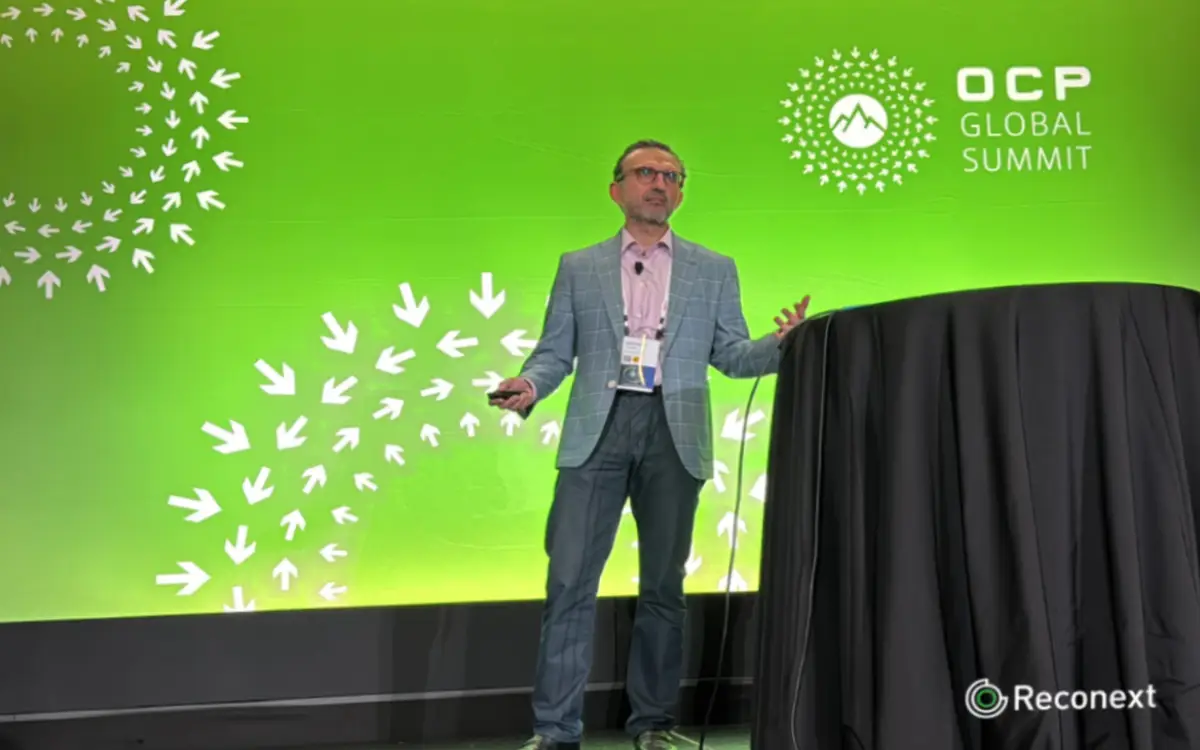
At this year’s Open Compute Project (OCP) Global Summit, Reconext CEO Shahriyar Rahmati opened with a picture of the modern data center that landed somewhere between awe and absurdity.
Hardware built to last half a decade now ages out in two. Entire racks are pulled not because they’ve failed, but because the next generation promised a few more teraflops per watt.
“The F1 car of yesterday gets ripped out and replaced by tomorrow’s model,” he said. “But that doesn’t mean it’s finished.”
That’s the quiet paradox behind AI’s infrastructure boom: acceleration creates waste faster than optimization can catch it.
Learning to measure what we’re throwing away
Rahmati called the current reflex – shred everything that’s touched data – an understandable relic. Decades of compliance conditioning trained the industry to equate safety with destruction. But that instinct, he suggested, now destroys more value than it protects.
Circularity, in his framing, is a systems problem – a calibration error that can be measured and corrected.
He described a hierarchy of reuse: validate whole systems first, repurpose what still works, break down only what truly can’t continue. The goal is to quantify recovery and embed it into engineering discipline.
“A hierarchy of testing and evaluation can keep entire systems in use, not just parts,” he said. “That’s how circularity stops being idealism and starts being engineering.”
Trust, by design
Every recovery process, he argued, stands or falls on visibility. Without clear data, trust collapses into ritual: we shred because we can’t prove safety any other way.
“There should be no gaps by design,” Rahmati said. “When you can see every step of an asset’s journey, risk and value stop fighting each other.”
He described the next evolution of decommissioning as algorithmic orchestration – systems that know where equipment belongs based on live data rather than static policy. Machines routing machines. A sort of choreography for reuse.
Proof in practice
To ground it, he shared a collaboration with MIDAS Immersion Cooling – a case where re-engineered, previously retired servers found a second life in portable, power-efficient immersion units.
They performed well. They also made money.
“The other green was pretty good too,” he said. “The economics were an order of magnitude better than the alternative.”
The result demonstrated that measured recovery can match new-build performance while cutting cost.
Circularity as a network effect
Rahmati closed on collaboration. Circularity, he said, depends on linkages – between OEMs, integrators, and recyclers who are finally speaking the same language.
“The goal is to make sustainability a continuous stream,” he said, “not a disjointed conversation.”
The OCP community, built around open standards and measurable design, is the natural laboratory for that shift.
A small part of a massive chain
He didn’t oversell Reconext’s role. He didn’t have to.
“We’re part of a massive chain,” Rahmati said. “Maybe a small part – but one that’s helping shift the model from linear to circular.”
The applause that followed wasn’t for rhetoric. It was recognition: that circularity isn’t coming as a movement or a mandate. It’s already happening through a feedback loop that measures and reinvests what we used to throw away.