Some of the best improvements in hardware recovery come from simple ideas. A machine that removes the top layer of plastic. A small shift in workflow. A single trial batch that surprises everyone.
This story started with remote controls. The kind that ship with every set-top box. The kind customers drop, scratch, and replace without thinking about the cost on the other end.
For years, most of those housings were headed for scrap. They arrived with cosmetic wear. They didn’t meet Grade A standards. Only a small fraction could be reused. The rest had to be replaced with new plastics sourced from overseas suppliers. The volumes were high enough to make the cost rise faster than expected.
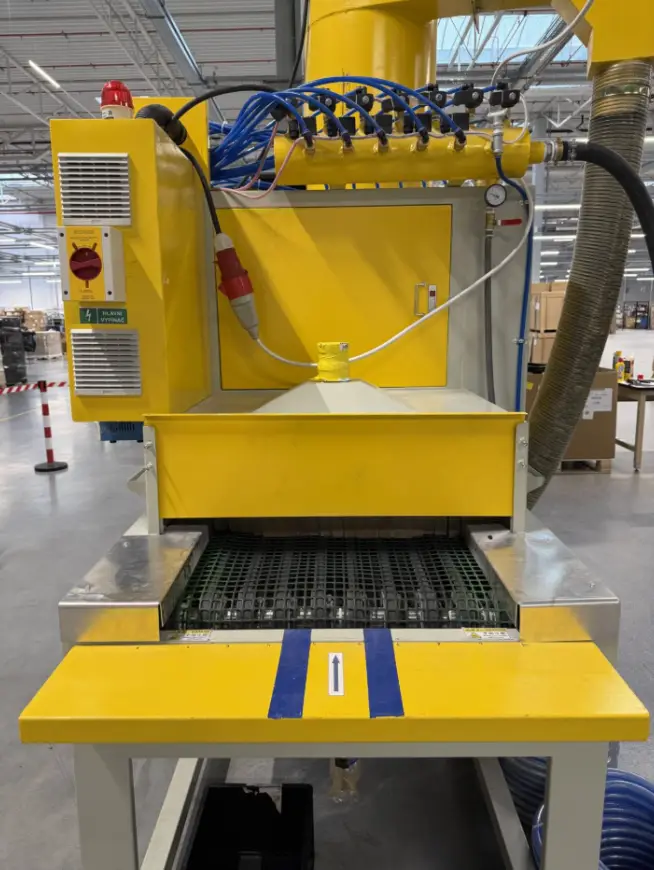
The team managing this device family wanted another option. They had seen a machine in Prague used for cleaning wearable devices. It looked promising. It worked like a sandblaster, although it used a different media specific to plastics. The question was whether it could take a scratched housing and turn it into something that felt clean, uniform, and ready for refurb.
A few boxes of remotes were sent over for testing. The operators ran them through the machine. The parts came out with a matte finish rather than the original gloss, but they were clean, consistent, and Grade A. The result was strong enough to send a batch back to the customer for inspection.
The feedback came quickly. They approved the finish. The cost savings were clear. The test moved to the next stage.
Scaling the idea
Prague no longer needed the machine for its original project, so we transferred it to our site in Poland. Once it arrived, the team ran more trials, adjusted the nozzles, refined the media grain, and set the conveyor speed. The setup mattered. The angle, the flow, and the grit determined whether a housing came out looking clean or washed out.
After several rounds, the process settled. The machine could remove scratches, keep the surface uniform, and handle repeated passes without damaging the plastic. The customer asked how many cycles the parts could survive. We tested five. They all passed.
That was enough to move from trials to production.
The monthly volume for this device family ranges between one hundred thousand and one hundred twenty thousand units. Most of these remotes were previously rebuilt using new plastics. The cost per device was roughly two euros and twenty five cents. Half of that was the housing.
The new process removed most of that cost.
Instead of recovering only ten percent of housings, the team now recovers close to eighty percent. Another ten percent qualify without any work. The remaining ten percent are still replaced with pristine parts. The shift is significant. Each refurbished unit saves close to one euro. Spread across monthly volumes, it adds up quickly.
What the workflow looks like now
The operator loads the housings onto the conveyor. The parts move through a chamber that blasts them with the chosen media. They exit ten seconds later. The operator wipes them with a plastic cleaner, performs a visual check, and sends them forward.
The media is recyclable. The machine recovers it and cycles it back through the hopper. The operator wears PPE because the machine is loud, but the work is straightforward.
Throughput currently sits around ten thousand units per day for this specific device family. The site already runs three shifts, so scaling is not complicated. The team can adjust conveyor spacing, add fixtures for different pieces, or increase the media intensity if a certain product needs more surface work.
The machine handles ABS and polycarbonate plastics well. Other materials may work, but the settings would need to be tuned. The team has already tested router brackets and modem housings. Those also came out clean and uniform.
Why this matters to more than one customer
Any hardware program with high cosmetic replacement rates faces this cost profile. Remote controls, routers, set-top boxes, IoT hubs, enterprise modems, and similar products all carry the same challenge: small scratches lead to full part replacement. Over time, the cost rises faster than teams expect. Inventory forecasts become unpredictable. Carbon emissions from shipping new plastics accumulate.
A simple surface-recovery step reduces all of that. It reduces waste, improves circularity metrics, and makes the refurbishment workflow more predictable.
There is also another use case: rebranding. Some devices arrive with logos etched into the plastics. A short pass through the machine can remove that marking and create a clean surface for resale. The team is already exploring this for future programs.
A new service line starting to take shape
This began as a single idea inside one repair program. It is now becoming a broader capability.
Other account managers have started putting samples through the machine. Additional trials are under review. The team is evaluating how the process fits into cosmetic recovery for larger enclosures and top covers. The early results are strong.
Automation is being explored as well. A future version may include automated cleaning, air-blade dust removal, and a cosmetic grading step using Optiline. That would create an end-to-end line: recover, clean, grade, and reassemble. The foundation is already there.
A practical step toward circularity
Hardware circularity is often discussed in terms of large redesigns and long-term strategies. Real progress also comes from smaller upgrades that remove waste from everyday flows. A machine like this is a good example.
A surface that once triggered disposal now returns to use.
A program that relied on new plastics now relies on recovered ones.
A cost center becomes predictable.
A supply chain becomes lighter.
The work is simple. The impact is not.